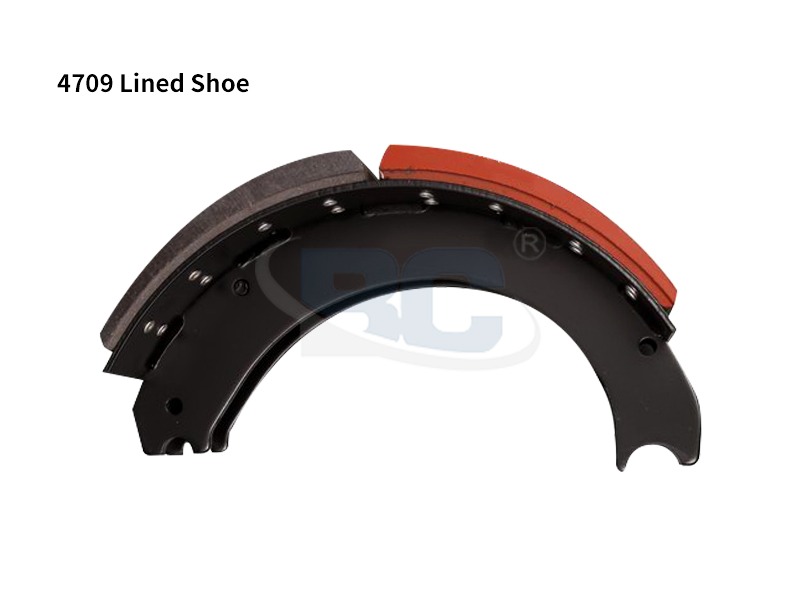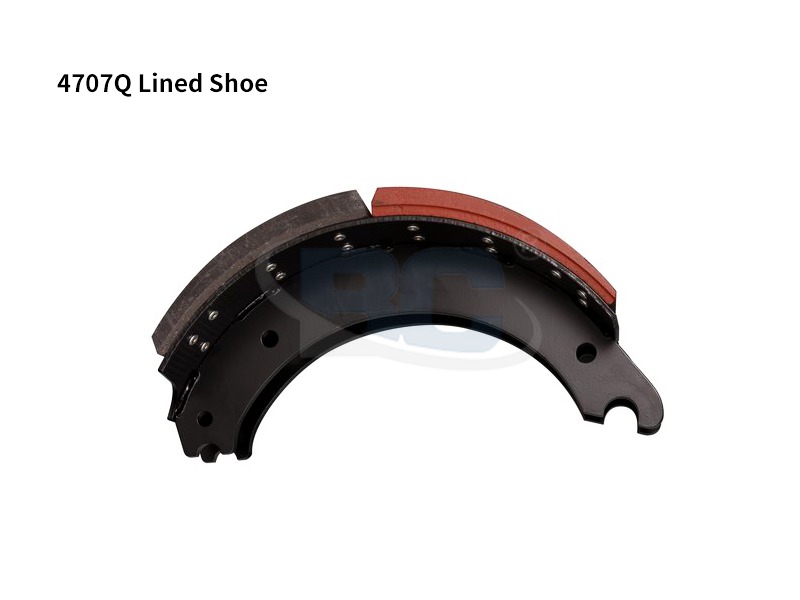
 English
 简体中文
Heavy-duty braking systems must deliver dependable stopping performance under demanding operating conditions. Commercial trucks, trailers, buses, and other work vehicles frequently operate with high gross weights, repeated braking cycles, long service routes, varying road surfaces, and severe temperature changes. In these applications, every brake component must be manufactured with dimensional accuracy, structural consistency, and reliable compatibility with the surrounding brake assembly. The 4700PQ lined brake shoe is designed for this type of demanding service, combining a robust steel shoe structure with a bonded or mechanically secured friction lining and a twelve-rivet-hole configuration.
As a steel brake shoe product, the 4700PQ is intended to provide a strong foundation for the friction material while maintaining the correct geometry required by the drum brake system. Its listed product size is 12.25 inches by 4 inches, with the supplied specification written as “12.25*4 mm.” Because dimensional conventions can vary between catalogs and vehicle applications, professional buyers should confirm the final unit of measurement, shoe radius, web profile, and drum compatibility before installation. The product is identified by part number 4700PQ and is described as a lined shoe.
The value of a commercial brake shoe is not determined by appearance alone. A dependable product must maintain its shape under load, support an even friction surface, accept accurate riveting or lining attachment, resist corrosion during storage and operation, and fit consistently within the brake assembly. Manufacturing discipline is therefore as important as the selected raw materials. Advanced production methods, inspection procedures, and adherence to the global FMSI numbering system help make a replacement brake component easier to identify and more practical for distributors, repair workshops, fleet maintenance departments, and original-equipment replacement markets.
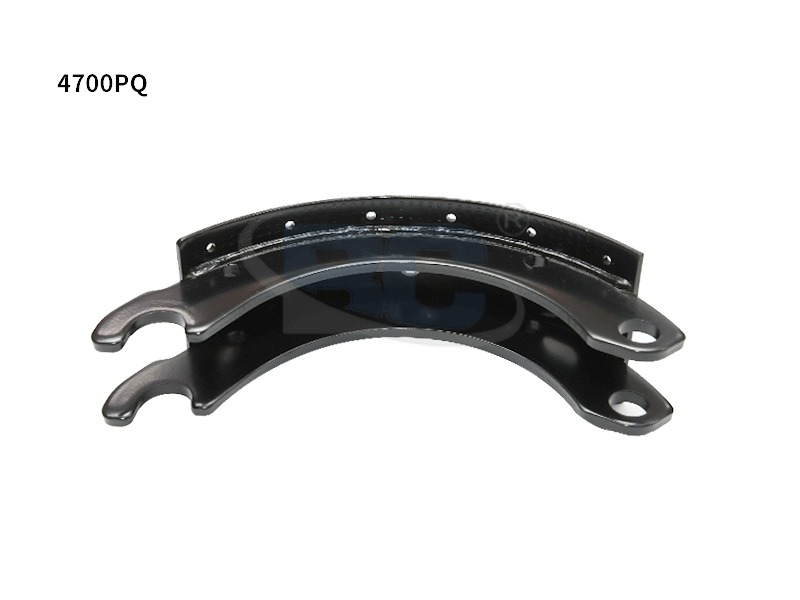
4700PQ Brake Shoe
Product Overview
The 4700PQ brake shoe is a lined steel brake shoe developed for heavy-duty brake service. The supplied product information identifies the item as a steel brake shoe and records the following basic details:
| Specification | Product Information |
|---|---|
| Part number | 4700PQ |
| Product type | Lined steel brake shoe |
| Listed product size | 12.25 inches by 4 inches, shown in the supplied data as 12.25*4 mm |
| Number of rivet holes | 12 |
| Application identification | To be confirmed against vehicle, axle, drum, and brake assembly specifications |
| Friction component | Brake lining supplied on the shoe |
| Numbering reference | Global FMSI numbering system |
The twelve-rivet-hole design is an important identification and installation feature. Rivet count and hole arrangement influence how the lining is secured to the shoe and how evenly clamping forces are distributed across the friction material. A correctly matched lining and shoe should maintain stable contact without excessive movement, edge lifting, or localized stress. For this reason, the rivet-hole pattern should be checked against the replacement lining, the original brake shoe, and the maintenance documentation for the vehicle.
The product is supplied as a lined shoe rather than as an unlined steel core alone. This can simplify replacement work for repair facilities that require a ready-to-install brake shoe. It may also reduce the number of separate operations required in the workshop, such as selecting compatible lining material, preparing the lining, positioning it on the shoe, drilling or aligning holes, and completing the riveting process. Even when a lined shoe is purchased, normal installation inspection remains necessary. Brake professionals should check the lining surface, rivet heads, shoe curvature, contact points, and overall fit before the vehicle returns to service.
Why the Steel Shoe Structure Matters
The steel shoe is the structural base of the brake assembly. During braking, the actuator or cam mechanism applies force to the brake shoe, pushing the lined outer surface against the inner diameter of the brake drum. The shoe must transfer this force evenly while resisting bending, distortion, and fatigue. If the shoe loses its intended shape, the lining may contact the drum unevenly. That condition can lead to reduced braking efficiency, irregular wear, noise, heat concentration, or premature replacement.
A properly manufactured steel brake shoe supports predictable force distribution. The web, table, edges, anchor areas, and lining support surface must work together as a stable structure. Accurate forming is especially important because the shoe must follow the designed drum radius. A shoe that is too flat, excessively curved, twisted, or dimensionally inconsistent may not establish proper contact with the drum. These issues can remain hidden until the vehicle is placed under load, making manufacturing control and incoming inspection essential.
Compared with poorly controlled low-cost alternatives, a precisely formed steel brake shoe can offer more consistent installation and more uniform lining contact. This does not mean that every replacement shoe is suitable for every vehicle. Brake components remain application-specific, and buyers must verify the full specification. However, consistent structural production gives a professional purchaser a stronger basis for quality control and reduces the likelihood of variation between different pieces in the same order.
Performance Advantages of a Lined Brake Shoe
Ready-to-Install Configuration
The lined configuration is one of the primary practical advantages of the 4700PQ. A ready-lined brake shoe can reduce preparation time in the workshop and help simplify inventory management. Instead of stocking an unlined shoe and a separate friction lining, the distributor or maintenance facility can handle one assembled replacement item. This may be particularly useful for fleets that need to return vehicles to service quickly and prefer to use replacement components with a defined part number.
A ready-to-install configuration can also improve consistency when the lining has been fitted under controlled manufacturing conditions. Factory positioning allows the lining to be aligned with the shoe, matched to the rivet-hole pattern, and checked before shipment. In contrast, field relining may depend heavily on local equipment, operator experience, drilling accuracy, riveting pressure, and preparation quality. A professional relining operation can be effective, but a factory-lined product provides an alternative for customers seeking a standardized replacement process.
Balanced Friction Surface
The brake lining is the working friction surface that interacts with the brake drum. Its location, curvature, attachment, and surface condition influence braking behavior. A well-fitted lining helps distribute contact across the designed braking area rather than concentrating pressure at isolated points. Even contact supports predictable wear and helps the drum and lining operate within their intended thermal and mechanical conditions.
The 4700PQ uses a twelve-rivet-hole arrangement, which supports secure attachment of the lining along the shoe. The exact rivet specification, lining compound, and application suitability should be confirmed with the product supplier and vehicle requirements. Nevertheless, the combination of a formed steel base, an aligned lining, and a defined hole pattern provides the foundation for repeatable assembly quality.
Heavy-Duty Service Orientation
The product is positioned for heavy-duty brake parts applications. Heavy-duty service often involves more frequent braking, higher axle loads, longer duty cycles, and more severe environmental exposure than ordinary passenger vehicle use. A brake shoe for these conditions must be designed and manufactured with attention to mechanical strength, lining security, dimensional stability, and heat management.
It is important to distinguish between a heavy-duty design orientation and a universal claim of suitability. The 4700PQ should be selected according to the correct brake system, drum dimensions, axle configuration, and vehicle service requirements. When properly matched, its steel shoe construction and lined format can provide a practical replacement solution for commercial vehicle maintenance programs.
Part Number-Based Identification
Clear identification is a major advantage in the commercial replacement market. The 4700PQ designation gives buyers, sales teams, warehouse staff, and technicians a common reference point. Part-number identification helps reduce confusion between similar-looking brake shoes that may differ in radius, width, offset, web design, rivet-hole arrangement, or application.
The global FMSI numbering system provides an additional framework for identifying friction and brake components. A standardized numbering approach can support catalog organization, cross-reference work, quotation accuracy, and international distribution. It also helps buyers communicate requirements without relying only on photographs or general descriptions. Because the part number is not a substitute for complete application verification, professional purchasing departments should compare the number with original-equipment references, dimensional drawings, and vehicle records wherever available.
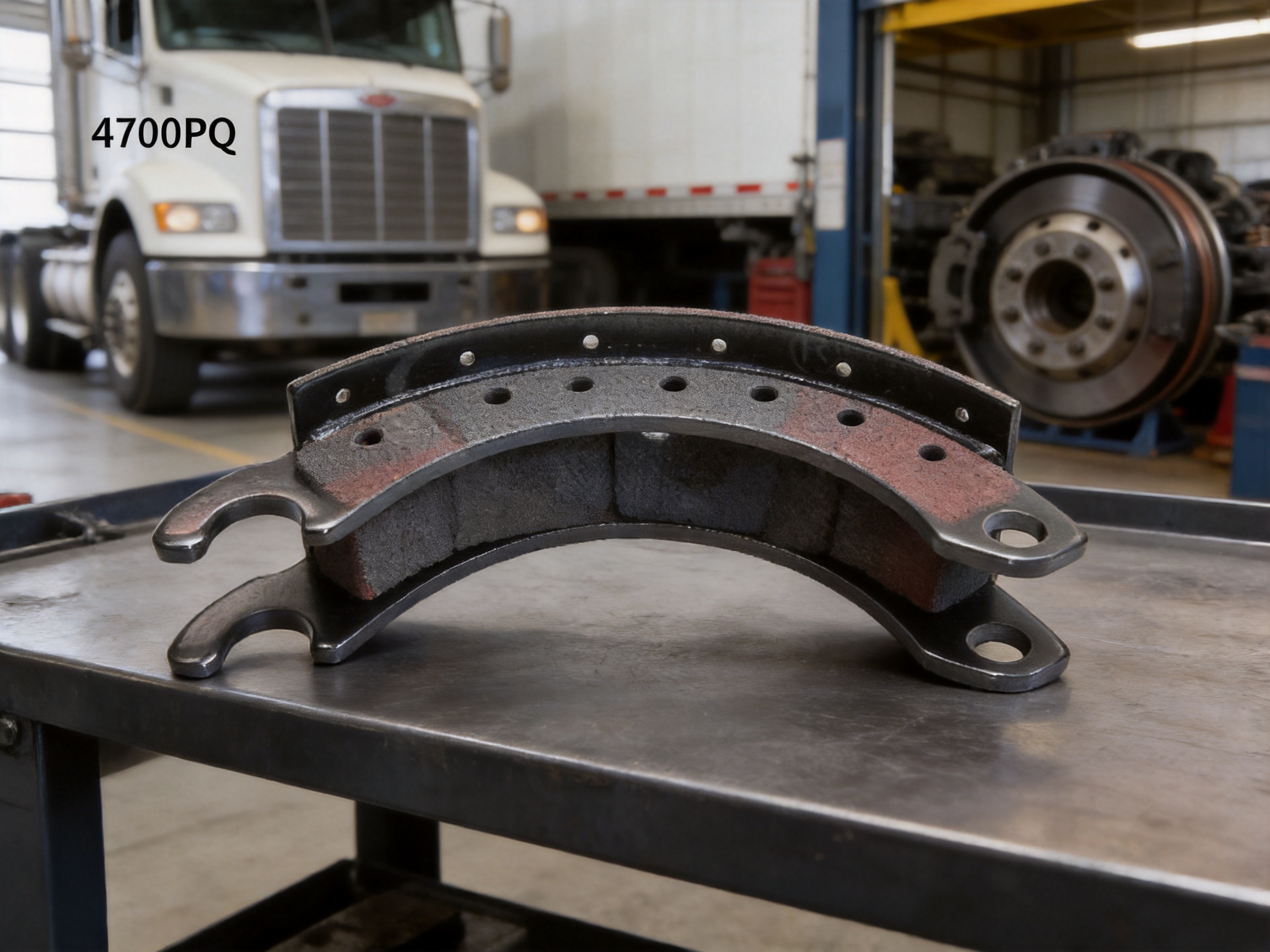
Manufacturing Process and Quality Focus
Reliable brake shoe production begins with controlled raw materials. Steel sheet, formed sections, lining material, rivets, and protective finishes must meet defined requirements before entering production. Material control reduces the risk of inconsistent thickness, unsuitable hardness, surface defects, or dimensional variation. A disciplined manufacturer maintains records for incoming inspection and separates approved materials from nonconforming stock.
Steel Preparation and Forming
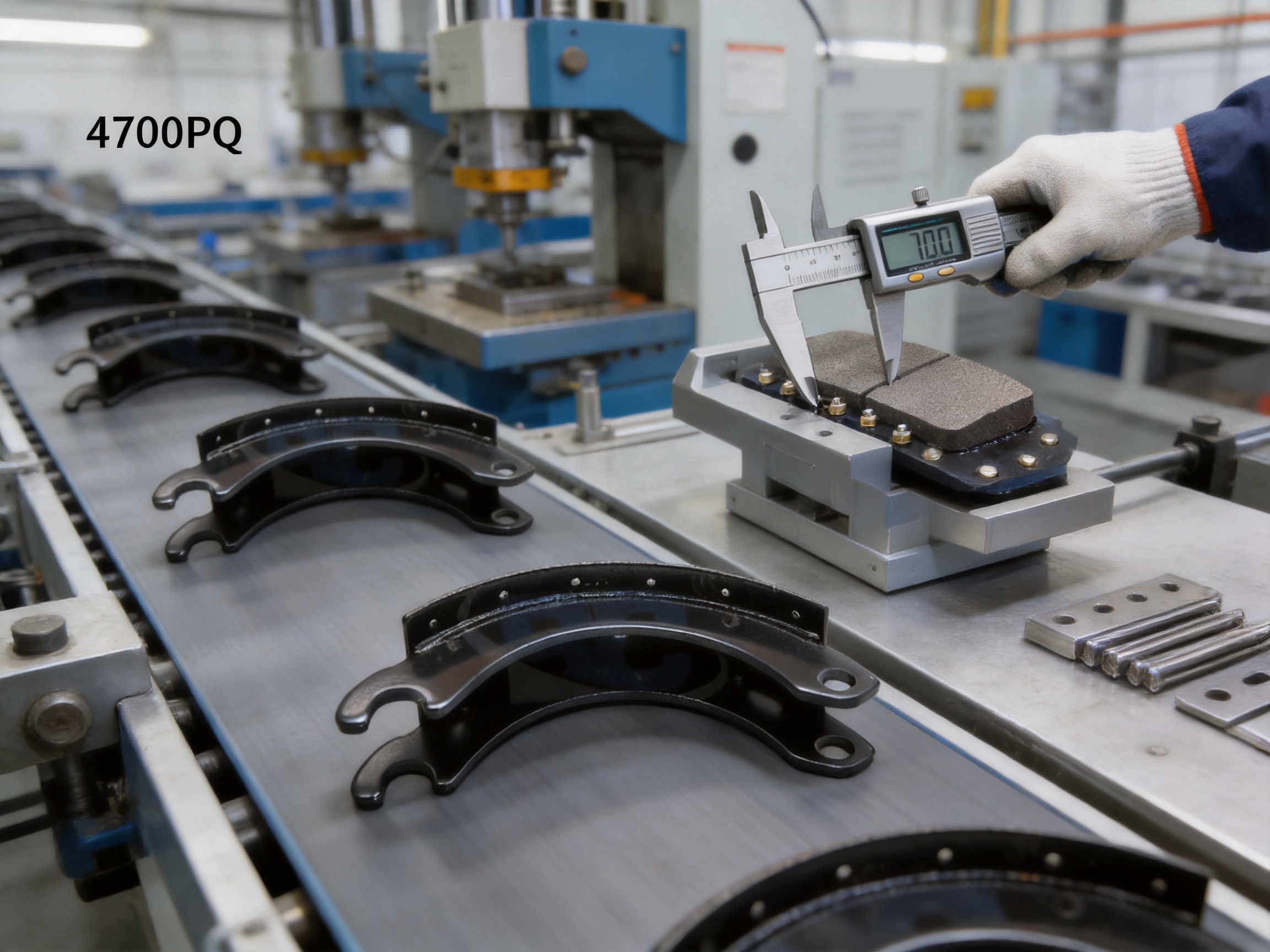
The steel shoe is produced through a sequence of cutting, forming, shaping, and finishing operations. The blank must be prepared to the correct outline before it is formed into the required shoe geometry. Press forming or related shaping operations establish the curvature and structural profile. Tooling condition is important because worn dies can create variation in radius, edge position, or web alignment.
During forming, the steel must achieve the intended shape without excessive cracking, wrinkling, or distortion. Production personnel can use fixtures and gauges to check the shoe after forming. A controlled forming process supports interchangeability, allowing pieces from the same production batch to fit the intended brake assembly in a more consistent manner. This is particularly valuable for fleet customers ordering multiple sets of brake shoes.
Rivet-Hole Processing
The twelve rivet holes must be positioned accurately. Hole spacing, diameter, edge distance, and alignment all affect lining attachment. If a hole is misplaced or incorrectly sized, the rivet may not sit properly, and the lining can experience uneven retention forces. Accurate hole processing also helps ensure that the supplied lining matches the shoe without requiring modification at the installation site.
Hole inspection can include visual checking, gauge measurement, dimensional templates, and sample-based verification. A mature production system does not rely solely on final visual inspection. It controls the tooling, machine settings, and work instructions that create the hole pattern in the first place. Process control at this stage supports stable quality and helps identify problems before lining installation.
Lining Preparation and Assembly
The lining must be prepared to match the shoe profile and application requirements. Preparation may include cutting, drilling, countersinking, curvature forming, cleaning, and surface treatment. The lining should be positioned so that its edges, holes, and contact area correspond correctly with the steel shoe. Poor alignment can create exposed edges, unsupported areas, irregular contact, or interference during installation.
Riveting is a critical assembly operation. Rivets should be correctly selected for the lining and shoe combination, placed in the intended holes, and formed with controlled force. Under-riveting may allow movement, while excessive force may damage the lining or distort the shoe. The finished rivet heads should be secure, evenly formed, and properly seated. The process should be checked using visual standards and, where appropriate, destructive or pull-out testing on representative samples.
Factory assembly offers an important advantage over uncontrolled installation because the manufacturer can use dedicated fixtures, repeatable tools, and trained operators. These controls help ensure that the lining follows the shoe curvature and that the rivet pattern is completed consistently. A professional production line can also establish inspection checkpoints after each major operation instead of waiting until the finished product is packed.
Surface Treatment and Corrosion Protection
Steel brake shoes may be exposed to humidity, road spray, salt, dust, and changing temperatures during transportation and service. Surface preparation and protective treatment can help reduce corrosion on non-friction areas. Depending on the product specification, this may include cleaning, coating, painting, or another controlled protection method.
Corrosion protection must be applied carefully. The friction surface and lining must remain free from contamination, while the structural portions of the shoe should receive suitable protection. Packaging also contributes to product preservation. Proper packing helps prevent impact damage, moisture exposure, and mixing of different part numbers during storage and shipment.
Final Inspection
Final inspection should confirm the identity, appearance, dimensions, lining attachment, rivet condition, and packaging of the completed brake shoe. Inspectors may verify the part number, shoe width, overall profile, rivet-hole count, lining position, and visible surface condition. Any product that fails the defined requirements should be isolated for review rather than released into finished-goods inventory.
Quality assurance is most effective when it combines incoming inspection, process control, in-process checks, and final verification. This layered approach supports a more reliable manufacturing system than relying on a single inspection at the end of production. It also creates useful records for traceability, customer service, and continuous improvement.
Production Strengths for International Buyers
A specialized heavy-duty brake parts manufacturer can provide advantages beyond the individual product. Experience with steel brake shoes, casted brake shoes, brake linings, lined brake shoes, repair kits, and lined brake shoe kits allows the supplier to understand the relationship between different components in a braking system. This product knowledge can assist distributors and fleet purchasers when they are building a broader replacement range.
Manufacturing under a common part-numbering framework supports more organized product management. A buyer can use the 4700PQ reference in purchase orders, warehouse records, inspection documents, and customer quotations. Consistent labeling is especially useful for international customers handling multiple vehicle makes and brake system configurations.
Production capability is also important when customers require repeat orders. A reliable supplier should be able to maintain documented specifications across batches, preserve tooling and process settings, and communicate clearly about minimum order quantities, packaging, lead times, and technical confirmation. Repeatability is often more valuable to a fleet or distributor than a one-time low purchase price because inconsistent parts can increase installation time, warranty exposure, and inventory complexity.
Export-oriented manufacturing requires attention to packaging, product identification, and communication. Each carton should clearly identify the part number and quantity. Products should be protected against movement and moisture during transport. Technical data should be presented in a way that allows overseas buyers to compare the product with local requirements. These practices help reduce receiving errors and support more efficient distribution.
Comparison with Alternative Brake Shoe Purchasing Options
The 4700PQ can be compared with several common purchasing options: an unlined steel shoe, a separately purchased lining, a locally relined original shoe, or a low-control replacement product. Each option has advantages and limitations, and the correct choice depends on the customer’s equipment, service procedures, and quality expectations.
| Purchasing Option | Potential Benefit | Important Consideration |
|---|---|---|
| 4700PQ lined steel brake shoe | Defined part number, steel structure, supplied lining, and twelve-rivet-hole configuration | Application, dimensions, and friction material suitability must be confirmed |
| Unlined steel shoe | Allows the buyer to select a separate lining material | Requires additional lining selection, fitting, riveting, and inspection |
| Separate brake lining | Useful for controlled relining programs and specialized friction requirements | Requires a compatible shoe, correct drilling, and qualified assembly work |
| Local relining of an old shoe | May reduce initial component cost when the original shoe remains serviceable | Old steel may be worn, distorted, corroded, or unsuitable for another service cycle |
| Uncontrolled low-cost replacement | May offer a lower purchase price | Variation in steel profile, lining attachment, dimensions, and traceability can create risk |
One clear advantage of a factory-lined product is process consistency. When a new steel shoe and lining are assembled under controlled conditions, the buyer does not need to depend on the condition of an old shoe core. Reusing a core may be practical in some repair programs, but the core should be carefully assessed for cracks, wear, corrosion, distortion, and loss of structural integrity. A new steel shoe removes many of those uncertainties.
Another advantage is purchasing simplicity. A distributor can order a complete lined brake shoe under one reference instead of managing separate shoe and lining numbers. This can reduce picking errors and simplify customer service. It may also help repair shops plan labor more accurately because the lining attachment operation is completed before the product arrives.
Compared with a product made without clear identification, the 4700PQ offers a more organized basis for technical communication. The part number, listed dimensions, and rivet-hole count create a starting point for verification. This is especially useful when a customer needs to replace a brake shoe from an aging vehicle or an imported commercial vehicle for which local catalog information is incomplete.
Application and Installation Considerations
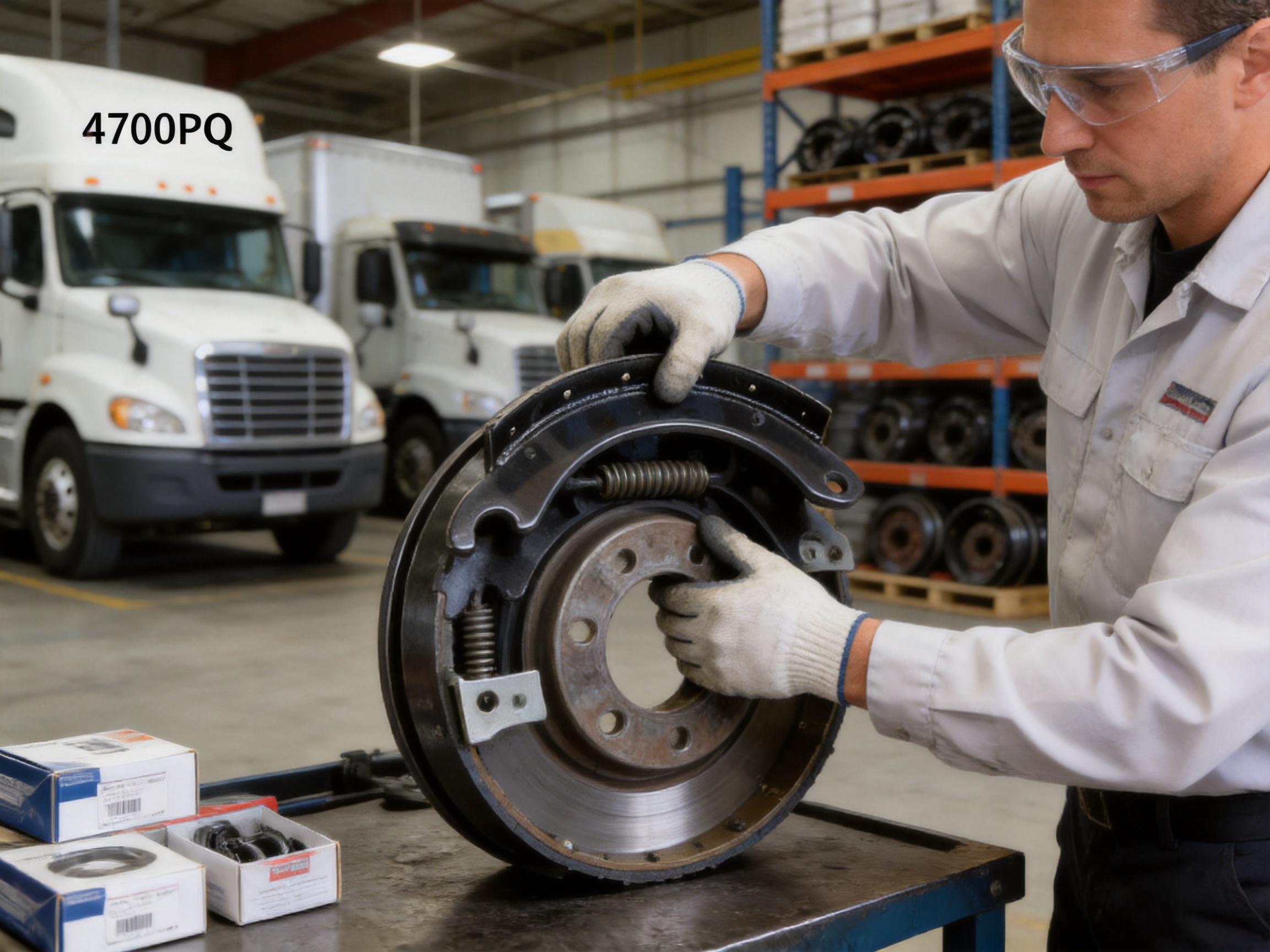
Brake components are safety-critical products. The 4700PQ should be installed only by qualified technicians who understand the relevant brake system and follow the vehicle or axle manufacturer’s service procedures. Before installation, the technician should compare the replacement shoe with the removed component and verify the shoe profile, width, offset, anchor points, cam contact areas, and lining position.
The supplied dimensional information lists the product size as 12.25 inches by 4 inches and also presents the notation “12.25*4 mm.” This mixed notation should be clarified before purchase or installation. Commercial brake shoes may be described using nominal lining dimensions, shoe dimensions, drum diameter references, or other catalog conventions. Buyers should request a technical drawing or confirmation when the measurement format is uncertain.
The brake drum should also be inspected. A replacement shoe cannot correct a drum that is cracked, excessively worn, deeply scored, out of round, or beyond its service diameter. The drum and shoe must be considered as a working pair. A clean, serviceable drum supports better lining contact and reduces the risk of abnormal wear. Contaminants such as oil, grease, or unsuitable paint must not reach the friction surface.
During installation, the technician should confirm that the shoe moves freely at its intended pivot or anchor points and that the actuating mechanism operates correctly. Hardware such as springs, retainers, pins, rollers, and adjusters should be inspected or replaced according to service requirements. The brake shoe itself is only one part of the complete braking system, and its performance depends on the condition and correct adjustment of the related components.
After installation, the brakes should be adjusted and tested according to the applicable service procedure. The vehicle should not be placed into normal heavy-duty operation until the braking system has passed functional checks. If a bedding or burnishing procedure is required for the lining material, it should be carried out under controlled conditions and in accordance with the relevant technical instructions.
Maintenance and Service Benefits
A consistent lined brake shoe can support more predictable maintenance planning. Fleet operators can use part-number records to monitor replacement intervals, compare service performance, and organize spare-parts inventory. If a particular axle or vehicle group uses the 4700PQ, the maintenance department can establish a dedicated stock location and reorder point.
Regular inspection remains necessary even when high-quality replacement parts are used. Technicians should monitor lining thickness, rivet condition, drum surface, shoe alignment, spring condition, adjuster operation, and signs of overheating. Uneven lining wear may indicate a problem with the drum, actuator, shoe geometry, or adjustment rather than a defect in the lining alone. Early diagnosis can prevent secondary damage and unplanned vehicle downtime.
Proper storage also protects product value. Brake shoes should be kept in a clean, dry area away from oil, grease, chemicals, and excessive humidity. Products should remain in their original packaging until needed, and different part numbers should be stored separately. Heavy cartons should be handled carefully to avoid bending or impact damage. These simple practices help ensure that the brake shoe reaches the workshop in the same condition in which it left the production facility.
Correct application can contribute to longer service life. An incorrectly matched brake shoe may exhibit premature wear even if its manufacturing quality is acceptable. Buyers should therefore avoid selecting parts based only on general dimensions or visual similarity. The brake system reference, part number, drum specification, lining type, and installation configuration should all be considered.
Advantages for Distributors and Wholesalers
Distributors need products that are easy to identify, explain, store, and sell. The 4700PQ provides a clear part-number reference and a defined twelve-hole lined configuration. These details can be included in catalogs, quotation sheets, inventory systems, and product labels. A clear description also makes it easier for sales staff to ask the right application questions before accepting an order.
The product’s relationship to heavy-duty brake parts and heavy truck brakes gives it a clear market position. Commercial vehicle parts customers generally value reliability, availability, compatibility, and documentation. A lined steel brake shoe can meet a practical need for customers that do not want to complete a separate relining operation. It can also support aftermarket programs where a distributor supplies repair shops, fleet operators, and regional vehicle service centers.
For wholesalers, product consistency can reduce returns caused by mismatched or incomplete components. Standardized packaging and labeling help warehouse personnel pick the correct item. Technical support from the manufacturer can further assist with cross-referencing, application confirmation, and repeat-order management. These business advantages are closely connected to manufacturing discipline because an organized production system is more likely to provide organized product information.
International buyers should request confirmation of packaging quantities, inspection documents, available technical drawings, and shipment terms before placing a large order. They may also need to confirm whether the friction material meets their regional requirements. Clear communication at the quotation stage reduces misunderstandings later and helps the supplier prepare the correct product configuration.
Technical Communication and Quality Assurance
Technical communication is an important part of brake component quality. A product description should identify the part number, product category, dimensions, rivet-hole count, lining status, and application information. When a specification is incomplete, the supplier and buyer should resolve the uncertainty before production or shipment. For the 4700PQ, the listed size should be confirmed because the supplied notation combines inches with millimeters.
Quality documents may include inspection reports, batch records, material information, dimensional checks, and packing lists. The exact documents available depend on the buyer’s requirements and the manufacturer’s quality system. These records can support customer confidence and make it easier to investigate any issue that arises during installation or service.
Traceability is particularly useful for safety-related components. A batch or production record can connect the finished brake shoe with the raw materials, tooling, operators, inspection results, and packaging date used during production. Traceability supports corrective action and continuous improvement. It also gives the manufacturer a structured way to respond to technical questions from distributors and fleet customers.
Manufacturing improvement should be ongoing. Production teams can review inspection data, customer feedback, return reasons, tool wear, and process deviations. Improvements may involve better fixtures, clearer work instructions, more frequent gauge checks, improved packaging, or enhanced operator training. The purpose is not merely to increase output, but to make each product more consistent and dependable.
Environmental and Operational Responsibility
Brake shoe production involves steel processing, friction-material handling, surface treatment, packaging, and transportation. Responsible manufacturing includes attention to workplace safety, dust control, waste management, energy use, and proper handling of production materials. Safe and organized factories are better positioned to maintain stable quality because employees can work with the correct equipment, procedures, and protective measures.
Operational responsibility also includes reducing avoidable waste. Accurate cutting and forming can improve material utilization. Controlled assembly can reduce rejected products. Durable packaging can prevent transport damage and the associated cost of replacement shipments. These practices benefit both the manufacturer and the customer while supporting a more efficient supply chain.
For fleet operators, product durability and correct application can have operational benefits. A brake shoe that performs consistently may help reduce unscheduled maintenance and unnecessary component replacement. However, service life depends on many factors, including vehicle load, driving conditions, brake adjustment, drum condition, climate, route profile, and maintenance quality. No brake component should be evaluated independently of the complete operating environment.
Recommended Buyer Verification Checklist
Before ordering the 4700PQ, buyers should confirm the vehicle or axle application and compare the replacement requirement with the available product data. The following checklist can support a more accurate purchasing decision:
1. Confirm that the required component is a lined steel brake shoe rather than an unlined shoe, separate lining, repair kit, or complete lined shoe kit.
2. Confirm the part number as 4700PQ and compare it with the original component, service catalog, or approved cross-reference.
3. Verify the listed size of 12.25 inches by 4 inches and clarify the unit notation before ordering.
4. Confirm the twelve-rivet-hole configuration and ensure that the lining and shoe hole pattern correspond.
5. Check the brake drum diameter, width, radius, offset, anchor arrangement, and actuator interface.
6. Review the required friction material characteristics for the vehicle’s load, operating speed, climate, and duty cycle.
7. Request technical drawings, inspection information, or samples if the application is uncertain.
8. Confirm packaging, labeling, shipment quantity, storage requirements, and documentation.
9. Ensure that installation will be completed by qualified personnel using the correct service procedures.
10. Inspect the complete braking system, including the drum, adjuster, actuator, springs, pins, and related hardware.
This checklist does not replace the vehicle manufacturer’s technical documentation. It is intended to help purchasing and maintenance teams organize the information needed for correct component selection.
Frequently Asked Questions
What is the 4700PQ product?
The 4700PQ is a lined steel brake shoe identified as a heavy-duty brake component. It is supplied with brake lining attached to the steel shoe and is listed with twelve rivet holes.
What is the listed size of the product?
The supplied product information lists the size as 12.25 inches by 4 inches and presents the notation “12.25*4 mm.” Because the notation is mixed, buyers should confirm the exact measurement convention and complete dimensional drawing before installation.
How many rivet holes does the 4700PQ have?
The product information specifies twelve rivet holes. The hole count should be compared with the original shoe and the intended replacement lining before purchase.
Is the 4700PQ supplied with lining?
Yes. It is described as a lined shoe. The lining is assembled on the steel shoe, allowing the product to be purchased as a prepared brake shoe rather than as a steel core alone.
Can the product be used on any heavy truck?
No. Heavy-duty brake shoes are application-specific. The 4700PQ must be matched with the correct brake drum, axle, shoe geometry, friction requirements, and vehicle or brake-system specifications.
What is the advantage of purchasing a lined shoe?
A lined shoe can simplify purchasing and workshop operations because the steel shoe and lining are supplied as one identified component. It can reduce the need for separate lining selection and field riveting, although normal installation inspection is still required.
Why is the rivet-hole pattern important?
The rivet-hole pattern determines how the lining is attached to the shoe. Correct hole count, spacing, and diameter help distribute retention forces and support secure, even lining installation.
What should be checked before installing the brake shoe?
The technician should check the part number, dimensions, shoe curvature, lining position, rivet condition, drum condition, anchor points, actuator components, adjuster, springs, and other related hardware. The complete brake assembly must be inspected.
How should the brake shoe be stored?
It should be stored in a clean, dry area away from oil, grease, chemicals, excessive moisture, and impact. Original packaging should be retained until installation, and different part numbers should be kept clearly separated.
Does a new brake shoe eliminate the need to inspect the drum?
No. The drum must be inspected for wear, cracks, scoring, distortion, contamination, and service-diameter limits. A new shoe requires a suitable drum and correctly functioning related components.
What does the FMSI numbering reference provide?
The global FMSI numbering system provides a structured way to identify friction and brake components. It can support cataloging, cross-referencing, purchasing, warehouse control, and communication between international buyers and suppliers.
What makes controlled manufacturing important for this product?
Controlled manufacturing helps maintain consistent steel forming, hole placement, lining alignment, riveting, surface protection, inspection, and packaging. Consistency supports easier installation and more predictable replacement quality.
Conclusion
The 4700PQ lined brake shoe is a practical heavy-duty replacement component built around a steel shoe structure, a supplied friction lining, and a twelve-rivet-hole configuration. Its principal advantages include a ready-lined format, clear part-number identification, a robust structural foundation, and suitability for organized commercial vehicle brake-parts programs when the application is correctly verified.
Its value is strengthened by the manufacturing processes behind the product. Controlled steel forming, accurate hole processing, careful lining preparation, disciplined riveting, corrosion-conscious finishing, layered inspection, and protective packaging all contribute to a dependable replacement component. These processes also support the needs of international distributors, repair workshops, fleet operators, and wholesalers that require repeatable quality and clear product identification.
At the same time, correct selection remains essential. The listed dimensions should be confirmed because the supplied specification uses mixed measurement notation. Buyers should verify the vehicle, axle, brake drum, shoe profile, lining requirements, and rivet pattern before ordering. Installation should be performed by qualified technicians, and the complete braking system should be inspected before the vehicle returns to service.
For customers seeking a clearly identified lined steel brake shoe for heavy-duty aftermarket applications, the 4700PQ provides a structured purchasing option. When supported by accurate application confirmation, professional installation, and appropriate maintenance, it can contribute to an efficient and dependable commercial vehicle brake service program.
References
1. Federal Motor Vehicle Safety Standards, Commercial Motor Vehicle Brake System Requirements.
2. Society of Automotive Engineers, Recommended Practices for Commercial Vehicle Drum Brake Service.
3. Friction Materials Standards and Testing Principles for Automotive Brake Linings.
4. Heavy-Duty Vehicle Maintenance Procedures for Brake Drums, Brake Shoes, and Actuation Components.
5. International Cataloging and Identification Practices for Replacement Brake Components.
6. Industrial Quality-Control Principles for Press-Formed Steel Components.
7. General Workshop Guidance for Riveted Brake Lining Installation and Inspection.