 English
 简体中文
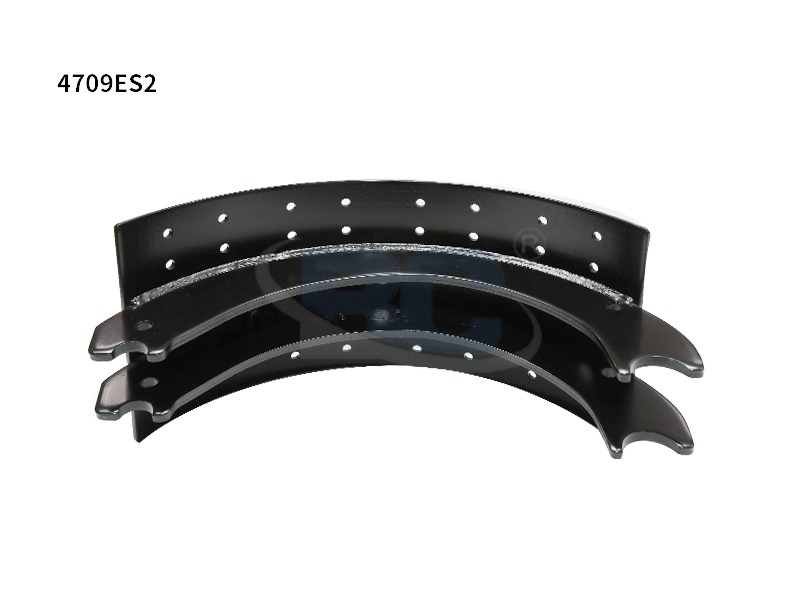
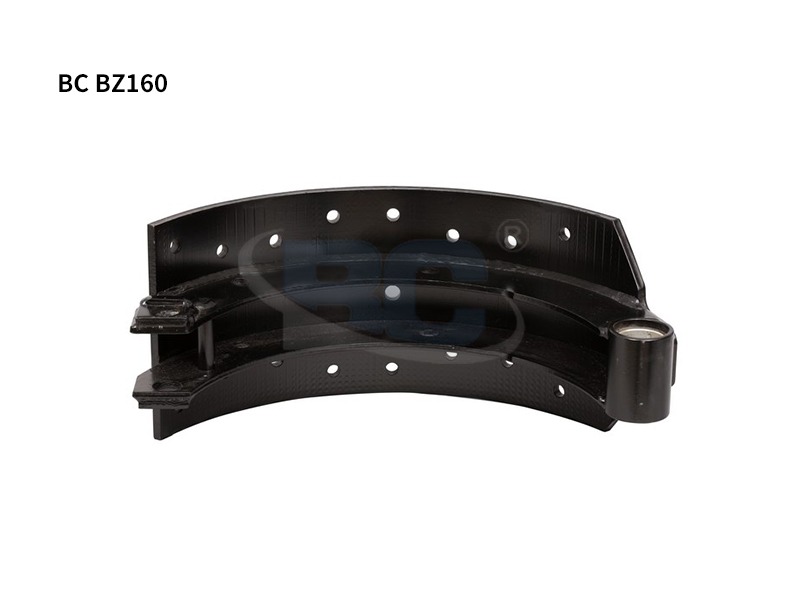
The A6594200019 BZ160 Brake Shoe is a steel brake shoe designed for commercial vehicle drum brake systems, heavy-duty trailer axles, and fleet maintenance applications. With a 410 × 160 mm working size, 16 rivet holes, and direct interchange with OE A 659 420 0019 on compatible systems, it is developed for dependable replacement performance where braking consistency, fitting efficiency, and controlled maintenance costs are essential.
For fleet operators, brake components are not judged only by their purchase price. They must fit correctly, perform predictably across different operating conditions, support efficient workshop installation, and remain available when scheduled maintenance is due. The BZ160 addresses these requirements through a defined dimensional specification, steel construction, a controlled friction performance range, and a production approach suited to volume replacement programs.
This article examines the product’s construction, technical characteristics, installation considerations, manufacturing strengths, procurement benefits, competitive advantages, and practical fleet applications. It also explains why accurate part identification, batch consistency, and disciplined maintenance procedures are important when replacing brake shoes in commercial drum brake systems.
1. Product Overview
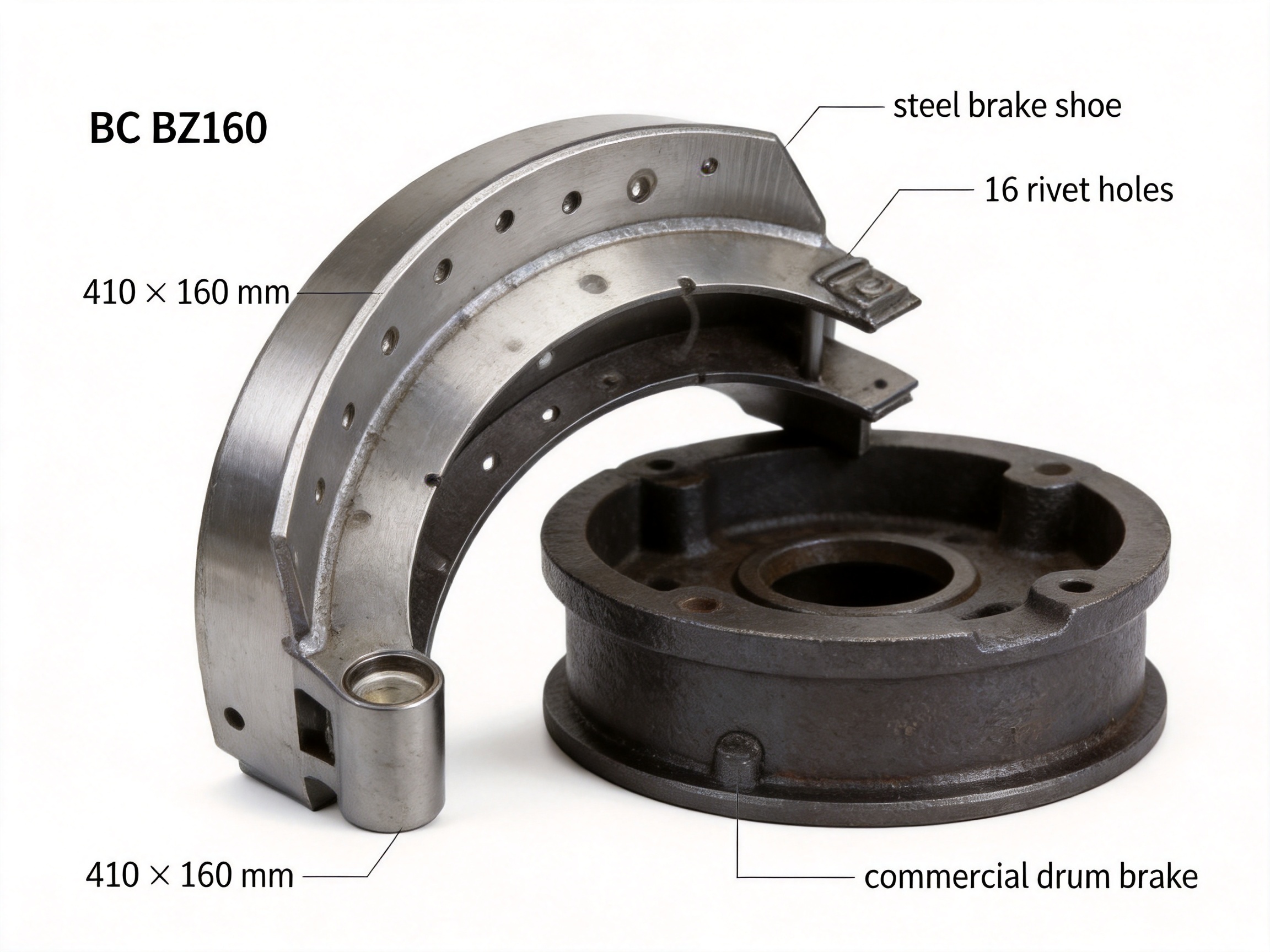
The BZ160 is identified by the OE reference A 659 420 0019 and is supplied as a steel brake shoe for compatible commercial vehicle drum brakes. The product has a nominal size of 410 × 160 mm and contains 16 rivet holes. These core dimensions are important because the brake shoe must match the drum assembly, lining configuration, mounting geometry, and operating clearances of the intended vehicle or axle.
A brake shoe is a curved structural carrier that supports friction lining inside a drum brake. During braking, the shoe is pushed outward against the inner surface of the rotating drum. The friction generated between the lining and drum converts vehicle motion into heat and slows the vehicle. The shoe therefore has two major responsibilities: it must maintain its structural shape under load, and it must support the lining in a way that allows stable contact across the braking surface.
The BZ160 combines a steel carrier with a 16-hole riveting pattern. The hole arrangement allows the lining to be mechanically secured to the shoe in a controlled sequence. Correct hole position is vital because inaccurate spacing can create installation problems, uneven fastening pressure, lining movement, or localized stress. A properly manufactured shoe provides the base for consistent assembly and reliable workshop fitting.
The stated friction coefficient range for the product is 0.38–0.42, with a maximum temperature specification of 450 °C. These values provide useful reference points for application planning, although actual braking performance also depends on the selected lining material, drum condition, vehicle load, braking system design, speed, temperature history, and maintenance condition.
| Item | Specification |
|---|---|
| Product code | BZ160 |
| OE reference | A 659 420 0019 |
| Product type | Steel brake shoe |
| Nominal size | 410 × 160 mm |
| Rivet hole quantity | 16 |
| Rivet hole reference | 16 holes, approximately 9.0 mm diameter |
| Brake system | Commercial vehicle drum brake |
| Friction coefficient reference | 0.38–0.42 |
| Maximum temperature reference | 450 °C |
| Primary use | Replacement and fleet maintenance programs |
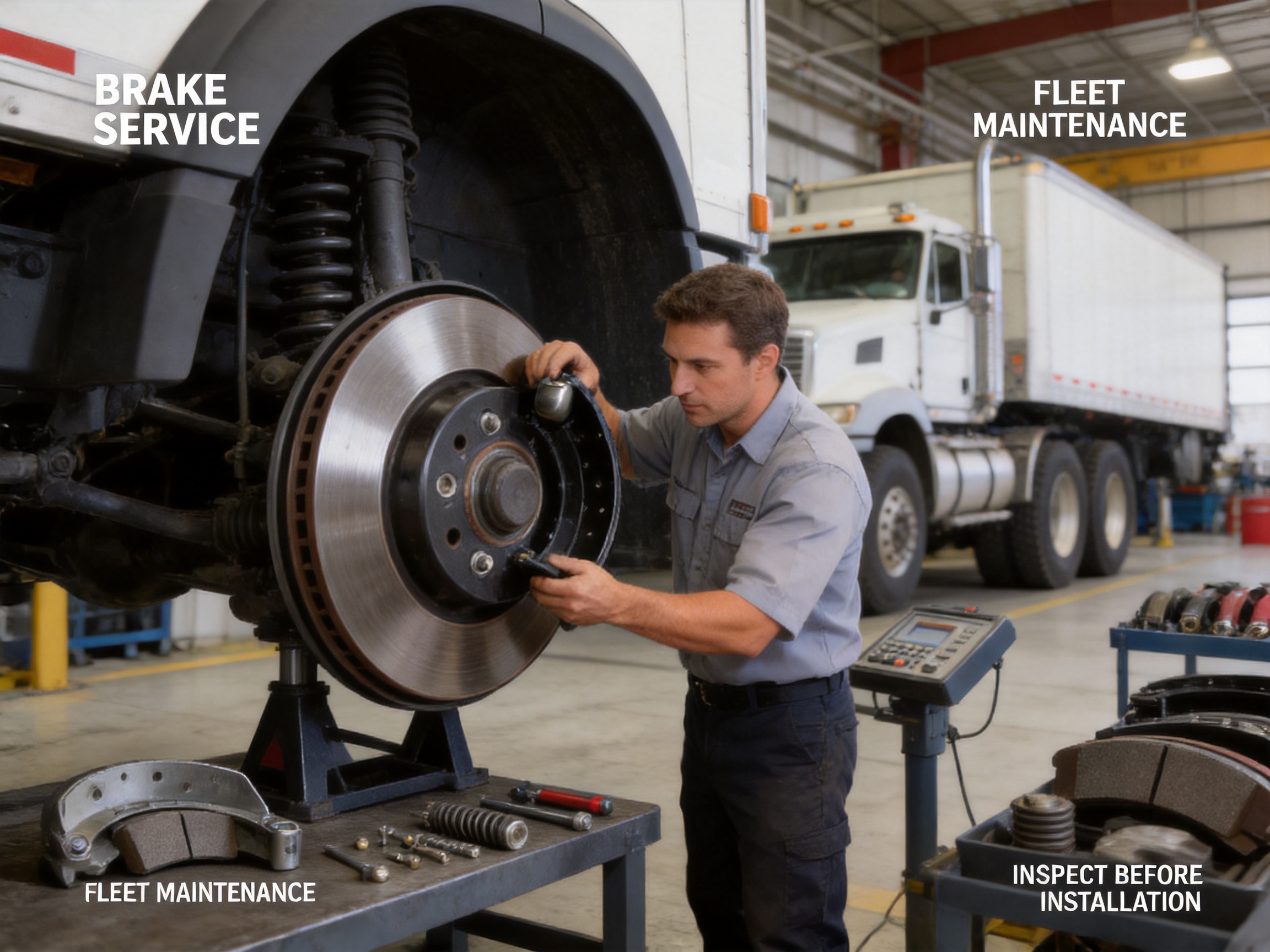
A6594200019 Brake shoe
2. Why Brake Shoe Accuracy Matters
Commercial vehicles often operate under demanding conditions that place repeated loads on their braking systems. Heavy payloads, long descents, frequent stops, trailer operation, urban traffic, and variable road surfaces can all increase thermal and mechanical stress. In these conditions, a brake shoe must remain dimensionally stable and work properly with the lining, drum, return springs, adjuster, anchor points, and other components.
Dimensional accuracy is one of the first requirements for dependable fitting. The shoe must sit correctly in the brake assembly without excessive interference or unwanted movement. The curved profile must be appropriate for the drum diameter, and the mounting points must align with the original design. If the shoe is dimensionally inconsistent, the workshop may face delays, forced fitting, premature wear, or the need to reject an otherwise suitable-looking part.
The BZ160 is specified with a 410 × 160 mm footprint and a defined 16-hole pattern. These details help purchasing departments and technicians compare the replacement part with the existing assembly before installation. They also provide a practical basis for stock identification, catalog organization, and application verification.
Hole positioning is particularly important for a riveted brake lining assembly. The rivets must distribute fastening force along the lining instead of concentrating stress in only a few areas. A regular pattern supports more even contact between the lining and the shoe. It also helps reduce the possibility of lining movement when the brake is repeatedly heated and cooled.
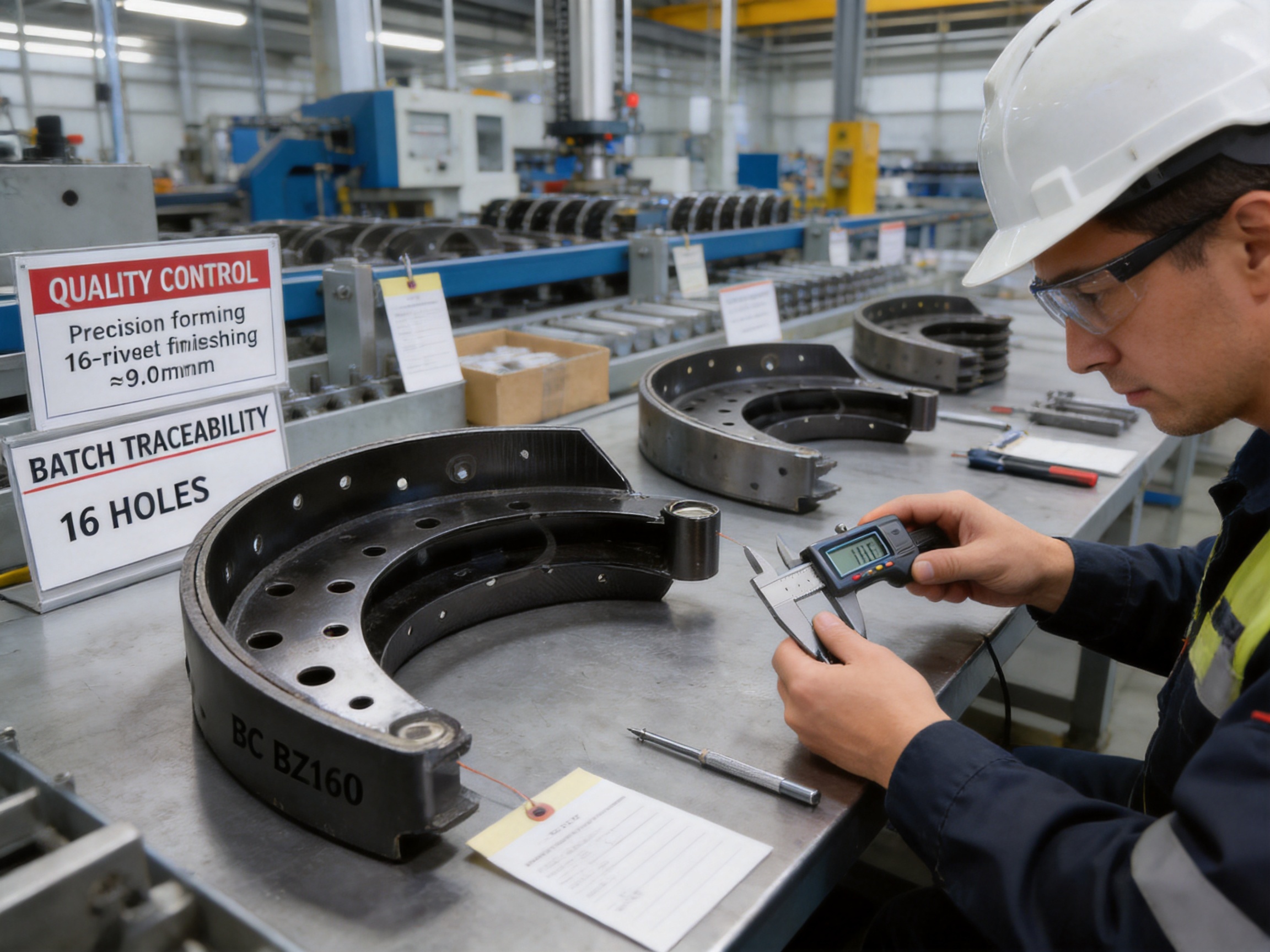
Consistency is equally important when multiple vehicles are maintained under one fleet program. A fleet may purchase dozens or hundreds of similar parts at a time. If product dimensions vary significantly between batches, workshop productivity can decline and technicians may need to perform additional checks. Batch traceability and production control help reduce this risk by linking supplied parts to defined manufacturing and inspection records.
3. Steel Construction and Structural Function
The BZ160 uses steel as the shoe material. Steel is widely used for brake shoe carriers because it offers a practical combination of strength, formability, durability, and resistance to the mechanical loads generated during braking. The shoe must tolerate repeated force transmission from the actuator to the lining and then to the drum while maintaining its basic geometry.
The carrier does not create braking friction by itself. Instead, it provides the structural support for the friction lining. When the brake is applied, force travels through the braking mechanism into the shoe. The shoe then presses the lining against the drum. This makes the carrier’s shape, rigidity, hole accuracy, and surface condition important to the overall performance of the assembled brake.
A steel shoe also offers stable behavior over normal commercial vehicle operating temperatures. The product information identifies a maximum temperature reference of 450 °C. This should be treated as an application and engineering reference rather than a guarantee that every vehicle will operate safely at that temperature under all conditions. Proper drum condition, correct lining selection, suitable adjustment, and appropriate driving practices remain essential.
Compared with poorly controlled low-cost alternatives, a consistently formed steel shoe can offer a more predictable foundation for lining installation. Competitor products may appear similar externally, but differences in curvature, material thickness, hole placement, edge finishing, and dimensional tolerance can affect fitting time and long-term wear. The value of the BZ160 is therefore connected not only to its material but also to the control applied during forming and inspection.
For buyers, steel construction also supports a straightforward product classification. The BZ160 can be managed as a replacement shoe for compatible drum brake systems, while separate lining selection and riveting procedures can be handled according to the maintenance department’s technical policy. This is useful for repair shops and distributors that maintain different lining specifications for different duty cycles.
4. Manufacturing Process and Quality Control Strengths
The available product information emphasizes consistent tolerances, batch traceability, volume supply, and compatibility with the OE reference. These strengths point to a manufacturing system organized around repeatable production rather than one-off fabrication. For a commercial brake component, repeatability is essential because the same design may be installed across many vehicles and maintenance intervals.
4.1 Material Preparation
Manufacturing begins with controlled steel material suitable for the intended brake shoe design. Material preparation includes confirming the required stock dimensions and ensuring that the material is appropriate for forming and subsequent assembly. Consistent input material supports more stable forming results and helps reduce variation between production batches.
For fleet programs, material control is especially valuable. A replacement part may be ordered months after the original delivery, and the buyer expects the later batch to remain compatible with the same application. Maintaining defined material and process requirements helps support this expectation.
4.2 Forming of the Shoe Profile
The flat or pre-shaped steel material is formed into the curved profile required by the drum brake assembly. Forming must be controlled so that the shoe follows the intended radius and retains its shape after processing. Excessive variation in curvature can create poor lining contact or make installation more difficult.
A controlled forming process also contributes to more uniform load distribution. When the shoe and lining match the drum geometry, the braking surface can develop contact progressively during bedding. This is preferable to a condition in which only a small area contacts the drum initially, which can cause localized heat and uneven wear.
4.3 Hole Production and Pattern Control
The BZ160 includes 16 rivet holes, with a reference hole diameter of approximately 9.0 mm. The hole-making operation must control quantity, position, spacing, and edge condition. Each of these factors affects the assembly of the lining and the quality of the finished brake shoe.
Hole pattern checks are a practical quality-control point because they can be verified against the product drawing or inspection standard. A consistent pattern supports faster riveting and reduces the chance of misalignment during workshop assembly. It also allows buyers to distinguish a correctly specified replacement from a visually similar but incorrectly drilled product.
4.4 Edge and Surface Condition
After forming and hole production, the shoe should be checked for sharp edges, burrs, distortion, and other conditions that could interfere with fitting or handling. Clean and properly finished edges help protect technicians during installation and reduce the possibility of interference with springs, retainers, or adjacent brake components.
Surface condition is also relevant where the shoe is stored, transported, or assembled at a later date. Appropriate handling and packaging practices help preserve the component before it reaches the workshop. For international and regional supply programs, stable packaging and clear identification are part of product quality because they reduce the chance of mixing different specifications.
4.5 Inspection and Batch Traceability
Batch traceability is one of the stated procurement benefits of the BZ160. It enables supplied parts to be associated with a production batch and relevant records. This is important when a customer needs to review a delivery, investigate a fitting issue, or coordinate replenishment for a large maintenance program.
Traceability also supports more disciplined inventory management. Purchasing teams can record the product code, OE reference, batch details, quantity, and delivery date. If a fleet later identifies a particular operating issue, the maintenance department can compare parts by batch instead of relying only on memory or visual inspection.
4.6 Consistency for Volume Production
The company’s stated ability to support volume supply and scheduled deliveries is relevant to commercial vehicle customers. A factory serving fleet and distributor requirements must manage production planning, raw material availability, tooling, inspection, packaging, and shipment coordination. The purpose is not merely to produce a part, but to maintain reliable supply over repeated orders.
For buyers, this manufacturing strength can be more valuable than a small difference in initial unit price. A delayed brake component can keep a vehicle out of service, interrupt a delivery route, or force a workshop to reschedule labor. Stable production planning helps reduce these secondary costs.
5. Advantages in Comparison with Generic Alternatives
The BZ160 competes in a market that includes original equipment parts, aftermarket replacements, generic brake shoes, and locally produced alternatives. A fair comparison should be based on application compatibility, measurable dimensions, material behavior, supply reliability, and total maintenance cost rather than appearance alone.
5.1 Direct OE Reference
The product is identified for direct interchange with OE A 659 420 0019 on compatible drum brake systems. This gives buyers a clear reference for catalog matching and reduces uncertainty during procurement. Generic products without a precise interchange reference may require more manual comparison and create a greater risk of ordering an unsuitable part.
OE referencing does not remove the need for vehicle verification. Drum diameter, brake assembly design, lining specification, axle configuration, and production variation should still be checked. However, a clearly stated OE number gives the purchasing process a strong starting point.
5.2 Defined Size and Rivet Pattern
The 410 × 160 mm size and 16-hole configuration provide measurable identification points. These specifications are useful when comparing the BZ160 with a competitor’s product. A replacement that is close in appearance but differs in width, arc, hole count, or hole position may not deliver the same installation result.
Defined specifications also help distributors organize stock. Instead of relying on photographs or informal descriptions, a warehouse can classify the product by product code, OE number, dimensions, and hole pattern. This can reduce picking errors and improve order accuracy.
5.3 Predictable Workshop Fitting
Consistent tolerances are listed as a product benefit. In practical terms, this means the part is intended to arrive with repeatable dimensions that support normal workshop operations. Faster fitting can reduce labor time, especially when several vehicles are being serviced during the same maintenance window.
Competitor products that require excessive adjustment, reworking, or repeated trial fitting can create hidden costs. These costs may include additional labor, longer vehicle downtime, damaged lining material, and delayed return to service. A product designed for controlled installation can therefore provide value beyond its purchase price.
5.4 Suitable for Fleet Replacement Programs
The BZ160 is positioned for volume replacement programs. Fleet customers can arrange batch production and scheduled deliveries around maintenance cycles and inventory plans. This is a meaningful advantage over suppliers that can provide only irregular quantities or short-term spot deliveries.
Planned supply supports preventive maintenance. A fleet can establish minimum stock levels, forecast upcoming brake jobs, and order replacement shoes before components reach a critical condition. This approach is generally more efficient than waiting for an emergency failure or last-minute workshop requirement.
5.5 Cost Planning Through Predictable Wear
The product information describes predictable wear as a procurement benefit. Wear is affected by many factors, including payload, road gradient, driver behavior, drum condition, brake adjustment, lining formulation, and environmental conditions. No brake shoe can guarantee an identical service life in every vehicle.
Nevertheless, consistent manufacturing and an appropriate friction specification can help fleet managers identify more stable maintenance patterns. When replacement intervals become easier to estimate, buyers can plan parts budgets, labor demand, workshop capacity, and vehicle availability more effectively.
5.6 Material Customization for Volume Orders
Customized material grades may be available for volume orders, subject to target specifications and order quantity. This creates an opportunity for customers with specialized operating requirements to discuss alternative material characteristics. For example, a fleet may have particular expectations regarding temperature behavior, wear balance, noise, or duty-cycle performance.
Customization should always be managed through a documented technical review. The selected material must be compatible with the drum, vehicle braking system, operating environment, and applicable customer requirements. A customized solution should not be treated as an informal substitution without validation.
6. Friction Performance and Thermal Considerations
The stated friction coefficient range of 0.38–0.42 provides a reference for the product’s friction behavior. Friction coefficient is not a single universal performance value; it can change with temperature, pressure, speed, surface condition, humidity, and material pairing. The value should therefore be interpreted within the complete brake system.
Stable friction behavior is desirable because it supports predictable brake response. A shoe and lining combination that changes significantly under ordinary operating conditions can make pedal response less consistent. In commercial applications, predictable braking is important for driver confidence and vehicle control.
The 450 °C maximum temperature reference highlights the need to consider heat management. Drum brakes generate heat whenever the vehicle slows, and heavy vehicles can produce substantial thermal loads on long descents or during repeated stops. If heat is not dissipated effectively, the system may experience fade, accelerated wear, drum distortion, or damage to associated components.
Thermal performance is influenced by the complete assembly. The brake shoe, lining, drum, adjuster, springs, wheel-end condition, and operating technique all contribute. A correctly installed shoe cannot compensate for a severely scored drum, incorrect adjustment, contaminated lining, seized hardware, or an overloaded vehicle.
For this reason, the product’s temperature reference should be used for application assessment and maintenance planning. It should not be interpreted as permission to exceed the vehicle manufacturer’s braking limits or as a replacement for proper inspection.
7. Fleet Applications
The BZ160 is suitable for commercial vehicle drum brake applications where the A 659 420 0019 reference and 410 × 160 mm, 16-hole configuration are confirmed. Potential operating environments include heavy-duty trailer axles, long-haul fleets, regional transport vehicles, municipal service vehicles, and other commercial platforms using compatible drum brake assemblies.
7.1 Long-Haul Transport
Long-haul vehicles may accumulate high mileage and experience varying load levels, road gradients, and weather conditions. For these fleets, replacement parts must be available in planned quantities and should support efficient workshop processing. The BZ160 can be incorporated into scheduled brake inspections and replacement cycles when application compatibility is confirmed.
7.2 Regional Distribution
Regional distribution vehicles often make frequent stops and starts. This operating pattern can increase brake usage compared with steady motorway travel. A defined replacement shoe helps maintenance teams maintain a consistent parts list across vehicles using the same brake assembly.
7.3 Heavy-Duty Trailers
Trailer axles can remain in service across different tractors and operating routes. Clear product identification is therefore useful for trailer maintenance providers, fleet depots, and independent workshops. Before ordering, the technician should verify the axle and drum specifications rather than relying only on the trailer model name.
7.4 Municipal and Service Vehicles
Municipal vehicles may experience repeated starts, low-speed maneuvering, stop-and-go traffic, and varying payloads. Scheduled maintenance and reliable parts availability help reduce disruptions to public service operations. The BZ160 may be useful for these applications when the braking system matches the stated specification.
7.5 Volume Maintenance Programs
Large fleets benefit from standardized procurement. A single verified part number can simplify purchasing, warehouse management, technician training, and service documentation. Batch traceability further supports the management of recurring orders and quality reviews.
8. Installation and Workshop Guidance
Brake work should be performed by qualified technicians using the vehicle manufacturer’s service procedures and suitable safety equipment. The following guidance summarizes the product information supplied for the BZ160, but it does not replace the vehicle or axle manufacturer’s instructions.
8.1 Confirm the Application Before Fitting
Before installation, verify the OE reference A 659 420 0019, product code BZ160, shoe dimensions, rivet hole quantity, drum diameter, and brake assembly configuration. Confirm that the replacement shoe is intended for the specific axle and vehicle application.
Do not install a part solely because it appears visually similar. Brake shoes can share general shapes while differing in width, radius, hole position, anchor design, or lining arrangement. An application mismatch can affect safety and may lead to poor contact or premature wear.
8.2 Inspect the Drum
The drum should be checked for scoring, cracks, excessive wear, heat damage, contamination, and surface irregularities. The supplied workshop note specifically recommends verifying drum diameter and surface finish before fitting. A damaged or incorrectly sized drum can prevent a new shoe and lining from bedding correctly.
If machining or replacement of the drum is required, the technician should follow the applicable service limits. The new brake shoe should not be used to compensate for a drum that is beyond its permitted dimensions.
8.3 Check Associated Hardware
Return springs, retainers, adjusters, anchor points, and other related hardware should be inspected during brake service. Worn or weakened hardware can affect shoe movement and adjustment. Replacing the shoe while leaving damaged hardware in place may reduce the benefit of the new component.
8.4 Rivet Installation
The workshop note recommends torquing rivets to 30–35 N·m in a diagonal sequence. Technicians should confirm that this instruction matches the selected rivet type, lining specification, tooling, and applicable service procedure. The rivets should be installed evenly so that the lining is held securely without distortion.
A diagonal or alternating sequence helps distribute fastening force progressively. The completed assembly should be checked for secure attachment, correct seating, proper clearance, and absence of cracks or damage. Rivet heads should be formed correctly and should not interfere with the drum.
8.5 Bedding-In
The recommended bedding guidance is 200–300 km of moderate braking. Bedding allows the lining and drum to develop a more complete contact pattern under controlled conditions. During this period, drivers should avoid unnecessary severe braking where operating conditions permit.
Moderate bedding is not a substitute for a proper brake adjustment or inspection. If abnormal noise, pulling, vibration, overheating, or reduced braking response occurs, the vehicle should be removed from service for diagnosis.
8.6 Inspection Interval
The supplied maintenance note recommends inspecting lining thickness every 12,000 km under normal mixed-load duty cycles. The actual interval should be adapted to the vehicle’s operating environment, load, route, braking frequency, and service history.
Replacement is recommended when lining thickness falls below 8 mm or when cracking is observed. Uneven wear, glazing, contamination, loose rivets, abnormal drum marks, and heat damage should also be treated as reasons for further inspection and corrective action.
9. Maintenance Planning and Total Cost of Ownership
A brake shoe’s commercial value is best measured through total cost of ownership. The purchase price is only one part of the cost. Labor, vehicle downtime, emergency freight, stockholding, inspection time, premature replacement, and damage to related components can all influence the final result.
The BZ160 supports cost planning through defined product identification and volume supply capability. When a fleet can forecast demand, it may reduce emergency orders and avoid unnecessary vehicle waiting time. Scheduled deliveries can also help align parts arrival with workshop capacity and planned vehicle downtime.
Batch traceability contributes to quality management. If a fleet records the batch number used on each vehicle, it can compare service results across routes, vehicle types, and operating conditions. This data can help identify whether wear patterns are linked to driving conditions, drum condition, adjustment, or a particular maintenance practice.
Predictable fitting has a direct labor benefit. A part that matches the intended application and hole pattern can reduce installation delays. In a busy workshop, small time savings per vehicle can become significant across a large maintenance program.
Inventory management is also improved when the product code and OE reference are consistently used. Warehouses can establish reorder points and distinguish the BZ160 from other shoes that may share similar visual features. Clear labeling reduces the risk of mixing incompatible parts.
10. Procurement Guidance for Distributors and Fleet Buyers
Buyers should begin with a complete application review. The OE number, product code, size, hole pattern, vehicle type, axle configuration, and quantity should be recorded before issuing a purchase order. If the customer requires a special lining or material grade, that requirement should be documented separately.
For volume orders, the buyer should discuss production scheduling, batch size, delivery intervals, packaging, labeling, and traceability records. Scheduled delivery arrangements may be aligned with fleet maintenance cycles and inventory planning, as indicated in the product information.
Technical documentation should identify the product as a steel brake shoe and should distinguish it from complete lined brake shoe assemblies, brake linings, and repair kits. This distinction is important because a bare shoe may require separate lining selection and riveting, while a lined shoe may arrive ready for installation depending on the purchase specification.
Buyers should also clarify inspection expectations. Useful records may include dimensional checks, hole pattern verification, batch identification, quantity confirmation, and packaging inspection. The level of documentation should correspond to the customer’s quality system and application risk.
When comparing suppliers, procurement teams should evaluate more than unit price. Important comparison points include consistency across batches, ability to support repeat orders, response time, application knowledge, customization capability, packaging quality, and communication during production and shipment.
11. Company Manufacturing and Supply Strengths
Zhejiang Bangchi Auto Parts Co., Ltd. is identified as the supplier of the BZ160 brake shoe. The company is located in Haining, Zhejiang, China, and provides heavy-duty brake parts for commercial vehicle applications. Its stated product focus includes OEM brake parts following the global FMSI numbering system.
The company’s stated strengths are particularly relevant to professional buyers. These include volume supply, batch traceability, direct OE interchange references, consistent tolerances, scheduled delivery support, and the possibility of customized material grades for volume orders.
Following an established numbering approach helps make product identification more systematic. For distributors and fleet purchasing teams, standardized references reduce ambiguity during quotation, ordering, stock control, and technical communication. They also make it easier to compare a replacement part with an existing application record.
Manufacturing strength should be understood as a combination of production control and customer support. A reliable supplier must be able to maintain the required product geometry, identify batches, coordinate quantities, respond to technical questions, and support repeat delivery. These capabilities are especially important for brake parts because incorrect identification or inconsistent production can affect both safety and operating cost.
The company’s location in Zhejiang also places it within an established manufacturing region with access to industrial supply networks and export logistics. Regardless of geographic location, buyers should still assess each order according to technical requirements, inspection expectations, delivery terms, and application suitability.
For customers requiring larger programs, communication about target specifications is essential. A volume buyer may need a particular lining combination, packaging format, label language, or delivery schedule. The product information indicates that customized material grades may be available for suitable order quantities, so these requirements should be reviewed before production begins.
12. Safety, Compliance, and Responsible Use
Brake components are safety-critical products. The BZ160 should be selected and installed only for compatible applications, and all work should be completed by qualified personnel. Product information, vehicle service procedures, and local requirements should be reviewed together.
The stated technical values provide useful product references, but they do not override vehicle manufacturer limits. A fleet should not exceed approved axle loads, drum dimensions, braking temperatures, or service intervals. Drivers should also receive appropriate guidance for long descents, heavy loads, and abnormal braking symptoms.
Any sign of cracking, loose lining, overheating, severe scoring, uneven wear, contamination, or reduced braking performance requires immediate investigation. Continuing to operate a vehicle with a suspected brake fault can create serious risks for the driver, cargo, other road users, and the vehicle itself.
13. Practical Selection Checklist
Confirm the OE reference A 659 420 0019.
Confirm product code BZ160.
Verify the 410 × 160 mm nominal size.
Confirm the 16-rivet-hole configuration.
Check the approximate 9.0 mm rivet-hole reference where applicable.
Verify drum diameter and surface condition.
Confirm the vehicle, axle, and brake assembly application.
Determine whether a bare steel shoe, lined shoe, or repair kit is required.
Review friction and temperature requirements for the operating duty cycle.
Discuss batch size, traceability, packaging, and delivery schedule for volume orders.
Record installation and inspection results for future maintenance planning.
14. Frequently Asked Questions
Q1: What is the A6594200019 BZ160 Brake Shoe?
The BZ160 is a steel brake shoe for compatible commercial vehicle drum brake systems. It is identified by the OE reference A 659 420 0019 and has a nominal size of 410 × 160 mm with 16 rivet holes.
Q2: Is the BZ160 a direct replacement for OE A 659 420 0019?
It is designed as a direct interchange for OE A 659 420 0019 on compatible drum brake systems. Application verification remains necessary because vehicle and axle configurations can vary.
Q3: What type of brake system uses this product?
The product is intended for commercial vehicle drum brake systems. Potential applications include heavy-duty trailer axles, long-haul vehicles, regional fleets, municipal service vehicles, and other compatible commercial platforms.
Q4: How many rivet holes does the brake shoe have?
The BZ160 has 16 rivet holes. The product information gives an approximate reference diameter of 9.0 mm for the holes, which should be confirmed against the relevant lining and riveting specification before assembly.
Q5: What is the friction coefficient range?
The stated friction coefficient reference is 0.38–0.42. Actual brake performance depends on the complete lining, drum, vehicle, load, temperature, adjustment, and operating conditions.
Q6: What maximum temperature is specified?
The product information lists a maximum temperature reference of 450 °C. This value should be considered together with the vehicle manufacturer’s operating limits and the condition of the complete brake assembly.
Q7: Can the BZ160 be supplied for fleet maintenance programs?
Yes. The product is positioned for volume replacement programs, and scheduled deliveries can be arranged to support fleet maintenance cycles and inventory planning.
Q8: Is batch traceability available?
Batch traceability is listed as a procurement benefit. Buyers should confirm the specific batch records and documentation required for their own quality-management system before placing an order.
Q9: Can the material grade be customized?
Customized material grades may be available for volume orders. The target specification, operating conditions, quantity, validation requirements, and delivery schedule should be discussed before production.
Q10: What should be checked before installation?
Verify the OE number, product code, shoe dimensions, hole pattern, drum diameter, drum surface finish, lining specification, and related brake hardware. The replacement must be suitable for the exact brake assembly.
Q11: What bedding procedure is recommended?
The workshop guidance recommends approximately 200–300 km of moderate braking for bedding. Drivers should avoid unnecessary severe braking during this period where conditions allow, while responding immediately to any abnormal braking symptoms.
Q12: How often should the lining be inspected?
The supplied guidance recommends inspection every 12,000 km under normal mixed-load conditions. The interval should be adjusted for severe duty, heavy loads, steep routes, frequent stops, or unusual wear patterns.
Q13: When should the lining be replaced?
The guidance recommends replacement below 8 mm lining thickness or at the first sign of cracking. Uneven wear, glazing, contamination, loose rivets, overheating, or other damage should also trigger a detailed inspection.
Q14: Is the BZ160 supplied as a complete lined brake shoe?
The supplied product is identified as a steel brake shoe. Buyers should confirm whether they require a bare shoe, a lined brake shoe, or a complete repair kit because these are different product categories.
15. Conclusion
The A6594200019 BZ160 Brake Shoe is a clearly specified steel carrier for compatible commercial vehicle drum brake systems. Its 410 × 160 mm size, 16-rivet-hole pattern, OE interchange reference, friction coefficient reference, and temperature specification provide a practical technical foundation for product selection and fleet maintenance planning.
Its main advantages over less controlled generic alternatives are the clear application reference, defined dimensions, consistent hole pattern, suitability for volume supply, batch traceability, and support for scheduled procurement. These features can reduce fitting uncertainty, simplify stock management, and help fleets plan maintenance costs more effectively.
The product’s performance depends on the complete brake system and on correct workshop practice. Drum condition, lining selection, riveting, adjustment, bedding, inspection, load, and driving conditions all influence results. When these factors are properly controlled, the BZ160 can provide a dependable replacement platform for demanding commercial vehicle applications.
For professional buyers, the strongest value proposition is the combination of product specification and manufacturing support. A reliable steel brake shoe must be dimensionally consistent, correctly identified, available in the required quantity, and supported by a supplier capable of repeat production and traceable delivery. These are the characteristics that make the BZ160 relevant to distributors, repair workshops, trailer operators, and fleet maintenance programs.
References
1. Product specification for A6594200019 BZ160 Brake Shoe, including dimensions, rivet-hole quantity, friction coefficient reference, and temperature reference.
2. Workshop notes for BZ160 installation, riveting sequence, bedding procedure, and inspection recommendations.
3. Commercial vehicle drum brake maintenance principles and general brake component inspection practices.
4. Fleet maintenance planning principles for scheduled replacement, batch traceability, inventory control, and vehicle downtime reduction.
5. General technical guidance on friction materials, drum brake heat management, lining wear, and bedding-in procedures.
6. Product category information covering steel brake shoes, cast brake shoes, brake linings, lined brake shoes, brake shoe repair kits, and lined brake shoe kits.