 English
 简体中文
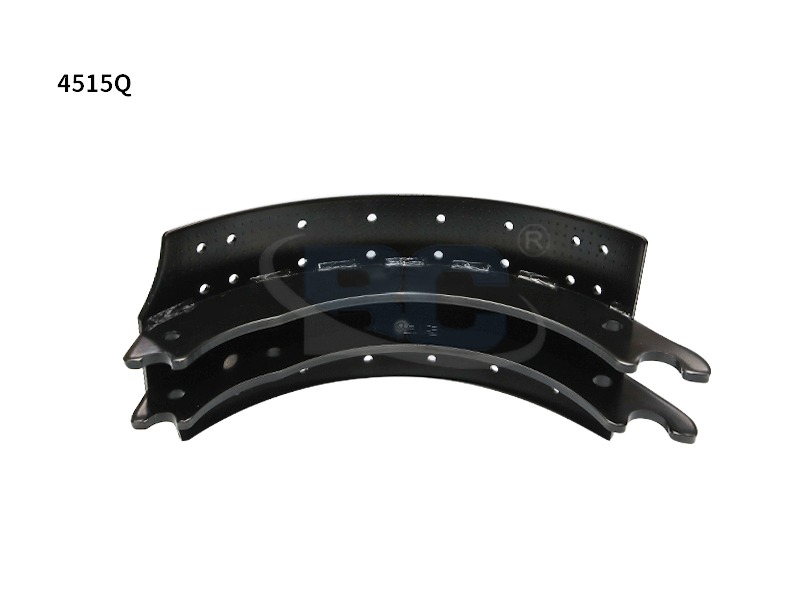
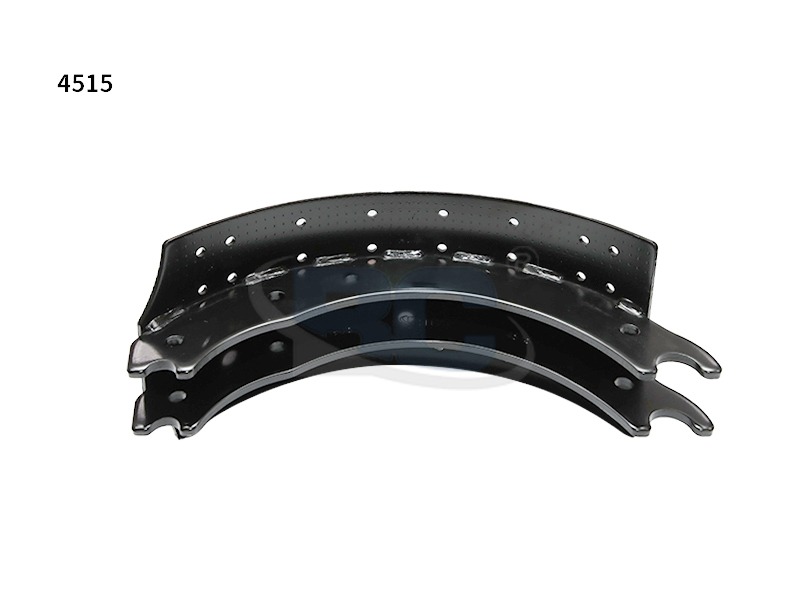
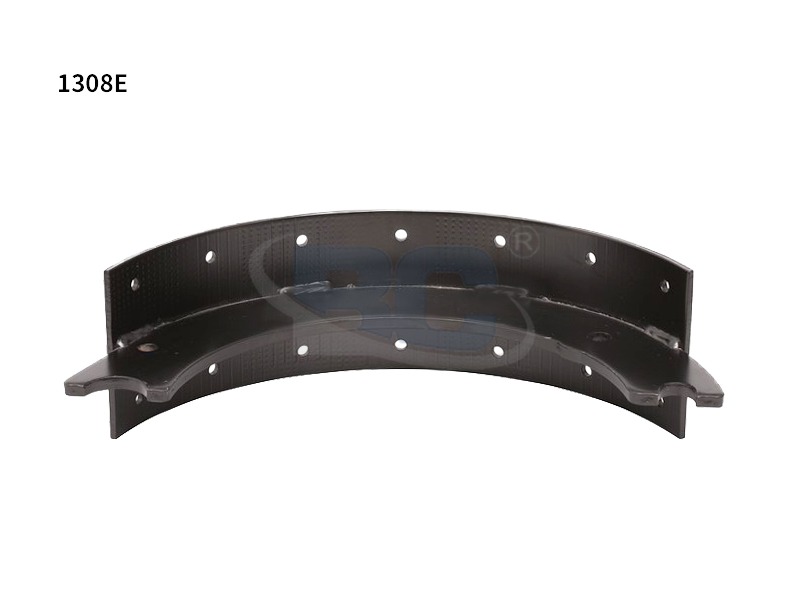
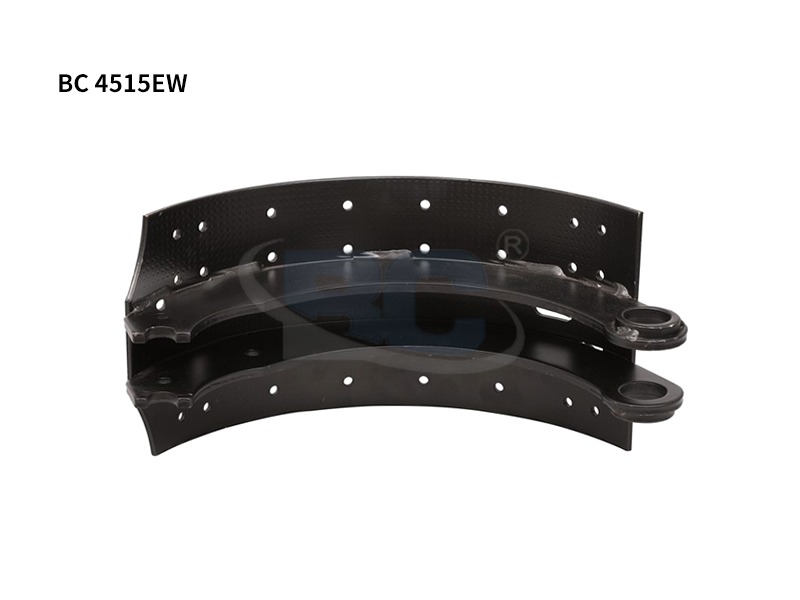
简体中文The 4515E Brake Shoe is a heavy-duty steel brake shoe designed for demanding truck, trailer, and commercial vehicle drum brake applications where stable geometry, reliable lining support, consistent rivet-hole alignment, and long service performance are essential. Identified by part number 4515EW, this product belongs to the steel brake shoe category and is built around the widely used 16.5-inch by 7-inch heavy truck brake configuration. With 32 rivet holes and a structure intended for lined or relined brake shoe assemblies, it serves fleets, repair workshops, distributors, and OEM-oriented brake part suppliers seeking dependable heavy-duty brake hardware.
In commercial braking systems, the brake shoe is not simply a curved metal carrier. It is a safety-critical structural component that supports the friction lining, transfers braking force, resists thermal and mechanical stress, and maintains contact geometry inside the drum. A poorly manufactured brake shoe can cause uneven lining wear, vibration, brake noise, reduced braking efficiency, premature drum damage, or even failure under severe operating conditions. The 4515E steel brake shoe is developed to address these practical challenges through a combination of material selection, precision forming, accurate rivet-hole layout, robust construction, and controlled manufacturing processes.
For heavy truck brake systems, reliability is measured over thousands of braking cycles, repeated heating and cooling, road vibration, payload variation, and maintenance intervals. The 4515E Brake Shoe is positioned as a durable, service-friendly solution for heavy-duty brake parts programs, especially where compatibility with recognized numbering systems and standardized dimensions is important. Its 16.5-inch by 7-inch size makes it suitable for a common heavy vehicle drum brake platform, while its 32 rivet-hole configuration supports secure lining attachment and even load distribution across the friction material.
Product Overview
The 4515E Brake Shoe is a steel brake shoe designed for heavy-duty drum brake applications. The listed part number is 4515EW, and the product size is 16.5 inches by 7 inches. The brake shoe includes 32 rivet holes, which are used to fasten brake lining material to the shoe platform. The product is also associated with a “with ring” configuration, indicating a structural or assembly-related feature intended to support fitment and stability in the relevant brake shoe system.
Steel brake shoes are commonly used in heavy truck and trailer braking systems because they provide a strong yet serviceable foundation for friction linings. Compared with many casted alternatives, a well-made steel shoe can provide advantages in weight control, dimensional consistency, repairability, and manufacturing repeatability. These qualities matter in fleets where brake shoes may be replaced, relined, or stocked in quantity across multiple vehicle types.
The 4515E model is especially relevant for distributors and maintenance teams that need brake shoes matching standard heavy-duty brake dimensions. Its structure is designed to provide a stable arc for the friction lining so that the lining can contact the drum consistently. Proper shoe radius and lining support help reduce localized pressure peaks, which can otherwise lead to hot spots, cracking, chatter, or uneven wear.
Because brake shoes work as part of a complete brake assembly, the product’s value depends not only on its individual strength but also on its ability to integrate smoothly with brake linings, rivets, rollers, anchor pins, springs, and drum surfaces. The 4515E Brake Shoe is intended to serve as a reliable foundation in this system. When paired with suitable lining materials and installed according to correct service procedures, it can help support predictable braking behavior and longer maintenance intervals.
Key Product Specifications
| Item | Specification | Practical Importance |
|---|---|---|
| Product Name | 4515E Brake Shoe | Identifies the brake shoe model for heavy-duty drum brake applications. |
| Part Number | 4515EW | Supports ordering, inventory control, and part matching. |
| Product Category | Steel Brake Shoe | Indicates a steel-formed structural brake shoe rather than a casted shoe. |
| Product Size | 16.5 inches by 7 inches | Matches a common heavy truck and trailer drum brake size. |
| Number of Rivet Holes | 32 | Provides multiple fastening points for secure brake lining attachment. |
| Configuration Note | With ring | Supports the specified design configuration for compatible brake assemblies. |
| Typical Application Area | Heavy-duty truck and trailer drum brake systems | Suitable for demanding commercial braking environments. |
Why the Brake Shoe Matters in Heavy-Duty Braking
In a drum brake system, braking force is generated when the brake shoe presses the friction lining against the inner surface of the brake drum. This contact converts vehicle motion into heat through friction. While the lining provides frictional engagement, the shoe carries the lining, transmits actuation force, and maintains the correct shape under load. Therefore, the quality of the shoe directly affects the quality of the braking event.
Heavy-duty vehicles place extraordinary stress on brake shoes. A fully loaded truck descending a long grade may create sustained heat and pressure at the drum interface. A city delivery vehicle may experience frequent stop-and-go cycles. A trailer may sit idle in harsh weather and then immediately return to highway operation. In each of these conditions, the brake shoe must resist deformation, corrosion, fatigue, and vibration.
If the shoe web, table, or platform is not properly formed, the lining may not sit evenly. If rivet holes are misaligned, the lining can be stressed during installation. If the steel is too weak or poorly processed, the shoe may lose shape over time. If surface treatment is inconsistent, corrosion may reduce service life. A high-quality brake shoe addresses these risks before the part reaches the vehicle.
The 4515E Brake Shoe is designed with these real operating conditions in mind. It provides a strong steel base, a standardized size, and a 32-hole rivet pattern that supports secure lining installation. For brake repair kits, lined brake shoe kits, and relining operations, such consistency helps reduce workshop time and improves confidence during installation.
Advantages of a Steel Brake Shoe Structure
Steel brake shoes offer several practical advantages in heavy-duty brake programs. First, steel can be formed into precise shapes with controlled thickness and geometry. When the forming process is well managed, the shoe can maintain a consistent arc and stable mounting features. This is important because a brake shoe must match the drum radius and the brake hardware layout.
Second, steel construction can provide favorable strength-to-weight performance. Heavy-duty brake components must be strong, but excessive weight can increase handling difficulty, shipping cost, and assembly effort. A steel shoe can be engineered to provide the needed structural stiffness without unnecessary bulk. Compared with some casted brake shoes, a steel shoe may offer improved consistency and easier process control in high-volume production.
Third, steel brake shoes are well suited to relining and repair programs. Many fleets and service providers use lined brake shoes, relined brake shoes, brake shoe repair kits, and lined brake shoe kits depending on operational needs. A durable steel shoe foundation can be reused in appropriate service conditions if it remains within inspection limits. This makes steel shoes valuable for maintenance systems that emphasize cost control and component lifecycle management.
Fourth, a steel brake shoe can be paired with a wide range of brake lining formulations, provided the lining is appropriate for the vehicle, duty cycle, drum material, and braking requirements. The 32 rivet holes on the 4515E Brake Shoe support mechanical fastening of the lining, helping maintain stable attachment during braking cycles and thermal expansion.
Dimensional Consistency and Fitment Confidence
One of the most important advantages of the 4515E Brake Shoe is its focus on dimensional consistency. Brake shoes must fit accurately within the drum brake assembly. The shoe radius, web alignment, hole positions, anchor area, roller contact points, and table surface must correspond to the intended brake system. Even small deviations can create installation problems or uneven braking performance.
In competitive markets, some brake shoes may appear visually similar but vary in critical dimensions. These variations can lead to increased installation time, difficulty aligning hardware, poor lining-to-drum contact, or shortened service life. A brake shoe intended for professional heavy-duty service must be manufactured with controlled tooling and inspection methods so that each batch remains consistent.
The 4515E Brake Shoe’s 16.5-inch by 7-inch size and 32-hole layout provide an organized basis for fitment and lining attachment. The defined dimensions allow distributors and service providers to manage inventory with greater confidence. For repair shops, correct geometry reduces trial fitting and helps ensure that the shoe can be assembled with related hardware as intended.
Fitment confidence is particularly important for fleets operating mixed equipment. When maintenance teams can rely on consistent brake shoe dimensions, they reduce downtime and improve scheduling. Brake work becomes more predictable, inventory turnover improves, and technicians can follow standard procedures rather than improvising around inconsistent parts.
Rivet-Hole Accuracy and Lining Security
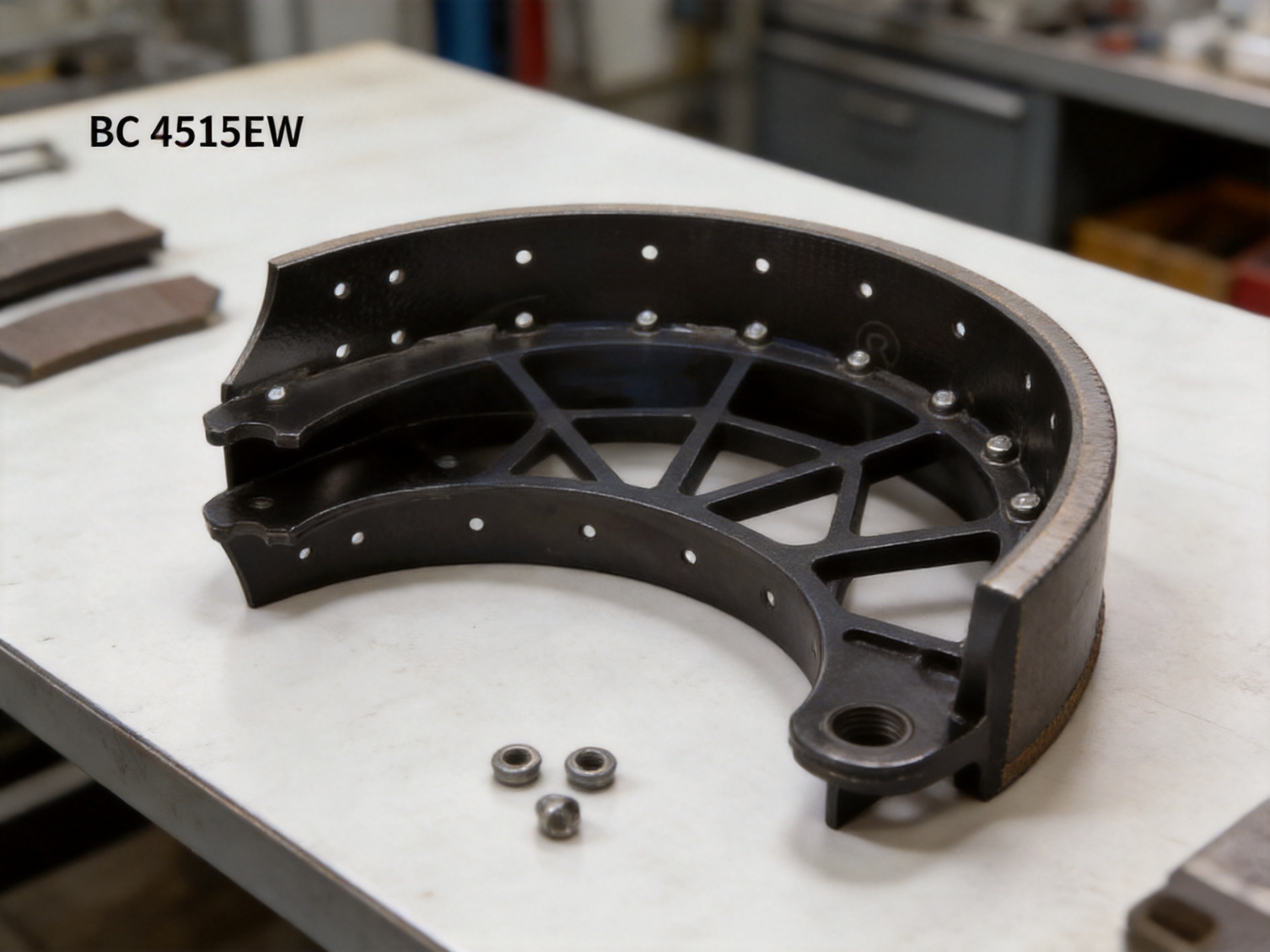
The 4515E Brake Shoe includes 32 rivet holes. This specification is not a minor detail. Rivet-hole placement affects lining attachment, clamping consistency, stress distribution, and assembly efficiency. If the holes are not accurately positioned, the lining may require forceful adjustment during installation. This can introduce stress into the lining material or create uneven contact between the lining and shoe table.
A 32-hole pattern provides multiple secure fastening points. During braking, the lining experiences shear forces, vibration, heat expansion, and pressure against the drum. Rivets help keep the lining properly seated on the shoe. When holes are correctly punched or drilled, rivets can be installed uniformly, reducing the risk of looseness, lining shift, or localized cracking.
Competitor products with poorly controlled hole patterns may cause technicians to spend extra time aligning parts. In some cases, minor hole mismatch can damage the lining during riveting. In severe cases, incorrect hole alignment may compromise the integrity of the lined shoe assembly. The 4515E Brake Shoe addresses this issue through attention to standardized hole geometry and manufacturing repeatability.
For lined brake shoe kits, rivet-hole precision also supports consistent production. When brake lining is attached during factory assembly, automated or semi-automated riveting depends on accurate hole positions. A consistent steel shoe foundation helps produce stable lined assemblies with reduced variation from piece to piece.
Competitive Advantages Over Ordinary Brake Shoes
The 4515E Brake Shoe provides competitive advantages in several areas: structural reliability, manufacturing consistency, serviceability, inventory compatibility, and value over the full product lifecycle. While many brake shoes may meet basic appearance requirements, performance in heavy-duty service depends on deeper factors such as steel quality, forming accuracy, weld integrity, surface treatment, and quality control.
Compared with lower-grade brake shoes, the 4515E model is designed to offer better dimensional stability. A shoe that maintains its shape helps the lining contact the drum more evenly. This can contribute to smoother braking, more uniform wear, and reduced risk of hot spots. Dimensional stability also supports repeatable installation, which is critical for professional repair shops and fleet maintenance centers.
Compared with products that lack consistent hole placement, the 4515E’s 32-rivet-hole configuration supports secure and orderly lining attachment. This improves assembly quality and can reduce rework. For distributors supplying brake shoe repair kits or lined brake shoe kits, this consistency can reduce customer complaints and improve confidence in repeat orders.
Compared with some casted brake shoes, a steel brake shoe can provide advantages in process repeatability and weight management. Casted shoes may be appropriate for certain applications, but casting quality depends heavily on mold condition, material control, cooling behavior, and defect management. Steel brake shoes, when manufactured through controlled forming and welding processes, can achieve strong consistency across production batches.
Compared with low-cost parts that prioritize price alone, the 4515E Brake Shoe is positioned as a practical value product. In heavy-duty braking, the cheapest component is not always the lowest-cost solution. If a brake shoe causes premature lining wear, difficult installation, vibration, or downtime, the total cost to the fleet increases. A reliable brake shoe helps reduce hidden costs by supporting predictable service performance.
Manufacturing Strength Behind the Product
Zhejiang Bangchi Auto Parts Co., Ltd. manufactures heavy-duty brake parts with an emphasis on OEM-style requirements and global FMSI numbering system compatibility. In the brake parts industry, manufacturing strength is demonstrated through stable processes, accurate tooling, disciplined inspection, reliable material handling, and the ability to produce components that meet repeatable dimensional expectations.
The production of a steel brake shoe such as the 4515E requires multiple coordinated manufacturing stages. These may include steel material selection, cutting or blanking, forming, web and table preparation, welding, rivet-hole punching or drilling, deburring, surface treatment, final inspection, packaging, and batch traceability. Each stage affects the final brake shoe’s performance and usability.
A strong manufacturer does not rely on final inspection alone. Instead, quality is built into each operation. Tooling must be maintained so that formed parts remain consistent. Welding parameters must be controlled so that the shoe structure has adequate strength and alignment. Hole-making processes must preserve location accuracy. Surface treatment must be applied evenly to help protect the steel during storage and service exposure.
For professional buyers, the manufacturer’s process capability is as important as the product specification. A brake shoe can look acceptable in a catalog photo, but only controlled production can ensure that every shipment matches expectations. The 4515E Brake Shoe benefits from a manufacturing approach centered on repeatability and compatibility with heavy-duty brake market requirements.
Material Selection and Steel Preparation
The foundation of a steel brake shoe is the quality of the steel itself. Steel used for heavy-duty brake components must provide sufficient strength, formability, weldability, and fatigue resistance. If the steel is too brittle, it may crack during forming or under repeated stress. If it is too soft or inconsistent, the finished shoe may deform more easily. Therefore, material selection is the first step in building a dependable brake shoe.
Steel preparation may include cutting sheets or sections to specified dimensions, verifying thickness, and preparing surfaces for downstream forming and welding. Consistency at this stage helps ensure that subsequent operations produce predictable results. For the 4515E Brake Shoe, stable steel preparation supports the target 16.5-inch by 7-inch geometry and the strength needed for heavy-duty braking.
Competitor products made with inconsistent or poorly controlled steel may vary in stiffness, weight, or service durability. Such differences may not be obvious during initial inspection but can become evident after repeated braking cycles. A manufacturer that emphasizes controlled material sourcing and preparation provides buyers with a more dependable product platform.
Good steel preparation also supports cleaner welding and coating. Contaminated, uneven, or improperly prepared surfaces can reduce weld quality and affect surface treatment adhesion. In brake shoe manufacturing, each stage builds on the previous one, so careful material preparation contributes directly to final product quality.
Precision Forming for Brake Shoe Geometry
The curved shape of a brake shoe must correspond closely to the drum brake design. Precision forming is therefore one of the most important production steps. The shoe table must present the correct arc for lining attachment, and the web must support the table without twisting or misalignment. If forming is inaccurate, the lined shoe may not seat correctly in the brake drum.
During forming, controlled pressure, tooling accuracy, and process repeatability are essential. The manufacturer must account for steel springback, thickness variation, and the relationship between different shoe features. Experienced production teams use dedicated tooling and inspection procedures to confirm that formed components remain within intended tolerances.
The 4515E Brake Shoe’s value depends heavily on this geometric control. A consistent arc supports more uniform lining contact after proper bedding. It can help reduce uneven wear and improve braking stability. For service technicians, a correctly formed shoe is easier to install and less likely to create fitment concerns.
Compared with ordinary shoes made with worn tooling or loose forming controls, a precisely formed steel brake shoe offers better repeatability. This advantage is especially important for distributors supplying multiple customers across different regions. When each batch performs consistently, customers can trust the part number and reduce inspection burden.
Welding Integrity and Structural Stability
Steel brake shoes typically involve joined components, and welding quality plays a major role in structural stability. Welded areas must resist vibration, braking loads, and thermal cycling. Weak or inconsistent welds can lead to premature failure, noise, or deformation. For a heavy-duty brake shoe, welding is not simply a production step; it is a core safety-related process.
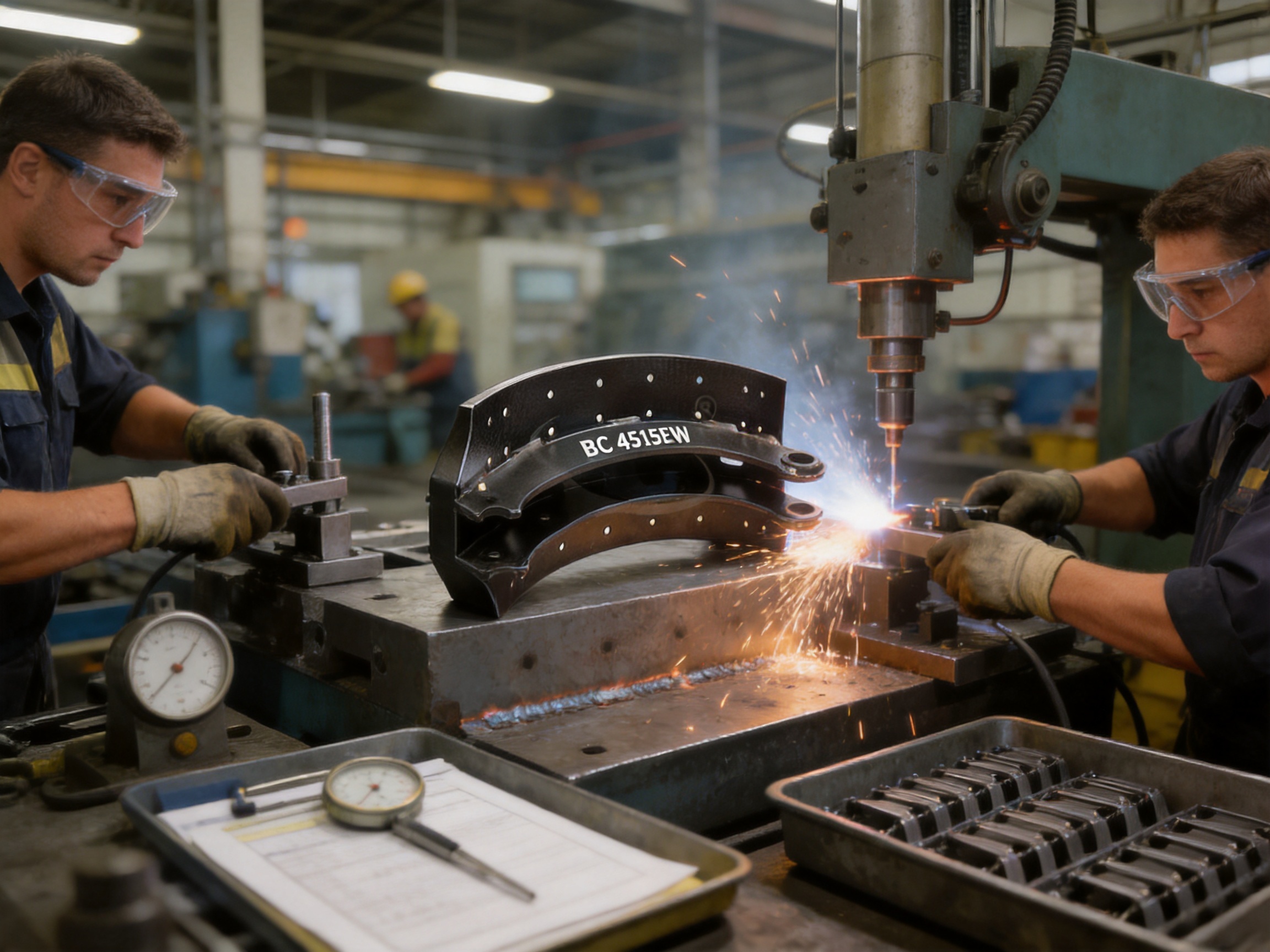
Strong manufacturing operations control weld parameters such as current, pressure, time, alignment, and fixture accuracy. Proper fixturing helps hold the shoe components in the correct position during welding. This reduces distortion and supports dimensional consistency. After welding, inspection may include visual checks, dimensional checks, and process-based verification.
The 4515E Brake Shoe is designed to provide a stable structure for heavy-duty use. Welding integrity supports the shoe’s ability to carry the brake lining and transmit braking force without unwanted flexing or separation. In competitive comparisons, this is a meaningful advantage because low-quality welds may not be visible after coating but can affect durability.
Structural stability also improves relining potential. If a steel shoe remains straight, properly welded, and free from unacceptable wear or damage, it may be suitable for service programs that inspect and reline brake shoes. A stable original structure supports better lifecycle value for maintenance-focused customers.
Hole-Making, Deburring, and Assembly Readiness
The 32 rivet holes in the 4515E Brake Shoe must be accurately made and properly finished. Hole-making can be performed through punching, drilling, or other controlled processes depending on production design. Regardless of method, the result must be clean, correctly positioned, and suitable for rivet installation.
Deburring is an often-overlooked step that affects assembly quality. Sharp edges or burrs around rivet holes can interfere with lining placement, damage rivets, or create stress points. A well-finished brake shoe allows the lining to sit flat and supports clean riveting. This is particularly important for lined brake shoe kits, where assembly speed and consistency matter.
Ordinary low-cost brake shoes may cut corners in hole finishing. While this may reduce production time, it can create problems during lining installation. Technicians may need extra time to clean holes, adjust alignment, or correct surface irregularities. The 4515E Brake Shoe’s focus on assembly readiness helps reduce such issues and contributes to smoother workflow in repair and production environments.
Assembly readiness is a practical advantage. A brake shoe should arrive ready to be lined, installed, or integrated into a kit according to its intended configuration. The less correction required by the customer, the greater the product’s real value.
Surface Treatment and Corrosion Protection
Brake shoes are often stored, shipped, and operated in environments where moisture, road salt, dust, and temperature changes are common. Corrosion can affect appearance, handling, and long-term durability. Surface treatment helps protect the steel shoe before and during service. It also improves product presentation for distributors and end users.
A controlled surface treatment process may include cleaning, pretreatment, coating, drying, and inspection. The goal is to provide consistent coverage without interfering with fitment or lining attachment. Coating thickness and adhesion should be suitable for the product’s intended use. Excessive coating in critical areas can affect assembly, while insufficient coating may reduce corrosion resistance.
The 4515E Brake Shoe benefits from manufacturing attention to surface condition. A clean and protected shoe is easier to handle, store, and assemble. For distributors, consistent surface quality helps maintain inventory value. For repair shops, it reduces the need for additional preparation before lining or installation.
Compared with competitor products that have uneven coating or exposed bare steel, a properly treated brake shoe offers better storage stability and a more professional finish. This matters not only for appearance but also for customer confidence. In heavy-duty brake parts, visible quality often reflects deeper process discipline.
Compatibility With Lined Brake Shoe Programs
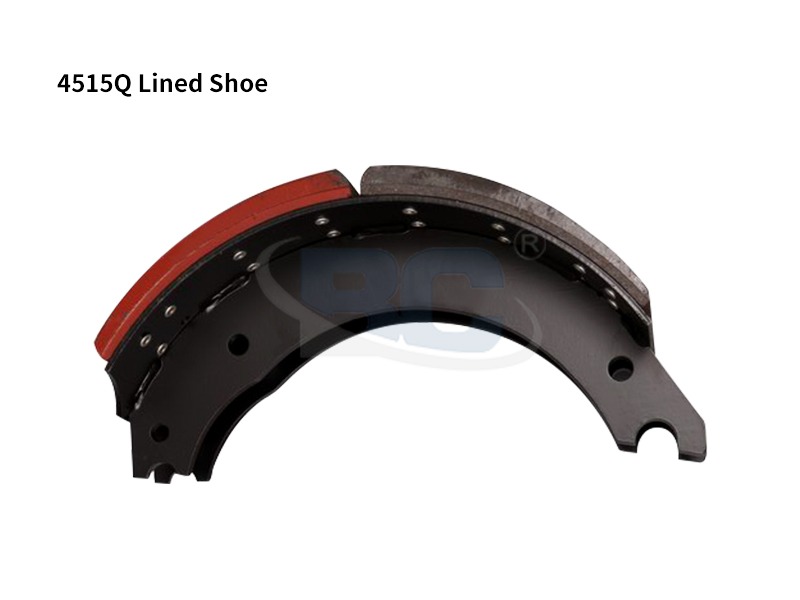
The product categories associated with this brake shoe include steel brake shoe, casted brake shoe, brake lining, lined brake shoe, brake shoe repair kits, and lined brake shoe kits. The 4515E steel brake shoe fits naturally into these product ecosystems. It can serve as the metal base for a lined brake shoe or as a component in repair and relining programs.
For lined brake shoe production, the shoe must provide a reliable platform for friction material. The table surface should support proper lining seating, and the rivet holes should align with the lining pattern. The 4515E’s 32-hole configuration helps create a secure mechanical bond when appropriate rivets and lining materials are used.
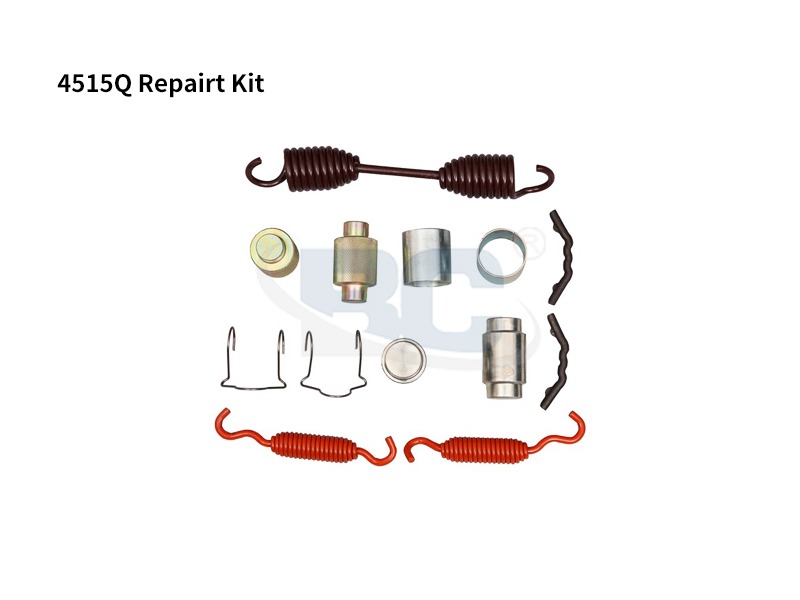
For brake shoe repair kits, consistent shoe geometry helps ensure that related components fit correctly. A repair kit is only as useful as the compatibility of its parts. If the shoe requires modification or does not match the expected hardware layout, the kit loses efficiency. The 4515E’s standardized heavy-duty configuration helps support kit-based service strategies.
For distributors, offering a brake shoe that can be sold as an unlined shoe, lined shoe, or part of a kit increases flexibility. Customers may have different preferences depending on labor cost, local regulations, fleet policy, or lining material requirements. A dependable steel shoe foundation allows the same product platform to serve multiple market needs.
Role in Heavy Truck Brake Performance
Heavy truck brakes must provide controlled stopping power under high loads. Brake performance depends on many factors, including air system condition, camshaft and slack adjuster function, drum condition, lining formulation, and brake shoe geometry. The brake shoe’s role is to support the lining and maintain the correct contact relationship with the drum.
When the brake actuator applies force, the shoe expands outward and presses the lining against the drum. The shoe must withstand this force without excessive distortion. If the shoe flexes unevenly, the lining may contact the drum in patches rather than across the intended surface. This can reduce braking efficiency and accelerate wear.
The 4515E Brake Shoe is designed for the heavy-duty environment where stability and repeatability are essential. Its steel construction provides a strong base for the lining, and its defined size supports compatibility with common heavy truck brake systems. When properly installed and maintained, it contributes to balanced brake operation and predictable service outcomes.
For fleet managers, predictable braking performance is directly linked to safety and operating cost. Brake-related downtime can disrupt delivery schedules, increase labor expense, and create compliance concerns. A reliable brake shoe helps support a preventive maintenance approach by reducing unexpected problems associated with poor fitment or weak construction.
Serviceability and Maintenance Value
Serviceability is a major advantage of a well-designed steel brake shoe. Heavy-duty vehicles require regular brake inspections, lining replacement, and hardware maintenance. Components that are easy to identify, install, and reline help reduce labor time and improve maintenance efficiency.
The 4515E Brake Shoe’s part number, size, and rivet-hole specification support clear identification. This makes it easier for parts departments to stock and issue the correct component. In busy repair environments, clear part matching helps prevent installation delays and reduces the risk of using an incorrect brake shoe.
Maintenance value also comes from durability. A brake shoe that resists distortion and remains structurally sound can support longer service usefulness when inspected properly. While brake linings are consumable friction parts, the shoe itself is expected to provide a stable foundation. A stronger shoe can improve lifecycle value by reducing premature replacement caused by structural issues.
Compared with competitor shoes that require extra preparation, correction, or frequent rejection, the 4515E Brake Shoe can offer lower total maintenance cost. It may not always be the cheapest option at the point of purchase, but its value appears in smoother installation, fewer fitment complaints, and more consistent service outcomes.
Inventory Benefits for Distributors and Fleets
Brake parts distributors need products that are easy to catalog, stock, and supply. The 4515E Brake Shoe supports this need through its defined part number and standard heavy-duty size. A product that follows recognized brake shoe identification practices is easier to integrate into inventory systems and customer ordering processes.
Fleets also benefit from standardization. When a fleet uses common brake platforms, stocking reliable replacement shoes reduces downtime. Maintenance teams can plan brake jobs with confidence, knowing that the shoe dimensions and rivet-hole layout are consistent. This reduces the risk of work stoppages caused by part mismatch.
The availability of related product categories, such as brake lining, lined brake shoes, brake shoe repair kits, and lined brake shoe kits, further supports inventory flexibility. Customers can select the level of assembly that best fits their labor resources and maintenance strategy. Some may prefer unlined shoes for custom lining selection, while others may prefer factory-lined assemblies for speed and consistency.
For international distributors, compatibility with global FMSI numbering practices is valuable. It helps align product identification across markets and reduces confusion when customers request heavy-duty brake parts. Zhejiang Bangchi Auto Parts Co., Ltd. emphasizes OEM brake parts following the global FMSI numbering system, which supports professional cataloging and cross-reference management.
Quality Control Throughout Production
Quality control for a heavy-duty brake shoe must include both process control and final inspection. Process control ensures that each production step remains stable, while final inspection verifies that the finished product meets requirements. For the 4515E Brake Shoe, relevant quality checks may include dimensional inspection, rivet-hole position verification, weld quality inspection, surface condition review, and packaging checks.
Dimensional inspection confirms that the shoe geometry supports fitment. Rivet-hole checks confirm that the 32-hole pattern is suitable for lining attachment. Weld inspection helps verify structural reliability. Surface inspection confirms that the shoe is clean, properly treated, and ready for shipment or assembly. Packaging checks help protect the product during transport.
A strong quality system also depends on trained personnel and documented procedures. Operators must understand the importance of critical dimensions and process settings. Inspectors must know how to identify unacceptable defects. Production managers must maintain tooling, monitor batch consistency, and address deviations quickly.
Compared with suppliers that rely mainly on visual inspection, a process-oriented manufacturer offers greater confidence. Heavy-duty brake components require repeatability, not just occasional good parts. The 4515E Brake Shoe’s competitive position is strengthened by manufacturing discipline that supports consistent output.
Packaging, Handling, and Logistics Considerations
Packaging is part of product quality because brake shoes are heavy metal components that can be damaged, scratched, or corroded if handled poorly. Proper packaging helps protect the shoe’s surface treatment, prevents deformation during transport, and keeps shipments organized. For distributors, good packaging also improves warehouse handling and customer presentation.
The 4515E Brake Shoe should be handled as a precision-formed heavy-duty component. Although it is strong, unnecessary impact or poor stacking can affect finish or geometry. Manufacturers with export experience understand the need for packaging that supports long-distance shipment, warehouse storage, and efficient unpacking.
Logistics reliability is important for customers who operate scheduled maintenance programs. If brake parts arrive damaged, delayed, or inconsistently packed, service planning suffers. A manufacturer with organized production and shipment processes helps customers maintain stable supply chains.
For international buyers, communication and documentation are also important. Clear part numbers, product descriptions, specifications, and packaging labels reduce confusion. The 4515EW part number and 16.5-inch by 7-inch size provide clear identifiers for ordering and receiving departments.
Application Scenarios
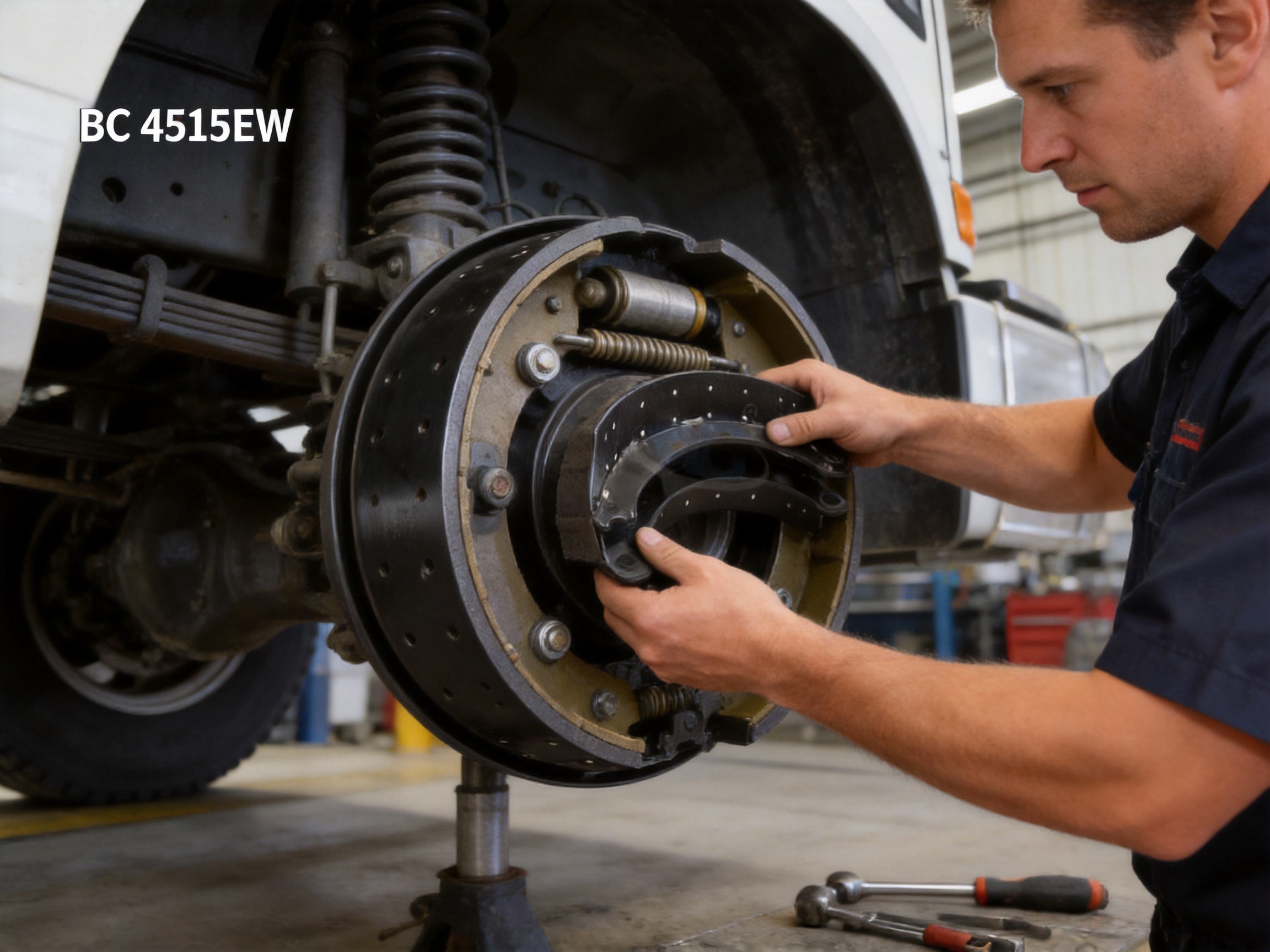
The 4515E Brake Shoe is suitable for heavy-duty drum brake service where the specified size and configuration match the vehicle system. Typical application scenarios include truck maintenance, trailer brake repair, fleet brake programs, brake shoe relining operations, aftermarket distribution, and lined brake shoe kit production.
In truck maintenance, the shoe may be used during scheduled brake replacement when linings reach wear limits or when brake components are renewed as part of axle service. In trailer brake repair, the shoe supports consistent braking across multiple axles, which is important for vehicle stability and regulatory compliance. In fleet programs, standardized brake shoes help simplify parts management.
In relining operations, the 4515E steel shoe provides the base for attaching new friction material. The 32 rivet holes support secure fastening when the correct lining and rivets are used. In aftermarket distribution, the shoe can be supplied as a replacement component for customers who need dependable heavy-duty brake parts.
In lined brake shoe kit production, the shoe becomes part of a more complete solution. By combining the steel shoe with suitable lining and related hardware, suppliers can offer technicians a convenient installation-ready package. This improves service speed and reduces the need to source separate components.
Installation and Use Considerations
Correct installation is essential for any brake shoe. Even a well-manufactured product must be used with compatible brake hardware and installed according to professional service procedures. Before installation, technicians should confirm part number, size, rivet-hole pattern, lining compatibility, drum condition, and hardware condition.
If the brake shoe is supplied unlined, the selected lining must be appropriate for the vehicle duty cycle and braking requirements. Rivets should match the lining and shoe specifications, and riveting should be performed with suitable equipment. The lining should seat properly against the shoe table, and rivets should be formed securely without cracking the lining.
If the brake shoe is supplied as part of a lined assembly, technicians should inspect the lining surface, rivets, shoe geometry, and coating condition before installation. The brake drum should also be checked for wear, scoring, heat checking, out-of-round condition, and diameter limits. Installing new or relined shoes in a damaged drum can reduce performance and shorten service life.
Brake hardware such as return springs, rollers, anchor pins, bushings, and camshaft components should be inspected and replaced if worn. A brake shoe works as part of a system, and worn hardware can cause uneven force distribution or dragging brakes. Proper adjustment and bedding procedures should be followed after installation.
Safety and Compliance Perspective
Heavy-duty brake systems are directly related to vehicle safety. Brake shoes must be selected, installed, and maintained responsibly. The 4515E Brake Shoe provides a strong product foundation, but safety also depends on correct application matching, qualified installation, and periodic inspection.
Commercial vehicle operators often face regulatory inspections that include brake condition, adjustment, and component integrity. A brake shoe with consistent dimensions and reliable construction supports compliance efforts by reducing the likelihood of fitment-related problems. However, maintenance teams must still monitor lining thickness, drum condition, brake balance, and air system performance.
Using brake parts that follow recognized identification systems helps reduce application errors. The global FMSI numbering approach supports more accurate part matching across markets. For distributors and fleets, this is an important risk-reduction factor because incorrect brake components can compromise safety and increase liability.
The 4515E Brake Shoe should be treated as a safety-critical component. It should not be modified casually, forced into incompatible systems, or used with damaged brake hardware. Proper selection and professional installation allow the product’s manufacturing advantages to translate into real-world performance.
Why Choose This Product for Heavy-Duty Brake Programs
The 4515E Brake Shoe is a strong choice for heavy-duty brake programs because it combines a recognized size, steel construction, 32-hole lining attachment capability, and manufacturing consistency. It is suitable for buyers who need more than a basic replacement part. It is intended for users who value predictable fitment, stable structure, and professional service performance.
For fleets, the product supports maintenance efficiency and brake system reliability. For repair shops, it offers assembly readiness and reduced installation uncertainty. For distributors, it provides a catalog-friendly heavy-duty brake shoe that can be positioned in steel brake shoe, lined brake shoe, and repair kit programs. For OEM-oriented customers, its compatibility with global numbering practices supports organized sourcing.
The product’s competitive advantage is not based on one feature alone. It comes from the combination of controlled steel forming, accurate rivet-hole layout, structural stability, surface protection, and quality management. In heavy-duty braking, the best product is often the one that performs consistently across many installations rather than the one that simply looks similar to a standard part.
Zhejiang Bangchi Auto Parts Co., Ltd. brings manufacturing capability to this product through its focus on heavy-duty brake parts and heavy truck brakes. By supplying OEM brake parts aligned with global FMSI numbering, the company supports customers who require dependable identification, repeatable production, and export-ready supply.
Comparison With Common Alternatives
When comparing the 4515E Brake Shoe with alternatives, buyers should consider more than purchase price. Important comparison points include material consistency, dimensional accuracy, rivet-hole quality, coating uniformity, packaging, supplier reliability, and availability of related brake products. These factors influence total cost and customer satisfaction.
A lower-cost shoe may appear attractive but can create hidden costs if it causes installation delays, requires rework, or wears unevenly. A casted shoe may be suitable for certain systems, but buyers should evaluate weight, casting quality, and dimensional repeatability. An unverified product may create application uncertainty if it does not follow recognized numbering practices.
The 4515E Brake Shoe offers a balanced solution. Its steel construction provides a serviceable and consistent foundation. Its 16.5-inch by 7-inch specification matches a common heavy-duty platform. Its 32 rivet holes support secure lining attachment. Its manufacturing background supports batch consistency and supply reliability.
In competitive aftermarket environments, customer loyalty often depends on whether parts fit correctly the first time. A brake shoe that reduces complaints and supports smooth service can strengthen a distributor’s reputation. The 4515E Brake Shoe is designed to support that outcome.
Q&A Section
What is the 4515E Brake Shoe?
The 4515E Brake Shoe is a heavy-duty steel brake shoe for drum brake systems. Its listed part number is 4515EW, and it is designed around a 16.5-inch by 7-inch size with 32 rivet holes for brake lining attachment.
What type of vehicle is this brake shoe intended for?
It is intended for heavy-duty truck, trailer, and commercial vehicle drum brake applications where the specified size and configuration match the brake system. Final application should always be confirmed by part number, dimensions, and system compatibility.
Why is steel construction important?
Steel construction can provide strong dimensional consistency, good strength-to-weight performance, repairability, and suitability for relining programs. A well-made steel shoe provides a stable foundation for the brake lining and supports predictable braking behavior.
What does the 32-rivet-hole design provide?
The 32 rivet holes provide multiple fastening points for attaching brake lining material. Accurate hole placement helps improve lining security, supports even load distribution, and makes assembly or relining more efficient.
How does this product compare with ordinary low-cost brake shoes?
The 4515E Brake Shoe is positioned to offer better consistency in geometry, rivet-hole alignment, structural stability, and assembly readiness. These advantages can reduce installation problems and lower hidden maintenance costs compared with poorly controlled alternatives.
Can this brake shoe be used in lined brake shoe kits?
Yes, it can serve as the steel foundation for lined brake shoe assemblies or kits when paired with compatible lining material, rivets, and related hardware. Correct assembly procedures must be followed.
Why is dimensional accuracy so important?
Dimensional accuracy affects fitment, lining contact, braking smoothness, and wear pattern. If a brake shoe is distorted or incorrectly formed, the lining may not contact the drum evenly, which can reduce performance and service life.
What should technicians check before installation?
Technicians should verify part number, size, rivet-hole pattern, lining compatibility, drum condition, brake hardware condition, and system fitment. Worn springs, rollers, anchor pins, drums, or camshaft components should be addressed during service.
Does the product follow a recognized numbering approach?
The manufacturer provides OEM brake parts following the global FMSI numbering system, which helps buyers, distributors, and service providers manage product identification and cross-reference requirements.
What is the main value of the 4515E Brake Shoe?
Its main value is the combination of heavy-duty steel construction, standardized 16.5-inch by 7-inch size, 32-hole lining attachment design, manufacturing consistency, and suitability for professional brake service programs.
Conclusion
The 4515E Brake Shoe is a practical and dependable steel brake shoe designed for heavy-duty drum brake systems. With part number 4515EW, a 16.5-inch by 7-inch size, and 32 rivet holes, it provides the specifications needed for many heavy truck and trailer brake applications. Its value comes from more than its dimensions; it is built to support stable lining attachment, reliable fitment, structural strength, and efficient service.
In a competitive market, brake shoes can look similar but perform very differently. The 4515E Brake Shoe stands out through its focus on steel construction, geometry control, rivet-hole accuracy, surface quality, and manufacturing repeatability. These features help reduce installation problems, improve maintenance efficiency, and support consistent brake performance when the product is correctly applied and installed.
Zhejiang Bangchi Auto Parts Co., Ltd. supports this product with manufacturing capabilities aligned with heavy-duty brake parts and heavy truck brake requirements. By offering products that follow global FMSI numbering practices, the company helps distributors, fleets, and repair professionals source brake components with greater confidence.
For buyers seeking a steel brake shoe that can support lined brake shoe assemblies, repair kits, relining programs, and heavy-duty replacement needs, the 4515E Brake Shoe is a strong product choice. It delivers the essential qualities that professional brake programs require: fitment confidence, structural reliability, assembly readiness, and long-term maintenance value.
References
Brake Manufacturers Council. Recommended Practices for Heavy-Duty Drum Brake Service and Maintenance.
Technology and Maintenance Council. Recommended Maintenance Practices for Commercial Vehicle Brake Systems.
SAE International. Technical Literature on Commercial Vehicle Foundation Brake Components.
Federal Motor Carrier Safety Administration. Commercial Motor Vehicle Brake Inspection and Maintenance Guidance.
FMSI Brake Standards. Heavy-Duty Brake Shoe and Friction Material Identification References.
Limpert, Rudolf. Brake Design and Safety. Society of Automotive Engineers.
Gilles, Tim. Automotive Chassis: Brakes, Suspension, and Steering. Technical Education Reference.