 English
 简体中文
简体中文
In commercial vehicle braking systems, the brake shoe is a fundamental structural component. It supports the friction lining, transfers braking force to the drum, and contributes directly to braking stability, heat management, service life, and maintenance cost. For heavy-duty trailers, semi-trailers, and trucks, the brake shoe must perform reliably under repeated high loads, long operating hours, changing road conditions, and demanding maintenance schedules.
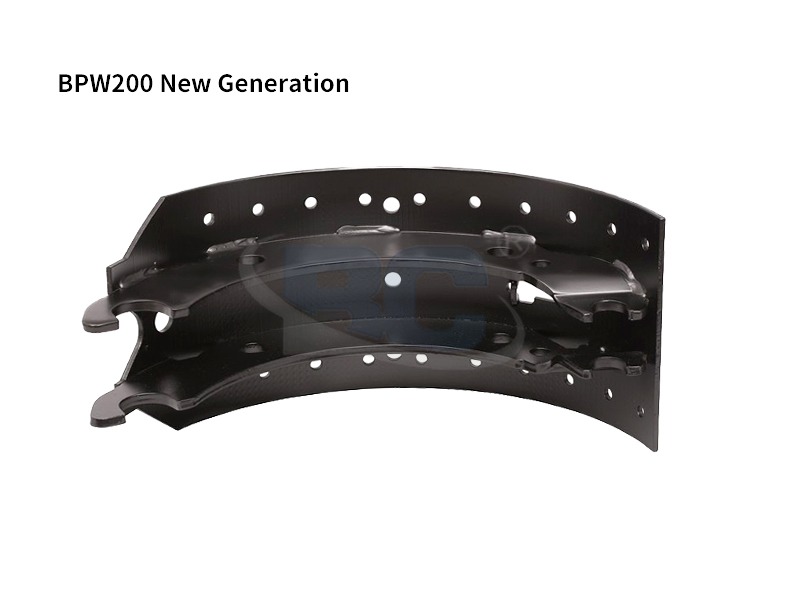
The 0509127830 brake shoe, identified as the BPW200 New Generation model, is designed for this type of application. It has a stated product size of 420 × 200 millimeters, a 20-rivet-hole configuration, and a steel substrate that can be supplied in customized material grades. The design is intended for modern heavy-duty axle and drum-brake systems where consistent lining support, accurate fitment, and dependable mechanical strength are essential.
Manufactured by Zhejiang Bangchi Auto Parts Co., Ltd., the product forms part of a broader range of heavy-duty brake components that includes steel brake shoes, casted brake shoes, brake linings, lined brake shoes, brake shoe repair kits, and lined brake shoe kits. The company positions its products for original equipment and replacement markets and follows the global FMSI numbering system for brake-part identification.
This article examines the construction, technical characteristics, applications, advantages, manufacturing considerations, quality controls, installation requirements, and purchasing value of the 0509127830 BPW200 New Generation brake shoe.
Product Overview
The BPW200 New Generation brake shoe is a steel brake shoe intended for heavy-duty drum-brake assemblies. Its main reference number is 0509127830, while BPW200 New Generation identifies the associated design and application family. The 420 × 200 millimeter dimensions provide a substantial working platform for supporting a brake lining designed for commercial vehicle service.
The shoe incorporates 20 rivet holes. This hole pattern is important because it allows the lining to be secured at multiple points along the shoe. When the rivets are correctly installed, the distributed fastening pattern can help maintain even contact between the lining and the shoe throughout the braking cycle. It also helps reduce localized movement, lifting, or stress concentration that may occur when a lining is inadequately supported.
The primary material is steel, although customized steel grades and surface treatments are available according to project requirements. Steel provides the structural stiffness needed to resist deformation during braking. It also offers a suitable foundation for transferring the mechanical force generated by the brake actuator to the lining and then to the drum.
For fleet operators, distributors, and brake-system assemblers, the product provides a practical balance between standardization and customization. The standard 420 × 200 millimeter configuration supports repeat purchasing and replacement planning, while customized material grades, coatings, hole patterns, and friction-material combinations can be discussed for specific original equipment or special-service requirements.
Key Technical Specifications
| Specification | Product Information |
|---|---|
| Product reference | 0509127830 |
| Design designation | BPW200 New Generation |
| Product category | Steel brake shoe |
| Nominal dimensions | 420 × 200 millimeters |
| Number of rivet holes | 20 |
| Rivet-hole diameter in stated technical data | 9.0 millimeters |
| Base material | Steel |
| Material option | Customized steel grades and surface treatments |
| Stated friction coefficient range | 0.40–0.45, depending on the selected lining material |
| Stated maximum operating temperature | Up to 500°C under specified conditions |
| Primary applications | Heavy-duty trailers, semi-trailers, and commercial trucks |
The values in this table should be evaluated together with the complete axle, drum, lining, and vehicle specification. A brake shoe is not an independent braking system. Correct performance depends on dimensional compatibility, lining selection, rivet quality, brake-drum condition, actuator adjustment, wheel-end maintenance, and operating temperature.
Why the Brake Shoe Design Matters
During braking, the actuator pushes the brake shoe outward until the lining contacts the inner surface of the drum. The resulting friction converts kinetic energy into heat and slows the vehicle. The shoe must therefore withstand repeated mechanical loading while preserving the correct relationship between the lining and the drum.
A poorly designed or inaccurately manufactured shoe may create several problems. Uneven contact can cause localized lining wear. Excessive flexibility can reduce braking consistency. Incorrect curvature can increase bedding time or produce high contact pressure in only a small area. Inaccurate rivet-hole placement can complicate assembly and weaken the lining attachment. Surface corrosion can reduce long-term durability, especially in vehicles exposed to water, road salt, dust, and changing temperatures.
The BPW200 configuration addresses these requirements through a broad 420 × 200 millimeter structure and a 20-hole fastening pattern. The design provides multiple attachment points for the lining and supports a stable assembly when matched with the correct drum and friction material. The steel substrate is intended to maintain structural integrity under the repeated loads associated with long-distance transport, distribution routes, mountainous roads, and frequent stop-and-go operation.
The “New Generation” designation also reflects an emphasis on updated geometry and modern production requirements. The product information describes optimized geometry intended to reduce stress concentrations, improved heat resistance, and protective surface treatment options. These characteristics are especially relevant to commercial vehicles, where brake components may experience long downhill descents, heavy payloads, repeated emergency stops, and limited opportunities for workshop intervention.
0509127830 BPW200 New Generation Brake Shoe
Advantages in Heavy-Duty Service
Uniform Lining Support
The 20-rivet-hole arrangement is one of the most important characteristics of the BPW200 brake shoe. A lining must remain firmly attached to the shoe throughout its service life. Multiple rivets distribute the fastening load over the length of the lining and help reduce the possibility of unsupported areas.
Uniform support can contribute to more consistent pressure distribution between the lining and the drum. When the lining contacts the drum more evenly, the assembly may provide smoother braking response and more predictable wear. This is valuable for fleet operators because uneven lining wear can increase inspection frequency, create heat concentration, and result in premature replacement.
High-Strength Steel Construction
Steel is used as the main structural material because it provides the strength and stiffness required for heavy-duty braking. The substrate must resist deformation as the brake actuator applies force. It must also tolerate thermal cycling as the assembly heats during braking and cools after the vehicle returns to normal operation.
Customized steel grades allow the manufacturer and customer to consider the specific service environment. A vehicle operating in a high-humidity coastal area may require a different protective treatment from a vehicle operating in a dry inland region. A heavy-haul application may prioritize structural strength and thermal stability, while a standard trailer fleet may focus on cost efficiency and reliable repeatability.
Thermal Performance
Brake drums and shoes operate in a challenging thermal environment. When a loaded vehicle descends a gradient or brakes repeatedly in urban traffic, the friction interface generates significant heat. If the heat is not managed properly, braking performance can decline, a condition commonly associated with brake fade.
The product information specifies a stated maximum operating temperature of up to 500°C under defined conditions and describes fade-resistant performance. Actual thermal behavior depends on the friction lining, drum condition, vehicle load, braking strategy, ventilation, adjustment, and ambient conditions. Nevertheless, a structurally stable shoe with suitable thermal conductivity provides a sound platform for managing these demands.
The steel substrate supports heat transfer away from the friction interface. Combined with a correctly specified lining and properly maintained drum, this can help reduce the risk of localized hot spots and support more stable performance during demanding operation.
Resistance to Wear and Corrosion
Commercial vehicles often operate in environments that accelerate corrosion. Water, mud, road salt, cleaning chemicals, and temperature changes can attack exposed steel surfaces. Corrosion may affect dimensional accuracy, weaken the substrate, or interfere with the reliable seating of the lining and rivets.
Protective coatings and surface treatments are available for the BPW200 platform. These options can improve resistance to environmental exposure and help preserve the condition of the shoe during storage and service. The appropriate coating should be selected according to the customer’s requirements and should not interfere with lining attachment, drum clearance, or other functional dimensions.
Reduced Stress Concentration
Brake shoes experience stress at several points, including the actuator contact area, anchor region, lining attachment points, and curved body. If the geometry is poorly controlled, stress may become concentrated in a small area. Over time, this can contribute to distortion, cracking, or inconsistent lining contact.
The BPW200 New Generation design is described as having optimized geometry intended to reduce stress concentrations. This approach is beneficial because it supports a more balanced transfer of force across the shoe. It also helps create a more stable platform for the lining, especially when the vehicle operates under high load or experiences repeated braking cycles.
Comparison with Lower-Quality Alternatives
Not all replacement brake shoes provide the same level of dimensional accuracy, material consistency, or manufacturing control. Some low-cost alternatives may appear similar at first glance but can differ in steel thickness, curvature, hole placement, surface finish, and heat-treatment quality. These differences may not be obvious until installation or field operation.
A lower-quality shoe may have an inconsistent arc that prevents the lining from bedding evenly against the drum. It may also have poorly formed rivet holes that make assembly difficult or create stress around the fastening points. If the shoe flexes excessively, the brake may require more adjustment and may deliver less predictable performance.
The BPW200 brake shoe is positioned as a more controlled alternative through its standardized dimensions, 20-hole configuration, steel construction, and availability of customized material and coating options. These characteristics help buyers evaluate the product using measurable criteria rather than relying only on visual similarity.
| Evaluation Area | BPW200 New Generation Approach | Potential Risk with an Uncontrolled Alternative |
|---|---|---|
| Dimensional consistency | Specified 420 × 200 millimeter format | Fitment problems or inconsistent drum clearance |
| Rivet-hole pattern | 20-hole configuration with stated 9.0 millimeter hole diameter | Assembly difficulty or uneven lining retention |
| Structural material | Steel substrate with customized grades available | Excessive flexing, distortion, or variable strength |
| Surface protection | Optional coatings and surface treatments | Earlier corrosion during storage or operation |
| Thermal capability | Designed for demanding drum-brake applications | Greater risk of heat-related performance decline |
| Application flexibility | Suitable for standard supply and customized projects | Limited ability to match special vehicle requirements |
Product selection should always be based on verified application data. The most expensive brake shoe is not automatically the best choice, and the least expensive component may create higher total cost through premature wear, installation delays, or unplanned vehicle downtime. The value of the BPW200 lies in combining repeatable production with options for different operating environments.
Applications and Vehicle Operating Conditions
Heavy-Duty Trailers and Semi-Trailers
The 0509127830 brake shoe is intended for next-generation trailer axle applications, including semi-trailers used in long-haul transportation and distribution. These vehicles may accumulate high annual mileage and experience substantial variation in payload. A brake shoe used in this environment must remain stable during both lightly loaded and fully loaded operation.
Trailer brake systems also operate under unique maintenance conditions. A trailer may be connected to different tractors, stored outdoors, and serviced by different workshops during its operating life. A standardized replacement shoe helps simplify inventory management and reduces uncertainty when repairs are required away from the fleet’s main facility.
Long-Haul Transport
Long-haul vehicles often face sustained highway speeds, extended downhill sections, and infrequent but intense braking events. The brake shoe must support a friction lining capable of handling high energy conversion without losing its attachment or creating abnormal wear.
The broad shoe structure and multi-rivet configuration are suitable for applications where dependable lining support and predictable braking are important. Fleet managers can combine the shoe with an appropriate lining compound selected for their normal load, route, climate, and maintenance practices.
Mountainous Routes
Mountain roads place additional demands on drum brakes. Descending grades can create repeated heat cycles, while curves and changes in elevation may require frequent braking. A properly specified steel shoe can contribute to stable mechanical support when paired with correct driver technique, auxiliary braking systems, and regular adjustment.
Brake shoes alone cannot eliminate the effects of excessive heat. Operators should use engine braking or other retarding systems when appropriate, avoid continuous brake application on long descents, and follow vehicle and axle manufacturer recommendations. The BPW200 is best understood as one component of a complete braking strategy.
Urban and Distribution Fleets
Distribution vehicles often make frequent stops and starts. This pattern produces repeated moderate braking events rather than only occasional high-speed stops. Such use can cause cumulative wear and may increase the importance of lining compatibility, drum condition, and routine inspection.
The 20-rivet-hole pattern and steel construction support the repeated operation expected in this type of service. Regular inspection remains essential because high stop frequency can wear the friction lining more quickly than highway operation, even when individual braking events are less severe.
Manufacturing Strengths of the Supplier
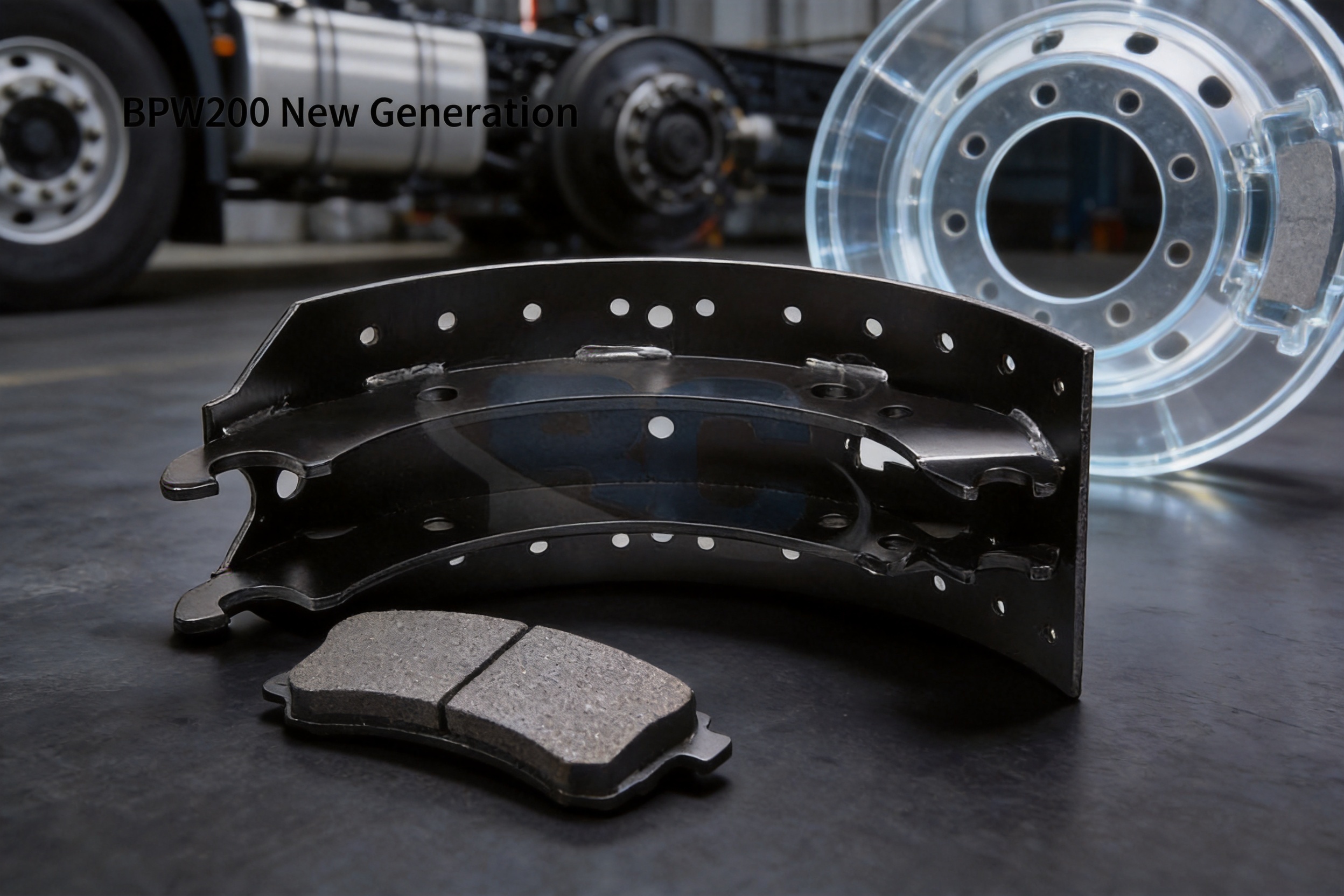
Zhejiang Bangchi Auto Parts Co., Ltd. is identified as a Chinese manufacturer and exporter of heavy-duty brake parts. Its product range covers several brake-component categories, allowing customers to source related products from one manufacturing organization. This breadth is useful for distributors and fleet suppliers that need steel shoes, casted shoes, linings, lined shoes, and repair kits under coordinated purchasing arrangements.
The company’s stated product approach follows the global FMSI numbering system. A consistent numbering structure helps buyers identify products, compare replacement requirements, maintain inventory records, and reduce confusion between similar brake components. For international customers, clear reference information is particularly important because vehicle specifications and aftermarket naming conventions may vary between regions.
Material Selection and Customization
Material selection is a central part of brake-shoe manufacturing. The steel must provide an appropriate balance of strength, formability, thermal behavior, and corrosion resistance. Different applications may justify different grades or treatments, so the ability to discuss customized material specifications can be a practical advantage.
Customization may include steel grade, surface treatment, coating, hole pattern, and friction-material combination. Such changes should be managed through documented drawings, approved samples, dimensional inspection, and application testing. A professional manufacturing process does not treat customization as an informal change; it treats it as a controlled engineering project.
Forming and Geometry Control
The curved profile of a brake shoe must correspond accurately with the intended drum and lining assembly. Forming operations must be controlled so that the shoe maintains its shape after production, handling, riveting, and thermal cycling. Excessive variation can affect contact pressure and bedding behavior.
Geometry control includes the shoe arc, width, thickness, actuator-contact areas, anchor regions, and rivet-hole locations. Inspection fixtures and dedicated gauges can help verify that each production batch remains within the agreed specification. This type of repeatability is especially important for export customers that purchase replacement components over an extended period.
Hole Positioning and Rivet Compatibility
The 20 rivet holes must be positioned accurately to match the intended lining. Hole diameter, spacing, edge distance, and perpendicularity all influence assembly quality. If the holes are misaligned, the rivets may not seat correctly, or the lining may be forced into a distorted position.
The stated technical data identifies a 9.0 millimeter rivet-hole diameter. Customers should confirm the final rivet and lining specification before production because rivet dimensions and lining designs may vary. Correct compatibility between the hole, rivet, tooling, and lining is essential for a secure finished assembly.
Surface Treatment and Corrosion Protection
Surface treatment can be used to improve the shoe’s resistance to corrosion during storage and service. A controlled treatment process should provide consistent coverage while preserving all functional interfaces. Areas associated with lining installation, drum clearance, actuator contact, and anchor movement require particular attention.
For customers operating in humid or corrosive environments, the coating specification should be included in the purchase documentation. Packaging and warehouse storage also influence corrosion performance. Even a well-treated steel shoe can be damaged by prolonged exposure to moisture, condensation, or aggressive chemicals before installation.
Inspection and Validation
Brake components require more than a visual inspection. A robust quality program may include incoming material verification, dimensional checks, hole-pattern inspection, surface-finish evaluation, hardness or mechanical testing where applicable, and final batch review. These controls help identify variation before products reach the customer.
The product information describes validation through extended dynamometer testing. Such testing can provide information about friction behavior, temperature response, wear, and repeated-cycle durability when the shoe is evaluated with an appropriate lining and drum combination. Test results should be interpreted according to the exact configuration because changing the lining compound or drum condition can influence performance.
For export and OEM-related projects, documentation is also part of manufacturing quality. Drawings, inspection reports, material certificates, packaging records, and traceability information can help customers verify that the delivered brake shoes match the approved specification.
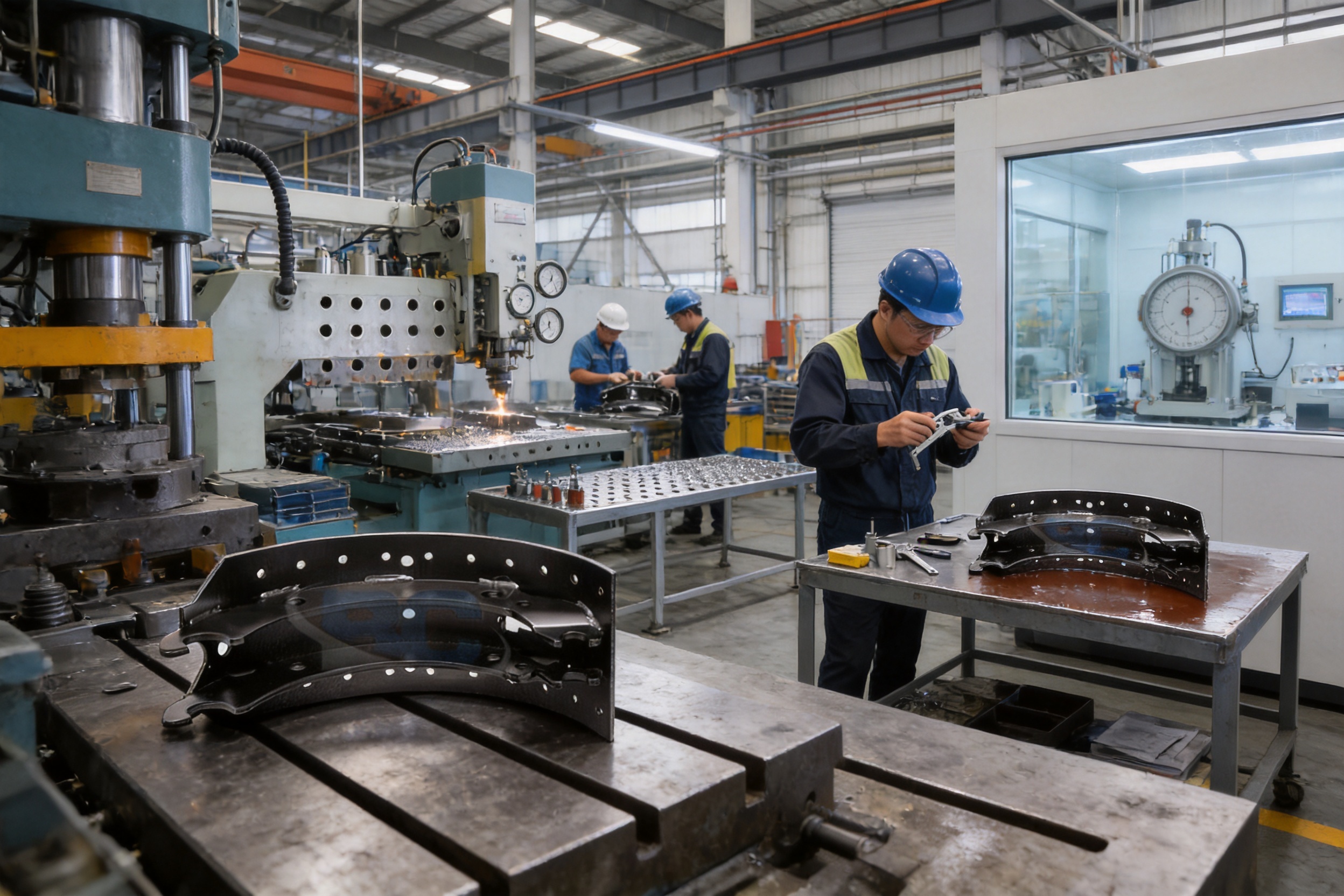
Production Process from Raw Material to Finished Component
Raw Material Preparation
Production begins with the selection and preparation of steel sheet, plate, or other approved material appropriate for the shoe design. The material should be checked for thickness, surface condition, composition, and mechanical characteristics according to the agreed specification.
Consistent raw material is important because changes in thickness or strength may affect forming behavior and final stiffness. Material identification and batch records also provide traceability if a customer later needs to review a production lot.
Blanking and Initial Forming
The steel is cut into blanks that reflect the basic outline of the brake shoe. Cutting accuracy affects the amount of material available for later forming and machining. The blanking stage must avoid excessive burrs, distortion, or edge damage.
After blanking, the component is formed into its curved shoe profile. Press-forming equipment and controlled tooling help establish the required radius and structural shape. The forming sequence should be designed to minimize springback and maintain repeatability across the production batch.
Hole Making and Finishing
The rivet holes are produced according to the approved 20-hole layout. Depending on the production method and volume, holes may be created through stamping, punching, drilling, or a combination of processes. The selected method should deliver clean edges and stable dimensions.
After hole production, burr removal and edge finishing are performed where required. Clean holes support more reliable rivet seating and reduce the chance that sharp edges will interfere with lining installation. Dimensional inspection verifies hole diameter and spacing before the shoe proceeds to surface treatment.
Surface Treatment
The formed and finished shoe may receive cleaning, pretreatment, coating, or another protective process. Surface preparation is important because contamination, oil, scale, or moisture can reduce coating adhesion. The treatment must be applied consistently and then dried or cured according to the process requirements.
Surface treatment is not only an aesthetic feature. It helps protect the component during transportation and storage and can extend resistance to environmental exposure. However, customers should confirm that the selected treatment is compatible with their assembly and service conditions.
Final Inspection and Packaging
Before shipment, the brake shoe should be checked for dimensions, hole pattern, surface condition, deformation, and visible defects. Packaging should protect the curved structure and finished surface from impact, moisture, and contamination.
Proper labeling is particularly important for international distribution. The product reference, design designation, quantity, batch information, and customer-specific identification can be included on the packaging documentation. Clear labeling reduces the risk of mixing similar products in warehouses and workshops.
Quality and Supply-Chain Benefits
For professional buyers, product quality is only one part of the purchasing decision. Supply continuity, response speed, customization capability, packaging, technical communication, and after-sales support also influence total value.
A manufacturer with a broader brake-parts portfolio can coordinate product development across related components. For example, a buyer may require a steel brake shoe for one axle program, a lined brake shoe for another, and repair kits for an existing fleet. A supplier capable of handling these categories may simplify qualification and purchasing administration.
The company’s location in Zhejiang, China, places it within a well-developed manufacturing region with access to industrial supply chains, metal-processing services, tooling resources, and export logistics. This infrastructure can support both standard products and customer-specific projects.
For distributors, customized packaging and private-label arrangements may also be discussed as part of a broader supply program. Any such arrangements should be established through formal specifications and approval procedures so that product identity and technical data remain clear throughout the distribution chain.
Installation Recommendations
Correct installation is essential to obtain the intended performance from any brake shoe. Before installation, technicians should verify the product reference, dimensions, hole pattern, lining compatibility, axle application, and drum specification. A component that is visually similar but not correctly matched should not be installed.
Inspecting the Brake Drum
The brake drum should be inspected before a new shoe or lined shoe is fitted. The technician should check for cracks, excessive scoring, heat checking, out-of-round conditions, excessive diameter, corrosion, and uneven wear. A damaged or excessively worn drum can prevent the new lining from bedding correctly and may shorten service life.
The drum should be measured using appropriate equipment. If the drum exceeds the permitted service diameter or has defects that cannot be corrected within specification, it should be replaced or professionally processed according to the axle manufacturer’s requirements.
Checking the Shoe and Lining
The shoe should be clean, correctly formed, and free from visible damage. Rivet holes should align with the lining holes without forcing. The lining should sit evenly on the shoe, with no gaps, cracks, contamination, or abnormal curvature.
When riveting is required, the rivets must be compatible with the hole diameter and lining specification. The supplied technical information refers to standard hydraulic or pneumatic riveting equipment with 9 millimeter dies. The exact tooling and riveting force should be confirmed with the lining and rivet supplier.
Riveting Sequence
Rivets should be installed in a controlled sequence so that the lining remains correctly positioned. A star or alternating pattern can help distribute clamping force and reduce the risk of pulling the lining toward one side. The rivet heads should be properly formed and seated without cracking the lining or deforming the shoe.
The provided product information recommends tightening rivets in a star pattern to 35–40 N·m. Because riveting practice varies by equipment and rivet design, this value should be treated as a product-specific recommendation that must be confirmed against the approved assembly procedure. Riveting is a forming operation rather than a conventional bolted joint, so the final rivet condition is more important than torque alone.
Bedding and Adjustment
A bedding period of approximately 150–250 kilometers is identified for the BPW200 application. During bedding, the lining gradually establishes a more complete contact pattern with the drum. Drivers should avoid unnecessary severe braking during this period while still following all road-safety requirements.
Brake adjustment should be checked after installation and during scheduled maintenance. Incorrect adjustment can create excessive clearance, delayed braking response, drag, or overheating. Technicians should follow the axle and brake-system manufacturer’s adjustment procedures rather than relying on a universal setting.
Maintenance and Service Inspection
Routine inspection helps operators identify wear before it becomes a safety or downtime issue. The product information recommends checking lining wear at 15,000-kilometer intervals. Actual inspection frequency should be adapted to vehicle load, route, braking intensity, climate, and fleet experience.
The lining should be replaced when it reaches the applicable minimum thickness. The supplied product information identifies 9 millimeters as the replacement threshold for the described application. Uneven wear, cracks, oil contamination, loose rivets, detached lining material, heat damage, and abnormal glazing are also reasons for immediate investigation.
Inspection should include the shoe itself. Technicians should look for distortion, cracks, excessive corrosion, damaged rivet holes, worn contact areas, and evidence of interference with other brake components. If the shoe has been overheated or mechanically damaged, replacing only the lining may not be appropriate.
Drum condition should be checked at the same time. A new lining installed against a damaged drum may produce poor contact and accelerated wear. The complete wheel-end assembly should be assessed as a system, including the actuator, slack adjuster, return springs, bearings, seals, and mounting points.
Total Cost of Ownership
Brake-shoe price is only one element of operating cost. A fleet should also consider installation labor, vehicle downtime, replacement frequency, lining wear, drum wear, inventory requirements, and the consequences of inconsistent braking performance.
A dimensionally consistent shoe can reduce installation time because technicians spend less time correcting fitment problems. A reliable rivet-hole pattern can simplify lining assembly. Stable structural performance can help avoid premature replacement caused by distortion or abnormal wear. Protective surface treatment can also reduce deterioration during storage, which is relevant for distributors carrying safety-critical inventory.
The 0509127830 BPW200 brake shoe supports a value-based purchasing approach. Its standard dimensions make it suitable for repeat replacement programs, while customization options allow customers to optimize material and coating requirements for their actual environment. When combined with appropriate lining selection and disciplined maintenance, these features may help reduce the total cost of ownership.
Ordering and Customization Considerations
Before ordering, customers should provide the complete product reference, axle type, drum diameter, shoe dimensions, rivet-hole count, lining requirements, quantity, packaging preferences, and intended operating conditions. If the product is part of an OEM program, engineering drawings and technical approval documents should be exchanged before mass production.
Customers requesting customized steel should identify the required mechanical characteristics, corrosion environment, temperature exposure, and forming requirements. If a special coating is needed, the specification should identify coating type, coverage, thickness, curing method, and any restrictions on functional surfaces.
Customized hole patterns should be supported by a drawing that clearly defines hole count, diameter, spacing, angular position, and datum references. This prevents misunderstandings between the shoe, lining, rivet, and riveting equipment.
Sample approval is recommended for new applications. A sample can be checked for fitment, lining contact, riveting quality, clearance, and installation time before the customer commits to larger quantities. For demanding applications, bench or dynamometer testing may also be appropriate.
Frequently Asked Questions
What is the 0509127830 brake shoe?
The 0509127830 brake shoe is the BPW200 New Generation steel brake shoe. It has stated dimensions of 420 × 200 millimeters and a 20-rivet-hole configuration for heavy-duty drum-brake applications.
Which vehicles use the BPW200 brake shoe?
The product is intended for heavy-duty trailers, semi-trailers, and commercial trucks. The supplied application information identifies compatibility with many BPW, SAF, and Knorr axle systems using a 420 millimeter drum diameter. Final compatibility must be confirmed using the axle, drum, and vehicle specifications.
Can the steel material be customized?
Yes. Customized steel grades and surface treatments are available for specific project requirements. Customers should provide the required mechanical, thermal, corrosion-resistance, and forming characteristics for evaluation.
How many rivet holes does the brake shoe have?
The BPW200 New Generation brake shoe has 20 rivet holes. The stated technical data identifies a 9.0 millimeter hole diameter, although the final rivet specification should be confirmed before assembly.
What lining materials can be used?
The shoe can be supplied as a steel substrate for lining installation, and related lined brake-shoe products are also available. The selected friction material must match the drum, axle, vehicle weight, operating temperature, and applicable performance requirements.
What is the stated operating temperature?
The provided technical information states a maximum operating temperature of up to 500°C. Actual temperature capability depends on the complete brake assembly, including the lining, drum, ventilation, load, adjustment, and braking conditions.
Does the product require special riveting equipment?
Standard hydraulic or pneumatic riveting equipment with suitable 9 millimeter tooling is identified as appropriate in the product information. The correct equipment setting depends on the rivet and lining specification, so technicians should use an approved riveting procedure.
How long should the bedding period be?
A bedding period of approximately 150–250 kilometers is recommended in the supplied product information. During this period, the lining should be allowed to establish contact with the drum under controlled operating conditions.
When should the lining be inspected?
The recommended inspection interval provided for this product is every 15,000 kilometers. Fleets operating in severe service may require more frequent inspections. The lining should be replaced when it reaches the applicable minimum thickness or shows cracking, detachment, contamination, or uneven wear.
When should the brake shoe itself be replaced?
The shoe should be replaced if it is cracked, distorted, excessively corroded, damaged around the rivet holes, or otherwise unable to support the lining correctly. Reusing a damaged shoe can compromise the performance of a new lining.
Can the shoe be supplied with a custom hole pattern?
The product information indicates that custom hole patterns can be discussed for specific OEM requirements. Any custom pattern should be defined by an approved engineering drawing and verified through sample inspection before production.
What makes this product different from a basic replacement shoe?
The BPW200 design combines a specified 420 × 200 millimeter format, 20-rivet lining support, steel construction, optional material and coating customization, and an application focus on modern heavy-duty axle systems. These characteristics support more controlled purchasing and application matching than an unverified substitute.
How should buyers verify compatibility?
Buyers should compare the reference number, dimensions, drum size, axle model, rivet-hole pattern, lining specification, and vehicle application. When uncertainty exists, technical drawings, photographs, samples, or axle-manufacturer information should be used before ordering.
Why Choose a Specialized Heavy-Duty Brake Manufacturer?
Brake shoes are safety-critical components. A specialized manufacturer understands that a successful product requires more than cutting and forming steel. It requires control of geometry, material, surface protection, lining attachment, packaging, traceability, and customer communication.
Zhejiang Bangchi Auto Parts Co., Ltd. focuses specifically on heavy-duty brake parts and offers multiple related product categories. This specialization can support more efficient communication when customers need a complete brake-component program rather than a single isolated part.
The company’s manufacturing model also supports standard and customized requirements. Standard references such as 0509127830 can be supplied for established replacement demand, while material grades, surface treatments, lining options, and hole patterns can be evaluated for special projects.
For exporters, wholesalers, fleet suppliers, and OEM-oriented buyers, this combination of product breadth, numbering-system awareness, manufacturing capability, and customization provides a practical foundation for long-term cooperation. The most important benefit is not simply the availability of a brake shoe; it is the ability to establish a repeatable, documented, and application-specific supply process.
Conclusion
The 0509127830 BPW200 New Generation brake shoe is designed for demanding commercial vehicle drum-brake applications. Its 420 × 200 millimeter size, 20-rivet-hole pattern, steel construction, and customization options make it suitable for heavy-duty trailers, semi-trailers, and trucks operating in long-haul, distribution, mountainous, and stop-and-go conditions.
Its principal advantages include distributed lining support, structural strength, thermal capability, optional corrosion protection, controlled geometry, and compatibility with customized production requirements. Compared with uncontrolled low-cost alternatives, a properly manufactured shoe can provide greater confidence in fitment, assembly, service stability, and inventory planning.
The manufacturing strengths associated with the product include material selection, forming control, accurate hole positioning, surface treatment, inspection, testing, packaging, and traceability. These processes are important because brake-shoe performance depends on consistent production rather than on design claims alone.
For best results, the brake shoe must be matched with the correct drum, lining, axle, rivets, and vehicle application. Installation should include drum inspection, controlled riveting, correct adjustment, and an appropriate bedding period. Continued inspection at suitable mileage intervals is necessary to maintain safe and dependable braking performance.
As a steel brake shoe for modern heavy-duty applications, the BPW200 New Generation platform offers a combination of standardized product information and flexible engineering support. For customers seeking a reliable replacement or OEM-oriented brake-part supply, the 0509127830 reference provides a clear starting point for technical evaluation and long-term procurement planning.
References
1. Product technical information for the 0509127830 BPW200 New Generation brake shoe, including dimensions, rivet-hole count, material, and application data.
2. Zhejiang Bangchi Auto Parts Co., Ltd. product-category information for steel brake shoes, casted brake shoes, brake linings, lined brake shoes, and repair kits.
3. Commercial vehicle drum-brake service principles covering lining installation, bedding, adjustment, drum inspection, and wear evaluation.
4. General engineering guidance for steel forming, rivet-hole dimensional control, surface treatment, corrosion protection, and batch traceability.
5. Global FMSI brake-part identification and numbering practices for aftermarket and original equipment applications.