 English
 简体中文
简体中文
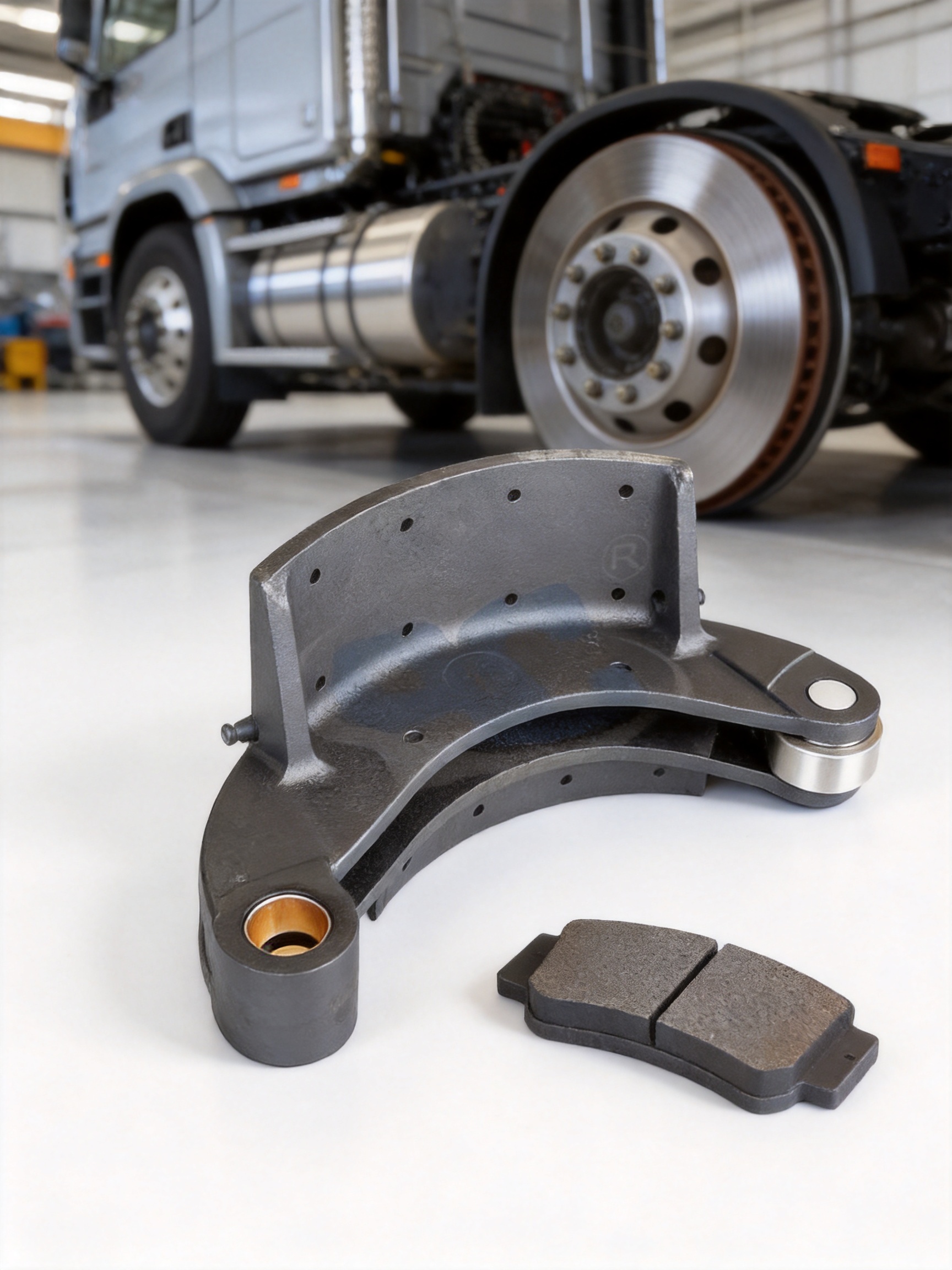
Heavy-duty braking systems operate under demanding conditions that ordinary passenger-car brake components rarely encounter. Commercial trucks, buses, trailers, and industrial vehicles may carry high loads, travel long distances, descend steep grades, and make repeated stops in changing weather and road conditions. In these applications, the brake shoe is a critical structural and friction-support component. Its dimensions, material integrity, hole pattern, and compatibility with the correct brake lining all influence braking consistency, service life, maintenance efficiency, and fleet operating costs.
The 1104545 Casted Brake Shoe is a heavy-duty replacement component identified by part number SCA254. It is designed for applications associated with SCANIA braking systems and is manufactured to a 413 x 254 millimeter specification with 16 riveting holes. These defined characteristics make the product suitable for professional maintenance programs that require repeatable dimensions, reliable lining installation, and dependable interchange with the intended original-equipment reference.
For fleet operators, distributors, repair workshops, and brake-system specialists, selecting a brake shoe is not simply a matter of choosing a component with a similar appearance. The correct product must match the application, brake drum arrangement, lining dimensions, riveting pattern, and service requirements. A properly specified casted brake shoe can help reduce installation complications and support stable braking performance throughout the replacement cycle.
This article examines the construction, application, manufacturing considerations, installation value, quality advantages, and purchasing benefits of the 1104545 Casted Brake Shoe. It also explains how a specialized heavy-duty brake-parts manufacturer can support customers through controlled production, product identification, compatible brake-lining options, and a broader range of brake-system components.
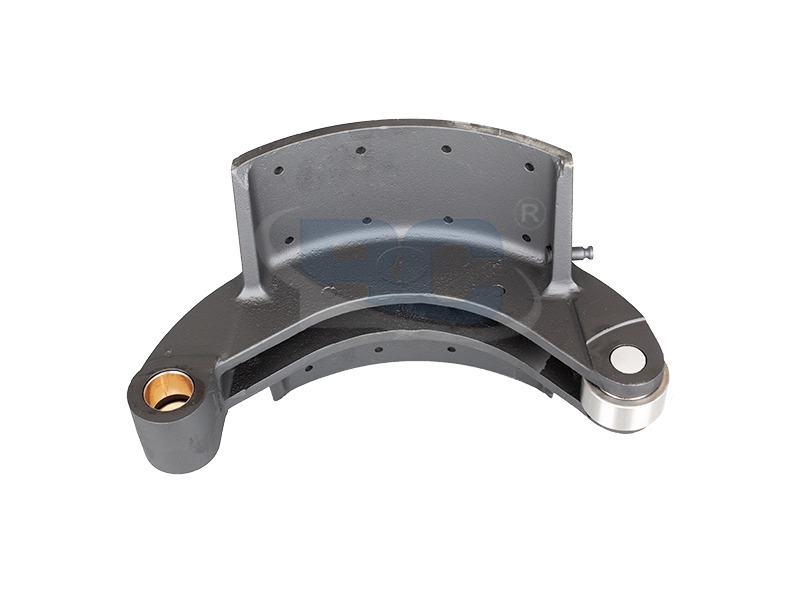
1104545 Casted Brake Shoe
Product Identification and Core Specification
The 1104545 Casted Brake Shoe is listed under the Casted Brake Shoe category. Its product part number is SCA254, while 1104545 is the referenced original-equipment number. The product is associated with SCANIA vehicle applications and has a specified size of 413 x 254 millimeters. It contains 16 riveting holes for the installation of a suitable brake lining.
| Item | Specification |
|---|---|
| Product type | Casted brake shoe |
| Product part number | SCA254 |
| Original-equipment reference | 1104545 |
| Application | SCANIA heavy-duty braking systems |
| Size | 413 x 254 millimeters |
| Riveting holes | 16 |
| Product category | Casted Brake Shoe |
| Compatible product range | Brake linings and lined brake shoe kits, subject to application confirmation |
These specifications provide the basic information required for initial product selection. However, professional buyers should always confirm the vehicle model, axle position, brake assembly, production year, drum dimensions, and lining requirements before ordering. Original-equipment references are useful for identification, but application verification remains essential because commercial vehicles can use different brake configurations across markets and production periods.
The 413 x 254 millimeter size is particularly important when the brake shoe is paired with a replacement lining. The lining must follow the correct arc, width, thickness, and hole pattern. The 16-hole riveting arrangement also needs to match the lining exactly. A mismatch may create installation difficulties, uneven contact, incorrect rivet seating, or reduced braking efficiency.
Why a Casted Brake Shoe Matters in Heavy-Duty Service
A brake shoe supports the friction lining and transfers braking force to the brake drum. During braking, the wheel-cylinder mechanism or mechanical actuator pushes the shoe outward. The lining then contacts the inner surface of the rotating drum. The shoe must withstand repeated mechanical loading while maintaining its shape and supporting an even lining profile.
In heavy-duty service, the brake shoe is exposed to several types of stress. These include radial force from drum contact, localized pressure near the lining attachments, vibration from road conditions, thermal cycling during braking, and fatigue caused by repeated actuation. The shoe must also maintain dimensional stability so that the lining remains correctly positioned throughout its service life.
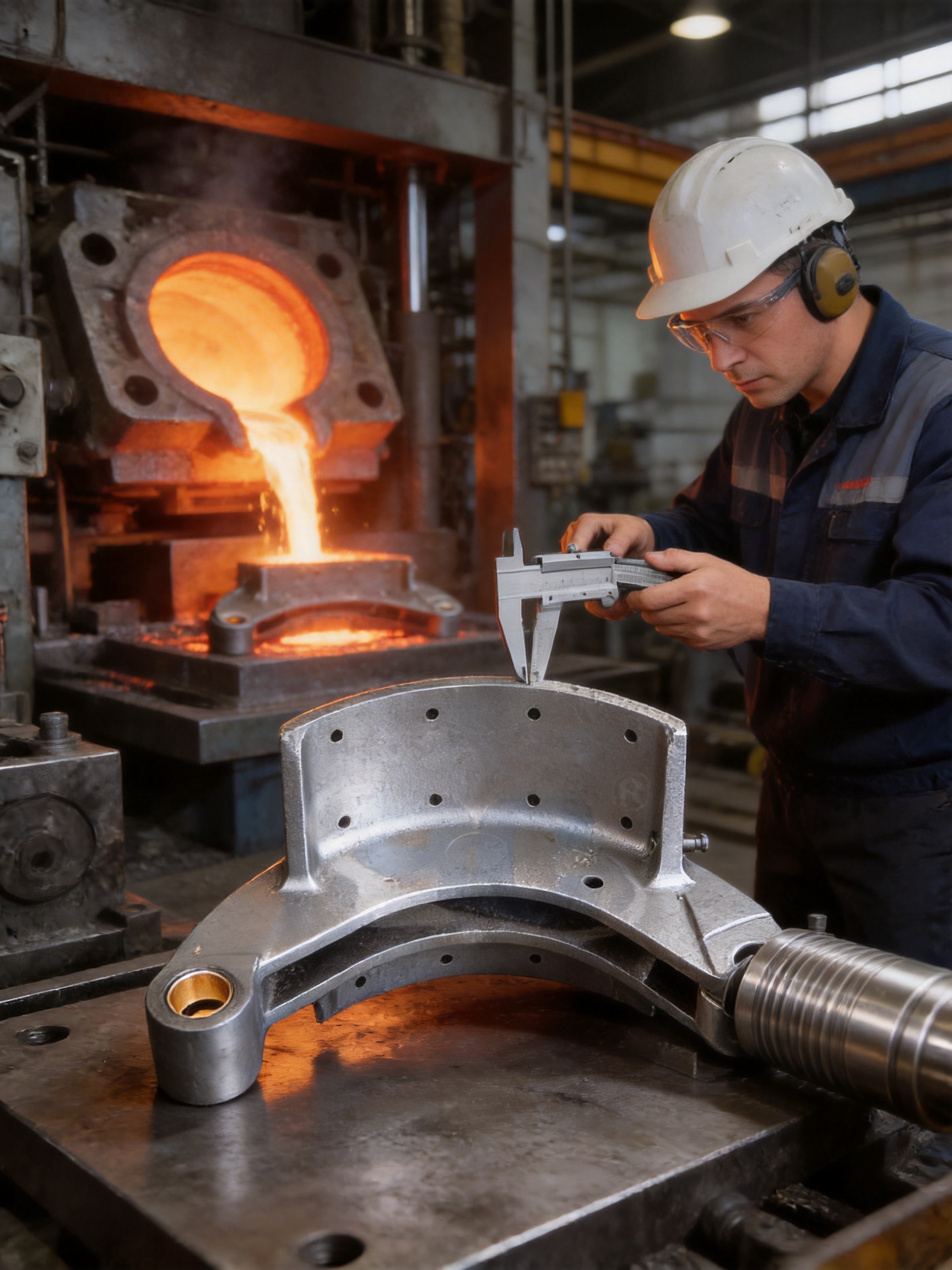
Casting is a widely used manufacturing method for producing durable brake-shoe bodies. A properly controlled casting process can create a robust component with the required structural form and suitable material distribution. After casting, the component can undergo cleaning, dimensional correction, machining, drilling, surface treatment, and inspection. Each stage contributes to the final fit and service performance of the product.
Compared with poorly controlled or lightly constructed alternatives, a properly manufactured casted shoe offers several practical benefits. It can provide a strong base for the lining, consistent attachment points, and an accurate interface with the brake assembly. It can also be integrated into a repeatable production system where part numbers, dimensions, hole counts, and application references are controlled throughout manufacturing and final inspection.
It is important to distinguish a casted brake shoe from a generic shoe that merely resembles the required component. Visual similarity does not guarantee correct geometry or safe interchange. The 1104545 replacement is defined by its application reference, size, and 16-hole configuration. Those details support more reliable identification than appearance alone.
Advantages of the 1104545 Replacement Design
Application-Specific Identification
One of the main advantages of the 1104545 Casted Brake Shoe is its clear application reference. The product is identified by both the SCA254 part number and the 1104545 original-equipment number. This dual identification helps purchasers compare catalogs, maintenance records, and vehicle requirements with greater confidence.
Clear identification is especially valuable for commercial fleets. A fleet may operate several vehicle generations, axle configurations, or brake-system designs at the same time. Without accurate numbering, technicians may select a component based on general size or visual shape and discover later that the hole pattern or lining profile is different. A defined part number reduces this risk and improves warehouse organization.
Controlled Dimensional Compatibility
The specified 413 x 254 millimeter size gives buyers a practical reference for compatibility evaluation. Dimensions are fundamental to brake-shoe performance because the shoe must fit within the drum assembly and provide the correct support area for the friction lining.
A shoe that is too small may provide insufficient support or an incorrect contact profile. A shoe that is too large may create interference, installation problems, or unwanted contact before the brake is applied. Maintaining the specified size therefore supports better assembly consistency and helps technicians match the shoe with the correct lining and drum.
Sixteen-Hole Riveting Pattern
The 16 riveting holes are another important product advantage. A defined riveting pattern allows the brake lining to be attached in a controlled way. Correctly placed rivets distribute the holding force along the lining and help keep the friction material securely aligned with the shoe.
During relining, the technician must ensure that every hole is correctly aligned and that the selected rivets are suitable for the lining and shoe. The holes should be clean and free from casting residue, burrs, or deformation. When the shoe is manufactured with consistent hole placement, the relining process can become more predictable and less dependent on manual correction.
Suitability for Repair and Remanufacturing Programs
The product can support different maintenance strategies. A workshop may purchase the bare casted shoe and install a compatible brake lining, or it may use the shoe as part of a larger brake-shoe repair program. This flexibility is useful for customers who maintain their own relining processes or who purchase lined brake shoes and kits according to individual operating requirements.
For some fleets, replacing only the worn lining may be economical when the existing shoe remains within serviceable limits. In other cases, replacing the complete shoe is more appropriate because of corrosion, deformation, worn rivet seats, cracking, or previous overheating. A replacement casted shoe gives the workshop a controlled foundation when the original shoe should no longer be reused.
Support for Efficient Inventory Management
Standardized part identification also helps distributors and fleet maintenance departments manage stock. The SCA254 and 1104545 references can be recorded in purchasing systems, shelf labels, inspection documents, and vehicle maintenance histories. This reduces the chance of mixing similar components and can make future replenishment faster.
A product that is available within a broader brake-parts range can offer additional inventory benefits. Customers may source steel brake shoes, casted brake shoes, brake linings, lined brake shoes, repair kits, and lined brake-shoe kits from one specialized supplier. Consolidating related products can simplify vendor management and improve the consistency of replacement components.
Manufacturing Process and Quality Considerations
The performance of a casted brake shoe depends not only on its design but also on the discipline of the manufacturing process. A professional production system should control the component from raw-material preparation through casting, finishing, machining, drilling, inspection, and packaging. The objective is to produce shoes that conform to the intended application and remain consistent from one production batch to the next.
Material and Pattern Preparation
The manufacturing process begins with the preparation of the material specification and casting pattern. The pattern defines the basic geometry of the brake shoe, including its curvature, mounting areas, reinforcing features, and general shape. Pattern accuracy is essential because errors at this stage may be repeated across an entire production batch.
Material preparation should also be controlled. The foundry process requires suitable metal inputs and a stable melting procedure. The manufacturer must manage furnace conditions, pouring temperature, composition control, and cooling behavior. These factors influence the final structure and mechanical characteristics of the casting.
Controlled Casting
During casting, molten metal is introduced into the prepared mold. Proper filling is necessary to avoid incomplete sections, excessive porosity, cold shuts, or other discontinuities. The design of the gating and feeding system affects how the casting solidifies and how internal shrinkage is managed.
A controlled casting operation is particularly important for brake shoes because the component must support repeated loads. Internal defects may reduce structural reliability, while external defects may interfere with machining, lining installation, or final fit. Process control, operator experience, and systematic inspection all help reduce these risks.
Cooling, Shakeout, and Cleaning
After pouring, the casting must cool under controlled conditions. Cooling affects the development of the material structure and the stability of the final dimensions. Once the casting has sufficiently solidified, it is removed from the mold and cleaned.
Cleaning may include the removal of molding sand, gates, risers, flash, and other excess material. The shoe must have a clean and stable surface before it proceeds to machining or drilling. A clean casting also makes it easier to identify surface imperfections during inspection.
Machining and Dimensional Correction
Machining operations refine the areas that require closer dimensional control. These may include mounting faces, reference surfaces, lining-support areas, and other interfaces. The purpose is to bring the part within the required dimensional tolerance and to create consistent contact surfaces.
For a 413 x 254 millimeter brake shoe, dimensional verification should include the overall size, curvature, width, and relevant mounting geometry. The component must be checked against appropriate production drawings or control standards. Maintaining these dimensions improves the probability of correct assembly and uniform lining contact.
Drilling and Riveting-Hole Control
The 16 riveting holes require careful positioning. Hole spacing, diameter, perpendicularity, and edge condition all influence the relining process. Drilling fixtures or controlled machining equipment can help maintain repeatability across the batch.
After drilling, the holes should be checked for burrs and obstruction. Sharp edges or residual material may interfere with rivet installation. A properly finished hole also helps the rivet seat correctly and reduces the possibility of damaging the lining during assembly.
Surface Treatment and Protection
Brake shoes may require surface protection to reduce corrosion during storage, transportation, and service. The selected treatment should be compatible with the areas that contact the brake assembly and should not contaminate the friction lining. Proper preparation before coating is important because oil, scale, dust, or moisture can reduce coating adhesion.
Surface protection is especially valuable for replacement parts that may remain in inventory before installation. Corrosion on the shoe body or around riveting holes can complicate relining and may compromise the condition of the component. Appropriate packaging further protects the finished shoe from impact, moisture, and contamination.
Inspection and Traceability
Quality inspection should confirm the product identity, basic dimensions, hole count, surface condition, and application reference. Where required by the customer or internal quality system, the manufacturer may also use additional inspections suited to cast components and heavy-duty braking products.
Traceability strengthens confidence in the supply chain. Batch records, production dates, inspection results, and packaging labels can help identify the source of a component if a technical question arises. Clear labeling of SCA254 and 1104545 also supports warehouse control and reduces the risk of incorrect shipment.
Manufacturing Strengths of a Specialized Brake-Parts Supplier
A company focused on heavy-duty brake parts can offer advantages that a general automotive-parts supplier may not provide. Specialization allows production planning, tooling, quality control, product development, and customer support to be organized around brake-system requirements.
Zhejiang Bangchi Auto Parts Co., Ltd. operates in the heavy-duty brake-parts field and supplies products including steel brake shoes, casted brake shoes, brake linings, lined brake shoes, brake-shoe repair kits, and lined brake-shoe kits. This product coverage is valuable because many customers need more than one component for their maintenance program.
The company states that its brake parts follow the global FMSI numbering system. A recognized numbering approach can improve catalog organization and make it easier for international customers to compare replacement products. Numbering alone does not replace technical verification, but it provides a useful structure for product identification and cross-reference management.
A specialized manufacturer can also develop production tooling for different brake-shoe shapes and applications. This capability supports a broader product range and can help customers source components for multiple vehicle platforms. In the case of the 1104545 Casted Brake Shoe, maintaining a dedicated product reference helps preserve consistency in the SCA254 design and its associated specifications.
Another strength is the ability to coordinate the shoe and lining relationship. A brake shoe cannot be evaluated independently from the friction material that will be installed on it. A supplier with both bare-shoe and lining capabilities can better understand the requirements of riveting, arc matching, lining thickness, and complete brake-shoe assembly.
Manufacturing strength also includes communication. International buyers may require technical drawings, packing information, sample approval, minimum order details, or application confirmation. A supplier that can provide organized product data helps distributors and repair centers make better purchasing decisions and reduces avoidable ordering errors.
Customers should still request the specific quality documents and inspection details relevant to their contract. The most effective supplier relationship combines the manufacturer’s production capability with the customer’s application knowledge, inspection requirements, and service expectations.
Comparison with Generic and Poorly Matched Alternatives
The 1104545 Casted Brake Shoe has practical advantages over generic alternatives when the application requires the stated 413 x 254 millimeter dimensions and 16-hole riveting pattern. The most important advantage is not an unsupported performance claim; it is the availability of defined product information that can be checked before installation.
| Evaluation area | 1104545 Casted Brake Shoe | Generic or poorly matched shoe |
|---|---|---|
| Product identification | SCA254 and 1104545 references | May rely only on appearance or incomplete description |
| Application reference | Listed for SCANIA use, subject to confirmation | May have uncertain vehicle compatibility |
| Basic dimensions | Specified as 413 x 254 millimeters | Dimensions may be unclear or inconsistent |
| Riveting arrangement | 16 identified riveting holes | Hole count or spacing may not be verified |
| Relining potential | Can be matched with a suitable 16-hole lining | May require modification or unsuitable lining selection |
| Inventory control | Part numbers support cataloging and traceability | Greater risk of mixing similar products |
| Supplier range | Available within a broader heavy-duty brake-parts range | May require multiple unrelated suppliers |
A generic component may look acceptable during a visual inspection but still differ in curvature, width, hole placement, or mounting geometry. Such differences can create problems during assembly and may affect how the lining contacts the drum. In contrast, a defined replacement reference gives the buyer a stronger basis for comparison.
The product may also be advantageous compared with a reused shoe that has exceeded its serviceable condition. Reusing a shoe with cracks, deformation, severe corrosion, stretched holes, or heat damage can create unnecessary risk. Installing a new casted foundation allows the technician to begin the relining process with a component whose condition is known and whose specifications can be documented.
However, the correct choice must always be based on application verification. No replacement shoe should be installed solely because it appears similar to the original. Brake components are safety-critical, and the complete assembly must be inspected and adjusted according to the vehicle manufacturer’s service procedures.
Brake Lining Compatibility and Relining Practice
The casted shoe is the structural base, while the brake lining provides the friction interface with the drum. Both parts must work together. The lining must have the correct dimensions and friction characteristics for the vehicle and operating environment. It must also match the shoe’s 16-hole riveting pattern.
Before relining, the technician should inspect the shoe for cracks, distortion, corrosion, damaged holes, and wear at the mounting points. The shoe should be rejected if its condition is outside the applicable service limits. A new lining cannot restore the structural integrity of a damaged shoe.
The lining should be positioned according to the approved assembly method. Rivet holes must align without forcing the material into place. Rivets should be selected for the lining thickness, shoe-hole dimensions, and approved installation equipment. Improper rivet selection may lead to loose attachment, lining damage, or deformation of the shoe.
Riveting should proceed in a controlled sequence that promotes even seating. The rivet heads should be properly formed, and the lining should remain firmly supported along its length. After riveting, the technician should check for movement, lifted edges, cracked friction material, protruding rivet heads, and other defects.
Where a fully lined brake shoe is preferred, customers may select a lined brake shoe or a lined brake-shoe kit, subject to exact application confirmation. Complete assemblies can reduce workshop labor and provide a more consistent factory-controlled relationship between the shoe and lining. Bare shoes and repair kits may be more suitable for customers with established relining equipment and procedures.
Installation and Maintenance Recommendations
Before installation, compare the replacement shoe with the removed component and verify the part number, size, hole count, and application. Inspect the brake drum for scoring, cracking, excessive wear, heat damage, or an unsuitable internal diameter. A new shoe should not be installed into a drum that is outside its allowable service condition.
Clean the brake assembly carefully. Dust, oil, grease, and loose corrosion can interfere with movement and contaminate the lining. Lubricate only the approved contact points and use the correct product in the correct quantity. Friction surfaces must remain free of lubricant.
Check the return springs, rollers, pins, adjusters, anchor points, and wheel-cylinder components. A worn or seized hardware component can prevent the brake shoe from operating correctly even when the shoe itself is new. Replacing related worn hardware may be necessary to achieve a dependable repair.
After installation, adjust the brake according to the vehicle manufacturer’s procedure. Confirm that the shoe moves freely and that the lining is correctly positioned relative to the drum. The brake should be tested in a controlled environment before the vehicle returns to normal operation.
Brake lining bedding procedures should follow the recommendations for the selected friction material. Sudden heavy braking immediately after replacement may create excessive heat and may prevent the lining from developing an even contact pattern. A controlled bedding process can support more uniform contact between lining and drum.
Maintenance records should include the replacement date, vehicle identification, axle position, part number, lining reference, drum condition, and inspection results. Recording the SCA254 or 1104545 reference helps future technicians identify the component and plan subsequent service.
Value for Fleets, Distributors, and Workshops
Fleet Operators
Fleet operators benefit from predictable replacement specifications. When the correct brake shoe is consistently used, maintenance departments can standardize inspection procedures, stocking policies, and training. The defined dimensions and hole pattern also help technicians identify the correct lining and reduce delays during scheduled service.
Heavy-duty fleets often evaluate parts according to total operating cost rather than purchase price alone. A component that fits correctly, supports efficient relining, and is available through a stable supply chain may reduce labor time and vehicle downtime. Accurate application data can also reduce the cost associated with ordering incorrect parts.
Distributors
Distributors require products that can be cataloged clearly and supplied to customers with dependable technical information. The SCA254 and 1104545 references provide useful catalog identifiers, while the 413 x 254 millimeter size and 16-hole configuration help support application discussions.
A broader product portfolio allows distributors to offer related brake components. Instead of handling only a single type of shoe, a distributor may support customers with casted shoes, steel shoes, linings, lined shoes, and repair kits. This can improve purchasing convenience and strengthen customer relationships.
Repair Workshops
Repair workshops can choose the supply format that best matches their equipment and workflow. A bare casted shoe may be appropriate for a workshop that performs its own riveting. A lined brake shoe or complete kit may be more efficient where rapid installation and consistent assembly are priorities.
The replacement shoe also provides a structured starting point for inspection and relining. Because the product has a defined hole pattern, the workshop can prepare the correct lining and rivets before beginning the job. This improves workflow planning and reduces the need for improvised modifications.
Purchasing and Technical Verification Checklist
Before placing an order, buyers should verify the vehicle and brake-system information rather than relying on the product title alone. The following points are useful for a professional purchasing review.
First, confirm that the original-equipment reference is 1104545 or that the vehicle manufacturer’s documentation identifies this number as an acceptable replacement reference.
Second, confirm the SCA254 product number and ensure that the supplier’s catalog description corresponds to the intended casted brake shoe.
Third, verify the 413 x 254 millimeter specification and compare it with the dimensions of the removed shoe, the brake drum, and the selected lining.
Fourth, verify the 16 riveting holes, including the hole spacing and diameter where technical drawings or samples are available.
Fifth, confirm the vehicle application, axle location, brake assembly type, and production details. A general SCANIA application reference should be supplemented by specific vehicle information.
Sixth, determine whether the order requires a bare shoe, a compatible lining, a lined brake shoe, or a repair kit. The choice should reflect the workshop’s equipment and the intended maintenance process.
Seventh, discuss packaging, labeling, inspection documents, sample approval, and shipment quantities with the supplier. Proper packaging is important because castings can be damaged by impact, and unprotected metal surfaces can corrode during storage.
Finally, confirm the applicable quality expectations and service documentation. Brake components are safety-related products, so purchasing decisions should be supported by technical review and controlled installation procedures.
Frequently Asked Questions
What is the 1104545 Casted Brake Shoe?
It is a heavy-duty casted brake shoe identified by product part number SCA254 and original-equipment reference 1104545. It is listed for SCANIA applications and is specified at 413 x 254 millimeters with 16 riveting holes.
What does the SCA254 number mean?
SCA254 is the product part number used to identify this casted brake shoe in the supplier’s product range. The number should be used together with the 1104545 reference, dimensions, hole count, and vehicle application when confirming compatibility.
Does the product include a brake lining?
The listed product is a casted brake shoe, which normally refers to the shoe body rather than a complete lined assembly. Customers should confirm whether they require a bare shoe, a separate brake lining, a lined brake shoe, or a complete repair kit.
What is the importance of the 16 riveting holes?
The 16 holes define the attachment arrangement for a compatible brake lining. The lining must have the same hole pattern, and the rivets must be suitable for the material thickness and installation method.
Can the shoe be used for every SCANIA vehicle?
No. The application reference indicates a SCANIA-related use, but commercial vehicles may have different brake configurations. Buyers should confirm the exact vehicle, axle, brake assembly, drum, and original-equipment reference before installation.
Why choose a casted shoe instead of a generic replacement?
A casted shoe with defined dimensions and application information provides a more reliable basis for selection. It can support consistent lining installation and reduce the uncertainty associated with generic parts that have not been adequately identified or dimensionally verified.
Can the shoe be relined?
It may be suitable for relining when the shoe is used with a compatible 413 x 254 millimeter lining and the correct 16-hole pattern. The workshop must inspect the shoe and follow approved riveting and brake-service procedures.
What should be checked before relining?
The technician should check for cracks, distortion, corrosion, damaged riveting holes, worn mounting areas, and other conditions that could affect safety or fit. A damaged or deformed shoe should not be reused simply because a new lining is available.
What related products can be sourced?
The manufacturer’s product range includes steel brake shoes, casted brake shoes, brake linings, lined brake shoes, brake-shoe repair kits, and lined brake-shoe kits. Availability and compatibility should be confirmed for each specific application.
How should the product be stored?
Store the shoe in a clean, dry environment protected from moisture, impact, corrosive chemicals, and contamination. Keep product labels visible and maintain part-number separation to prevent mixing similar components.
What makes a specialized supplier valuable?
A specialized supplier can combine brake-shoe manufacturing, lining knowledge, application identification, product numbering, and related component supply. This can simplify purchasing and provide better technical support than an unverified source.
Is the product suitable for high-load commercial vehicles?
The product is categorized as a heavy-duty casted brake shoe and is listed for the stated SCANIA application. Suitability must still be confirmed against the exact vehicle and brake assembly, and installation must follow professional service procedures.
Conclusion
The 1104545 Casted Brake Shoe is a purpose-identified heavy-duty replacement component for applications associated with SCANIA braking systems. Its SCA254 product number, 413 x 254 millimeter size, and 16 riveting holes provide the essential information needed for technical evaluation and inventory control.
Its value lies in the combination of application-specific identification, casted construction, defined dimensions, and compatibility with a controlled relining process. Compared with generic or poorly matched alternatives, the product gives fleet operators, distributors, and workshops a clearer basis for selecting the correct component.
The performance of any brake shoe depends on more than the component alone. Correct vehicle verification, suitable lining selection, proper riveting, drum inspection, hardware maintenance, adjustment, and bedding are all necessary. When these procedures are supported by a specialized manufacturer and a consistent supply of related brake products, customers can improve repair efficiency and maintain stronger control over heavy-duty braking programs.
For purchasing inquiries, technical confirmation, and application review, customers may contact Zhejiang Bangchi Auto Parts Co., Ltd. at No. 9 Building, No. 11 Qiyi Road, Chang’an Town, Haining, Zhejiang, China. The listed contact details include +86-133 7230 7977, +86-0573-87960600, +86-0573-87960639, and sfp@zjbangchi.com.
References
1. Product specification supplied for the 1104545 Casted Brake Shoe, including product number SCA254, size 413 x 254 millimeters, 16 riveting holes, and SCANIA application reference.
2. Original-equipment reference information supplied for brake shoe identification under number 1104545.
3. Global FMSI numbering principles for the identification and organization of friction-material and brake-component applications.
4. General commercial-vehicle brake maintenance practices covering brake-shoe inspection, lining riveting, brake-drum evaluation, adjustment, and bedding.
5. General foundry and machining principles applicable to cast heavy-duty brake components, including pattern preparation, controlled casting, cleaning, dimensional finishing, drilling, and inspection.
6. Manufacturer product-range information covering steel brake shoes, casted brake shoes, brake linings, lined brake shoes, brake-shoe repair kits, and lined brake-shoe kits.