 English
 简体中文
简体中文
In heavy-duty vehicle braking systems, the brake shoe is a critical component that transfers braking force to the friction lining and ultimately helps convert vehicle motion into controlled deceleration. A well-designed casted brake shoe must combine dimensional accuracy, structural strength, reliable heat resistance, and dependable compatibility with the intended brake assembly. The 6594200019 Casted Brake Shoe, identified by part number BZ160, is developed for Benz applications and is designed to meet the demanding requirements of commercial and heavy-duty vehicle braking systems.
With a specified size of 410 x 162 mm and 16 riveting holes, this brake shoe provides a clear dimensional reference for distributors, maintenance professionals, fleet operators, and brake system assemblers. Its cast construction is intended to provide a strong and stable foundation for the brake lining, while its application-specific design supports efficient replacement and service operations.
This article explains the product’s specifications, construction, operating advantages, manufacturing considerations, quality expectations, installation requirements, and commercial value. It also discusses how Zhejiang Bangchi Auto Parts Co., Ltd. supports the production of heavy-duty brake parts through application-focused manufacturing, OEM reference alignment, and product category specialization.
Product Overview
The 6594200019 Casted Brake Shoe is a heavy-duty brake shoe used as a supporting carrier for a brake lining. During braking, the brake shoe is actuated against the inner surface of a brake drum. The friction lining mounted on the shoe generates the friction necessary to slow or stop the wheel assembly.
The brake shoe must perform several functions at the same time. It must maintain its shape when exposed to repeated mechanical loading. It must support the lining evenly across the working surface. It must maintain accurate contact with the brake mechanism. It must also tolerate the temperature, vibration, and contamination commonly associated with commercial vehicle operation.
The product is listed under the Casted Brake Shoe category and is associated with OEM number 6594200019. Its internal part number is BZ160. The stated application is Benz, making accurate part identification especially important before purchase or installation.
| Item | Specification |
|---|---|
| Product name | 6594200019 Casted Brake Shoe |
| Product category | Casted Brake Shoe |
| Part number | BZ160 |
| OEM number | 6594200019 |
| Application | Benz |
| Size | 410 x 162 mm |
| Riveting holes | 16 |
| Manufacturer | Zhejiang Bangchi Auto Parts Co., Ltd. |
These specifications should be checked against the vehicle’s original component, brake drum dimensions, lining configuration, and service documentation. Part numbers can be used for identification, but fitment should always be confirmed through the relevant vehicle or brake assembly information.
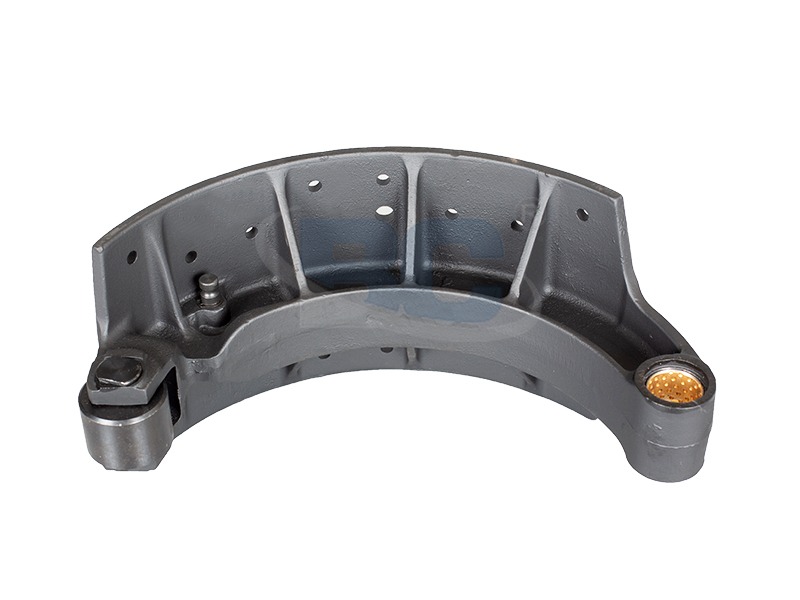
6594200019 Casted Brake Shoe
Why Casted Brake Shoes Matter in Heavy-Duty Braking
Heavy-duty vehicles operate under conditions that are significantly more demanding than those experienced by passenger cars. Commercial trucks, buses, trailers, and other large vehicles carry higher loads, travel longer distances, and often brake repeatedly in urban traffic, mountainous regions, construction zones, or busy logistics corridors. These conditions place considerable stress on brake components.
A casted brake shoe is designed to provide a rigid and stable foundation for the friction lining. Compared with a component that is not adequately engineered for heavy-duty use, a properly manufactured casted shoe can offer improved resistance to deformation and more consistent support across the lining surface. This is particularly important because uneven support can contribute to irregular lining wear, reduced braking efficiency, noise, vibration, and maintenance problems.
The shoe also serves as a connection point between the brake actuator and the lining. When the brake mechanism applies force, that force must be transmitted through the shoe in a predictable manner. If the shoe is distorted, incorrectly dimensioned, or poorly matched to the brake assembly, the contact pattern may become uneven. A precise and robust design helps promote stable mechanical operation.
For fleet operators, brake shoe reliability has a direct influence on vehicle availability. Unplanned brake repairs can cause delivery delays, increase labor expenses, and create additional vehicle downtime. A replacement brake shoe that is accurately identified and consistently produced can help simplify routine service planning.
Key Advantages of the 6594200019 Casted Brake Shoe
Application-Specific Compatibility
The product is identified for Benz application and is associated with OEM number 6594200019. This application-specific reference helps buyers narrow their selection when sourcing replacement brake shoes for compatible brake systems. Instead of choosing a generic shoe based only on appearance, purchasers can compare the OEM reference, part number, dimensions, and riveting-hole configuration.
Application-specific manufacturing is especially valuable in commercial vehicle maintenance. Heavy-duty brake shoes may look similar while differing in width, radius, hole arrangement, actuator interface, or lining position. A reference such as 6594200019 provides a practical starting point for confirming the correct replacement.
Rigid Cast Construction
The casted construction is intended to provide a strong structural base for the brake lining. A stable shoe can help preserve the geometry of the braking surface during repeated braking cycles. This is important for maintaining consistent lining contact and supporting predictable wear characteristics.
Cast construction can also be advantageous where the brake shoe must withstand repeated loads, vibration, and temperature changes. The exact performance of any casting depends on material selection, mold design, process control, heat treatment where applicable, and inspection standards. For this reason, manufacturing discipline is as important as the basic choice of a casted design.
Defined 410 x 162 mm Size
The stated dimensions of 410 x 162 mm help buyers and technicians compare the product with the original brake shoe. Dimensional data supports inventory management, cross-reference work, and preliminary fitment review. It is particularly useful when a fleet maintains multiple brake shoe models and needs to distinguish between products with similar appearances.
Dimensions should not be considered in isolation. The shoe’s curvature, mounting points, lining seat, hole positions, and other interface characteristics must also match the target assembly. Nevertheless, a clear size specification reduces uncertainty during the sourcing process.
Sixteen Riveting Holes
The 16 riveting holes are an important part of the product identity and lining installation configuration. Riveting holes must be positioned accurately so that the lining can be attached evenly and securely. Correct hole alignment supports the intended distribution of mechanical load across the lining.
An accurate hole pattern can also help reduce installation complications. If holes are poorly positioned or inconsistent, lining installation may require excessive adjustment, and the finished assembly may not provide the expected contact profile. A defined 16-hole configuration gives lining manufacturers, repair shops, and distributors a useful technical reference.
Suitability for Replacement and Repair Programs
The brake shoe is suitable for use in replacement-oriented supply programs where fleets, wholesalers, repair centers, and brake specialists require repeatable part identification. It can be considered alongside brake lining, lined brake shoe, and brake shoe repair kit products when building a complete heavy-duty brake service offering.
Because the product is supplied as a casted brake shoe rather than necessarily as a complete lined assembly, buyers can select the lining specification separately when their service process requires a particular friction material, thickness, or riveting method. This can provide flexibility for professional brake rebuilders.
Product Positioning Compared with Generic Alternatives
Brake shoes from different manufacturers may share similar dimensions while differing substantially in production quality, consistency, and application support. The advantage of the 6594200019 Casted Brake Shoe is not simply that it is a metal component. Its value comes from the combination of a defined OEM reference, a stated Benz application, a specific size, a fixed riveting-hole count, and a product category dedicated to heavy-duty brake service.
| Evaluation area | Defined casted brake shoe | Unverified generic alternative |
|---|---|---|
| Identification | OEM number 6594200019 and part number BZ160 | May rely mainly on visual similarity |
| Application reference | Listed for Benz application | May have unclear or incomplete application data |
| Dimensions | 410 x 162 mm stated | Measurements may be unavailable or inconsistent |
| Riveting configuration | 16 riveting holes specified | Hole count and placement may require additional checking |
| Product category | Dedicated casted brake shoe | May be grouped with unrelated brake components |
| Supply support | Produced by a heavy-duty brake parts specialist | Manufacturing background may be unclear |
| Procurement confidence | Technical references support comparison | Limited information can increase fitment risk |
This comparison does not mean that every alternative product is unsuitable. It demonstrates why buyers should evaluate brake shoes by more than price alone. Product documentation, dimensional accuracy, manufacturing consistency, material control, inspection, and after-sales communication all affect the total value of a replacement component.
Manufacturing Strengths of a Specialized Brake Parts Producer
Zhejiang Bangchi Auto Parts Co., Ltd. focuses on heavy-duty brake parts and lists product categories including steel brake shoes, casted brake shoes, brake linings, lined brake shoes, brake shoe repair kits, and lined brake shoe kits. This category specialization is important because brake components are not isolated products. A manufacturer familiar with shoes, linings, rivets, and complete repair kits can better understand how individual parts interact within a service assembly.
The company’s stated business focus includes OEM brake parts following the global FMSI numbering system. A numbering and reference approach helps organize product information and supports clearer communication between manufacturers, distributors, and professional buyers. For international customers, consistent part identification can reduce confusion caused by different local naming conventions.
Process Planning for Cast Components
Producing a reliable casted brake shoe begins with process planning. The manufacturer must consider the target geometry, material behavior, casting design, dimensional tolerances, and the subsequent machining or finishing requirements. A well-planned process helps reduce common casting concerns such as porosity, incomplete filling, inclusions, dimensional distortion, and excessive surface irregularities.
For a brake shoe, process planning should also consider the areas that interact with other brake components. Mounting points, lining seats, actuator interfaces, and riveting holes must be treated as functional features rather than decorative details. Their location and geometry influence the final performance of the assembled brake.
Production planning should be connected to the product’s application. A shoe intended for a heavy-duty Benz brake system requires appropriate attention to load conditions, assembly geometry, and service expectations. This application-based approach is one of the advantages of working with a manufacturer that concentrates on commercial vehicle brake products.
Material and Casting Control
Material consistency is fundamental to cast component quality. The selected material must provide an appropriate balance of strength, toughness, wear resistance, and thermal stability for the intended brake shoe design. During production, control of the melt, pouring conditions, cooling behavior, and casting practice can influence the internal structure of the finished component.
A professional production system should include procedures for controlling incoming materials and monitoring batch information. Material records can support traceability and help identify the production conditions associated with a specific lot. Although detailed material grades and test results should be requested directly for a particular purchasing program, the principle remains clear: a brake shoe should be manufactured through controlled and repeatable material processes.
Machining and Dimensional Accuracy
After casting, selected surfaces may require cleaning, machining, drilling, or other finishing operations. These operations help bring the component to its intended dimensions and prepare it for lining installation and brake assembly. The 410 x 162 mm specification and 16-hole configuration make dimensional and positional accuracy especially important.
Hole location affects rivet alignment and lining installation. Surface condition affects how the lining sits against the shoe. Curvature affects how the lined shoe interacts with the drum. A robust production process therefore combines casting with appropriate secondary operations and inspection.
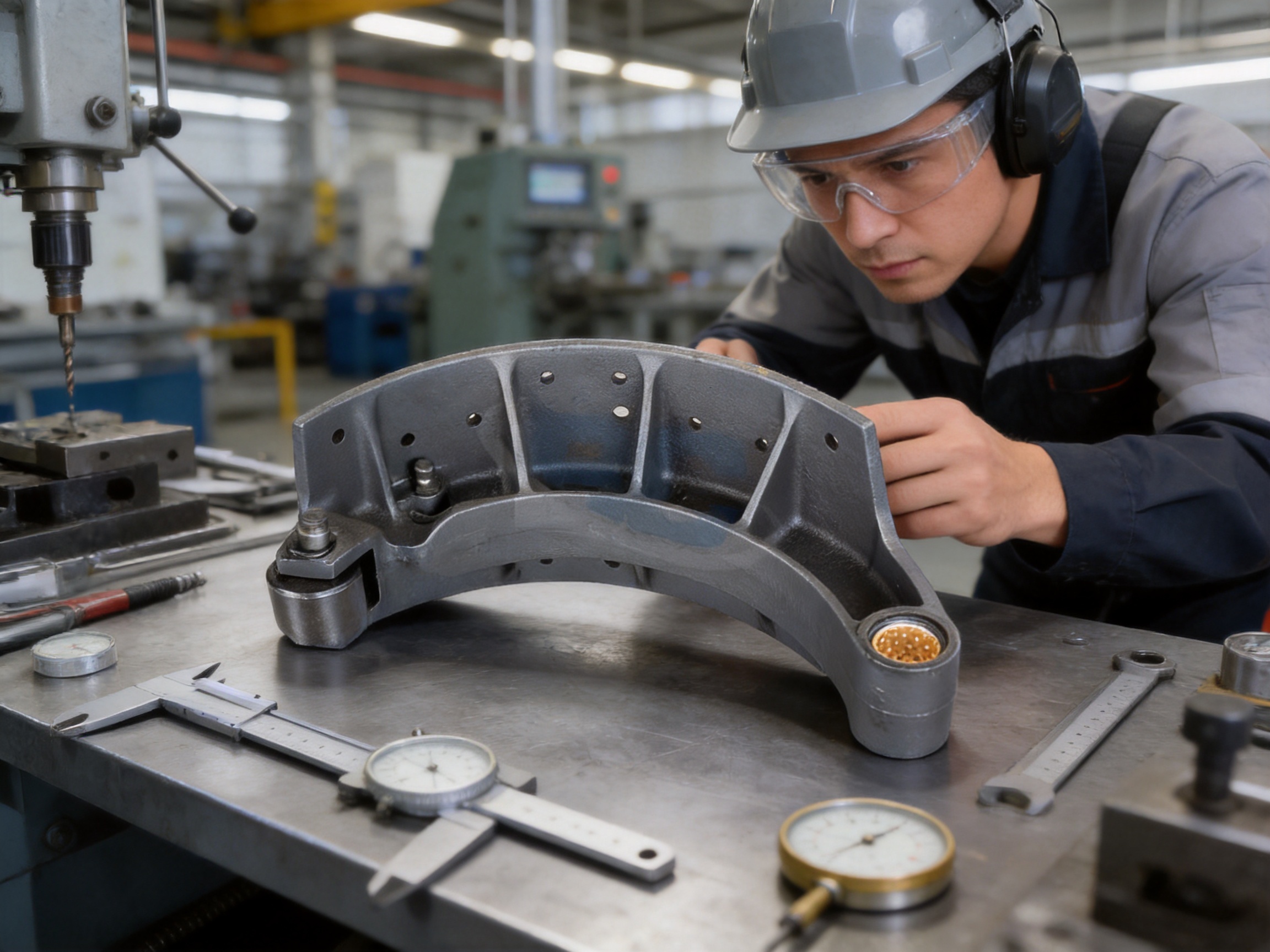
Dimensional inspection may include gauges, templates, measuring fixtures, calipers, coordinate measuring equipment, or application-specific checking tools. The exact inspection method can vary according to production volume and product design, but the purpose is the same: to confirm that functional features remain within the required range.
Inspection Before Shipment
Inspection is a central manufacturing strength because it transforms a production intention into measurable product control. For a casted brake shoe, inspection may cover appearance, casting integrity, critical dimensions, hole count, hole position, surface condition, and packaging condition.
Visual inspection can identify cracks, excessive flash, incomplete finishing, or other visible defects. Dimensional inspection can verify the size and functional interfaces. Hole inspection can confirm that all 16 riveting holes are present and correctly formed. Packaging inspection can help ensure that the finished parts are protected during storage and transportation.
For customers purchasing in volume, additional documentation may be requested, such as inspection records, batch information, material declarations, or agreed sampling reports. The availability and scope of these documents should be confirmed with the manufacturer during the quotation and order process.
How the Brake Shoe Works in a Drum Brake System
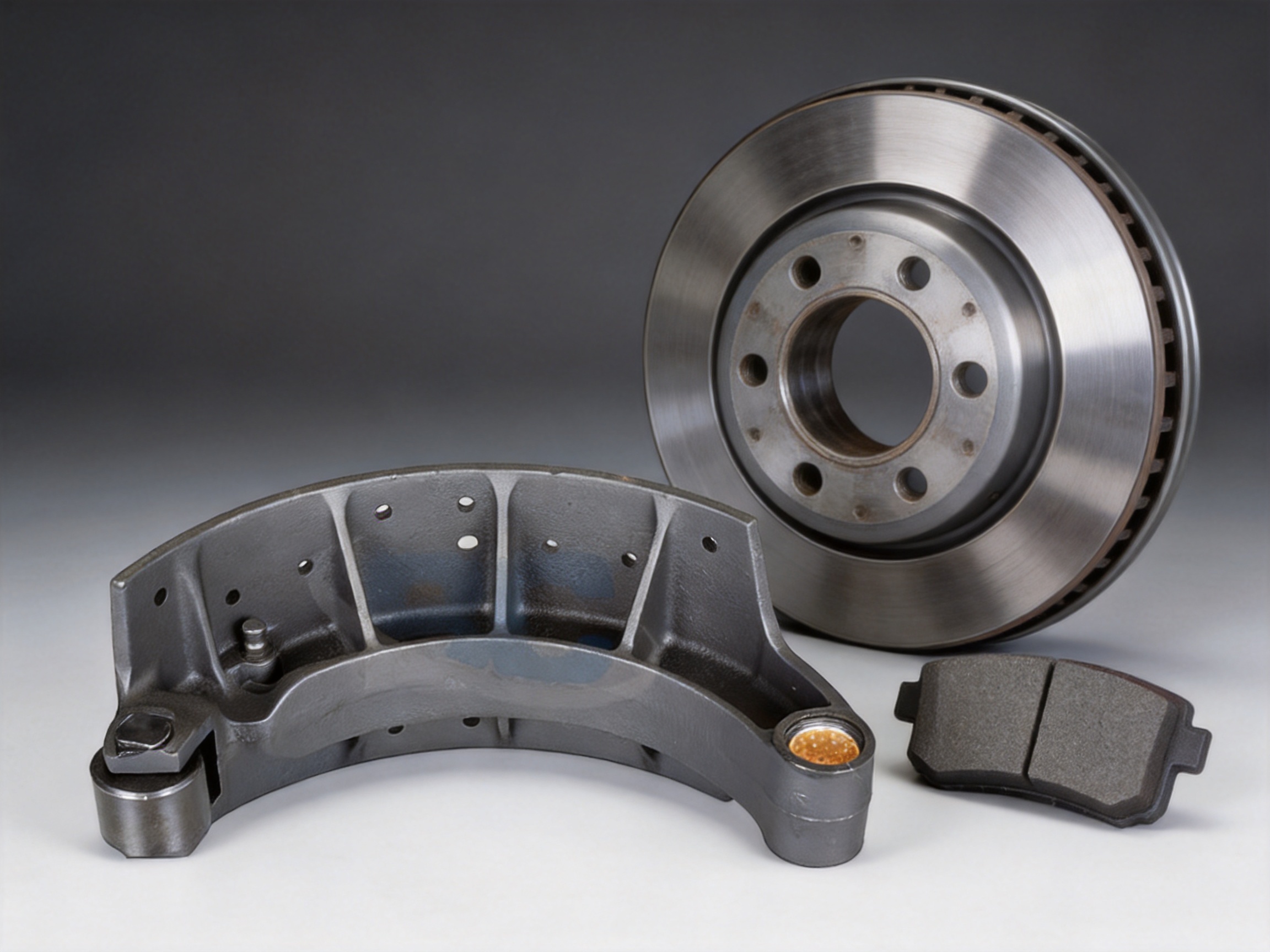
A drum brake system uses a rotating drum and one or more brake shoes. When the driver applies the brake, the actuator mechanism pushes the shoe outward. The friction lining attached to the shoe contacts the inner drum surface. The resulting friction resists rotation and reduces the vehicle’s speed.
The shoe must move through a controlled arc and remain supported by the brake hardware. Its geometry helps determine how the lining contacts the drum. If the shoe is not correctly matched, the lining may contact only part of the drum surface. This can produce uneven wear and reduce the effective braking area.
The brake shoe also operates under changing thermal conditions. Braking converts kinetic energy into heat. In a heavily loaded vehicle, repeated braking can generate substantial heat in the drum and lining. The shoe must retain adequate structural stability while the complete assembly experiences thermal expansion and contraction.
In addition, brake components are exposed to dust, moisture, road salt, oil contamination, vibration, and mechanical shock. These environmental factors make surface quality, material integrity, and correct assembly important throughout the service life of the brake system.
Technical Benefits for Fleet Maintenance
Improved Part Identification
Fleet maintenance departments often manage a large inventory of replacement parts. Clear product references help technicians and purchasing teams identify the right component more efficiently. The combination of OEM number 6594200019, part number BZ160, Benz application, 410 x 162 mm size, and 16 riveting holes provides several points of comparison.
Multiple identification points are useful when packaging labels, workshop records, or supplier catalogs use different naming conventions. A purchasing department can search by OEM number, while a warehouse can organize by internal part number. A technician can verify the dimensions and hole pattern before installation.
Support for Predictable Service Scheduling
When replacement parts are consistently identified and supplied, fleet operators can improve preventive maintenance planning. Brake shoes can be ordered according to inspection results, mileage schedules, vehicle operating conditions, or seasonal maintenance programs.
Predictable sourcing does not eliminate the need for brake inspection. Instead, it helps maintenance teams prepare the correct parts before a repair begins. This can reduce delays associated with incorrect or incomplete orders.
Flexibility in Lining Selection
A bare casted brake shoe can be useful for workshops that install linings according to vehicle duty, regional requirements, or customer preference. A repair facility may select a lining based on friction characteristics, operating temperature, noise expectations, and regulatory considerations.
When a complete lined brake shoe is preferred, the same type of product category can also support more convenient replacement. The choice between a bare shoe, a lined shoe, or a repair kit depends on the customer’s technical capability, inventory strategy, and service method.
Installation and Lining Considerations
Installation should be performed by qualified brake technicians using the correct tools and procedures. Before fitting the shoe, the technician should compare the replacement part with the removed component and verify the OEM reference, size, hole pattern, curvature, and mounting features.
The brake drum should be inspected for scoring, cracking, excessive wear, contamination, and out-of-round conditions. Installing a new shoe against a damaged or unsuitable drum can compromise the result. The condition of springs, pins, adjusters, rollers, anchors, and other related hardware should also be evaluated.
If the product is supplied as a bare shoe, the lining must be compatible with the brake system and correctly matched to the shoe. The lining should sit evenly on the shoe without rocking, excessive gaps, or misalignment. Rivets must be suitable for the lining and installed using an appropriate riveting process.
The 16 riveting holes should be checked before lining installation. The technician should confirm that the lining’s hole pattern corresponds to the shoe and that rivets are seated correctly. Riveting should provide secure attachment without cracking the lining or distorting the shoe.
After installation, the brake assembly should be adjusted according to the vehicle or brake manufacturer’s service procedure. The wheel should rotate as intended without abnormal drag, and the system should be tested in a controlled environment before the vehicle returns to normal operation.
Important Safety Practices
Brake dust may contain hazardous particles depending on the age and composition of the brake lining. Technicians should follow workplace safety requirements, use appropriate protective equipment, and avoid practices that disperse dust into the air. Cleaning methods should be selected in accordance with applicable regulations and workshop procedures.
All fasteners and retaining components should be installed correctly. Brake hardware should not be substituted with unsuitable parts. If any component appears damaged, excessively worn, corroded, or deformed, it should be replaced or professionally evaluated.
Because the brake shoe is a safety-critical component, installation should never be based solely on visual judgment. Product identification, dimensional checks, professional assembly, and post-installation testing are essential.
Quality Factors Buyers Should Evaluate
Buyers comparing the 6594200019 Casted Brake Shoe with competing products should evaluate the complete supply package rather than only the unit price. The following factors can influence long-term value.
Reference Accuracy
The supplier should clearly state the OEM number, internal part number, application, dimensions, and other relevant technical data. Ambiguous descriptions can create fitment risks and increase the cost of returns or workshop delays.
Production Consistency
Commercial vehicle customers often require repeat orders over an extended period. The supplier should be able to maintain consistent geometry, material behavior, hole configuration, and finish across production batches. Consistency is particularly important when the same brake shoe is used across multiple vehicles in a fleet.
Inspection Capability
Customers should ask how the manufacturer controls critical dimensions and how finished parts are inspected. For volume orders, it may be appropriate to agree on inspection points, sampling procedures, packaging requirements, and documentation before production begins.
Packaging and Logistics
Cast brake shoes are heavy metal components that can be damaged by impact, moisture, and poor handling. Packaging should protect the functional surfaces and prevent unnecessary movement during transport. Clear labels can help warehouses identify the OEM number, part number, quantity, batch, and application.
Communication and Technical Support
A specialized supplier should be able to discuss product dimensions, application questions, lining options, packaging, minimum order quantities, and customization requirements. Responsive communication can be especially valuable when customers are building a new catalog or resolving a cross-reference question.
Advantages of Working with Zhejiang Bangchi Auto Parts Co., Ltd.
Zhejiang Bangchi Auto Parts Co., Ltd. is located in Haining, Zhejiang, China, and specializes in heavy-duty brake parts. Its stated product range covers several connected categories, including steel brake shoes, casted brake shoes, brake linings, lined brake shoes, brake shoe repair kits, and lined brake shoe kits.
This range provides a practical advantage for distributors and professional buyers. Instead of sourcing every brake component from unrelated suppliers, customers can explore a broader product family through one specialized manufacturer. This may simplify communication, product development, packaging coordination, and order management.
The company’s focus on OEM brake parts and the global FMSI numbering system also supports structured catalog development. A catalog based on recognizable references can make it easier for international buyers to match products with their existing inventory systems and customer requirements.
Specialization in Heavy-Duty Brake Parts
Specialization allows a manufacturer to build experience around the particular requirements of commercial vehicle brake components. Heavy-duty brake parts require attention to structural loading, lining attachment, drum compatibility, wear behavior, and service conditions. A company that concentrates on these products can direct its manufacturing and quality resources toward the relevant technical challenges.
Specialization may also support more efficient product expansion. Once a manufacturer understands a brake family, it can develop related shoes, linings, kits, and lined assemblies while maintaining consistent terminology and reference management.
OEM-Oriented Product Development
OEM-oriented production emphasizes matching the functional requirements of an existing brake system. This includes attention to dimensions, mounting points, lining interfaces, hole patterns, and application references. For the 6594200019 product, the OEM number and Benz application provide a clear basis for product identification.
OEM-oriented does not automatically mean that every replacement component is identical in every material or process detail to the original. Buyers should confirm the specific technical requirements, certificates, testing documentation, and warranty conditions relevant to their market. However, an OEM reference provides a more reliable foundation than a product description based only on general size.
Integrated Product Categories
The company’s range includes both individual components and assembled or repair-oriented products. A buyer may require a bare casted shoe for in-house lining installation, a lined brake shoe for faster workshop replacement, or a complete repair kit for a more comprehensive service operation.
This integrated product structure can help customers choose the level of assembly that best suits their business model. It can also support distributors that want to offer multiple service solutions for the same vehicle or brake platform.
Purchasing Guidance for Distributors and Importers
When sourcing the 6594200019 Casted Brake Shoe, distributors should establish a technical information sheet containing the OEM number, BZ160 part number, Benz application, 410 x 162 mm size, 16 riveting holes, product photographs where available, packaging details, and any agreed inspection requirements.
Sample approval is recommended before large-scale procurement. A sample can be compared with the original part for overall geometry, mounting interfaces, lining seat, hole location, surface condition, and packaging. If the product will be lined locally, the distributor should also test the lining installation process and confirm that the finished assembly fits the intended drum.
Importers should discuss production lead time, order quantity, shipping method, documentation, labeling, and export packaging in advance. If the customer requires private labeling, barcode labels, neutral cartons, or special palletization, these requirements should be agreed before production starts.
For repeat orders, it is useful to maintain an approved sample or a controlled technical drawing. This provides a reference for future production and helps reduce the risk of unintended design changes. Any change to material, casting process, hole position, machining, or packaging should be communicated and approved according to the customer’s quality procedure.
Storage and Handling Recommendations
Brake shoes should be stored in a clean and dry environment. Excessive moisture can contribute to corrosion, while contact with oil, grease, paint, or other contaminants may affect later lining installation. Products should remain in their original protective packaging until they are ready for inspection or assembly.
Heavy components should be stacked safely to prevent collapse, impact damage, or deformation of packaging. Warehouse personnel should use appropriate lifting methods and avoid dropping the parts. Stock should be rotated according to the distributor’s inventory system so that older products are used in an orderly manner.
Before installation, each shoe should be checked for visible damage, corrosion, contamination, or missing features. The OEM number, part number, and application should be confirmed against the work order. If the product has been stored for an extended period or exposed to unsuitable conditions, additional inspection may be appropriate.
Application and Performance Expectations
The 6594200019 Casted Brake Shoe is intended for a compatible Benz heavy-duty brake application. Actual braking performance depends on the complete brake system, including the drum, lining material, actuator, springs, adjuster, wheel-end condition, vehicle load, road conditions, and maintenance quality.
A brake shoe cannot compensate for a worn drum, an improperly adjusted mechanism, contaminated lining, damaged hardware, or an unsuitable friction material. The best results are achieved when the shoe is installed as part of a properly inspected and correctly adjusted brake assembly.
Under suitable conditions, a structurally sound and accurately dimensioned shoe can support stable lining contact and reliable mechanical operation. Its cast construction, defined hole pattern, and application reference make it a practical candidate for professional replacement programs.
Users should follow applicable vehicle service instructions and local regulations. Where braking requirements are regulated, the finished assembly should meet the standards and test procedures applicable to the relevant vehicle category and market.
Common Questions and Answers
What is the OEM number of this brake shoe?
The OEM number provided for the product is 6594200019.
What is the manufacturer’s part number?
The manufacturer’s part number is BZ160.
What type of brake shoe is it?
It is a casted brake shoe designed to support a brake lining in a heavy-duty drum brake assembly.
Which vehicle application is listed?
The stated application is Benz. Buyers should verify the exact vehicle, axle, brake assembly, and service configuration before ordering.
What are the listed dimensions?
The listed size is 410 x 162 mm. Additional geometry and interface measurements should be confirmed when precise fitment is required.
How many riveting holes does it have?
The product is specified with 16 riveting holes.
Is the product supplied with a brake lining?
The listed product is a casted brake shoe. It should not be assumed to include a lining unless the quotation, product title, or order confirmation specifically states that it is supplied as a lined brake shoe or kit.
Can it be used with any brake lining?
No. The lining must be compatible with the brake shoe, drum, riveting-hole pattern, application, friction requirements, and applicable regulations. Professional fitment and lining selection are required.
What is the benefit of choosing a casted brake shoe?
A casted shoe is intended to provide a rigid structural foundation for the lining and resist the mechanical demands of heavy-duty braking. Its performance depends on material quality, manufacturing control, dimensional accuracy, and correct installation.
How should buyers confirm compatibility?
Buyers should compare the OEM number, manufacturer’s part number, application, dimensions, riveting-hole count, curvature, mounting interfaces, and original component. When uncertainty remains, they should provide the supplier with vehicle and brake assembly information for technical confirmation.
Can the product be purchased in volume?
Volume purchasing should be discussed directly with Zhejiang Bangchi Auto Parts Co., Ltd. Customers should confirm available quantities, production lead times, packaging, inspection documentation, and shipping conditions.
What related products may be available?
The company lists steel brake shoes, brake linings, lined brake shoes, brake shoe repair kits, and lined brake shoe kits in addition to casted brake shoes. Availability should be confirmed for the specific application and market.
Why is accurate hole positioning important?
Accurate hole positioning allows the lining to be attached correctly and helps distribute mechanical load across the shoe. Incorrect hole alignment may complicate riveting and affect the finished brake assembly.
Does the brake shoe determine total braking performance?
No. Total braking performance depends on the complete brake system and operating conditions. The shoe is an important structural component, but the drum, lining, actuator, adjustment, hardware, vehicle load, and maintenance condition also have major effects.
Conclusion
The 6594200019 Casted Brake Shoe, part number BZ160, is a heavy-duty replacement component identified for Benz application. Its principal specifications include a 410 x 162 mm size, 16 riveting holes, and OEM number 6594200019. These details provide a practical foundation for product identification, purchasing, inventory management, and installation verification.
The product’s casted construction is intended to provide a strong and stable support for the brake lining. Its value is further supported by application-specific identification and a defined riveting configuration. Compared with an unverified generic alternative, these references can help reduce fitment uncertainty and support more professional procurement decisions.
Zhejiang Bangchi Auto Parts Co., Ltd. brings additional value through its specialization in heavy-duty brake parts, its broad product range, and its stated focus on OEM brake parts following the global FMSI numbering system. Its manufacturing strengths are associated with application-oriented process planning, casting control, machining, dimensional inspection, and product-category expertise. Specific material grades, test reports, certifications, and quality documents should be confirmed according to each customer’s purchasing requirements.
For the best result, buyers should verify the complete brake application, compare the replacement shoe with the original component, inspect the associated brake hardware, use a compatible lining, and follow professional installation procedures. When correctly matched and properly installed, the 6594200019 Casted Brake Shoe can serve as a practical component for heavy-duty brake maintenance and replacement programs.
References
1. Product specification supplied for the 6594200019 Casted Brake Shoe, including part number BZ160, OEM number 6594200019, size 410 x 162 mm, 16 riveting holes, and Benz application.
2. Zhejiang Bangchi Auto Parts Co., Ltd. company and product information supplied for this article.
3. General principles of drum brake construction, brake shoe operation, friction lining installation, and commercial vehicle brake maintenance.
4. General manufacturing practices for cast automotive components, including material control, casting process planning, machining, dimensional inspection, and finished-part quality control.
5. General industry guidance concerning replacement-part identification, brake system inspection, lining attachment, workshop safety, storage, and professional installation.
6. FMSI-style automotive replacement-part numbering principles as referenced in the manufacturer’s stated product-development approach.
For product quotations, technical confirmation, and current availability, contact Zhejiang Bangchi Auto Parts Co., Ltd., No. 9 Building, No. 11 Qiyi Road, Chang’an Town, Haining, Zhejiang, China. Telephone: +86-133 7230 7977. Additional telephone: +86-0573-87960600. Fax: +86-0573-87960639. Email: sfp@zjbangchi.com.