 English
 简体中文
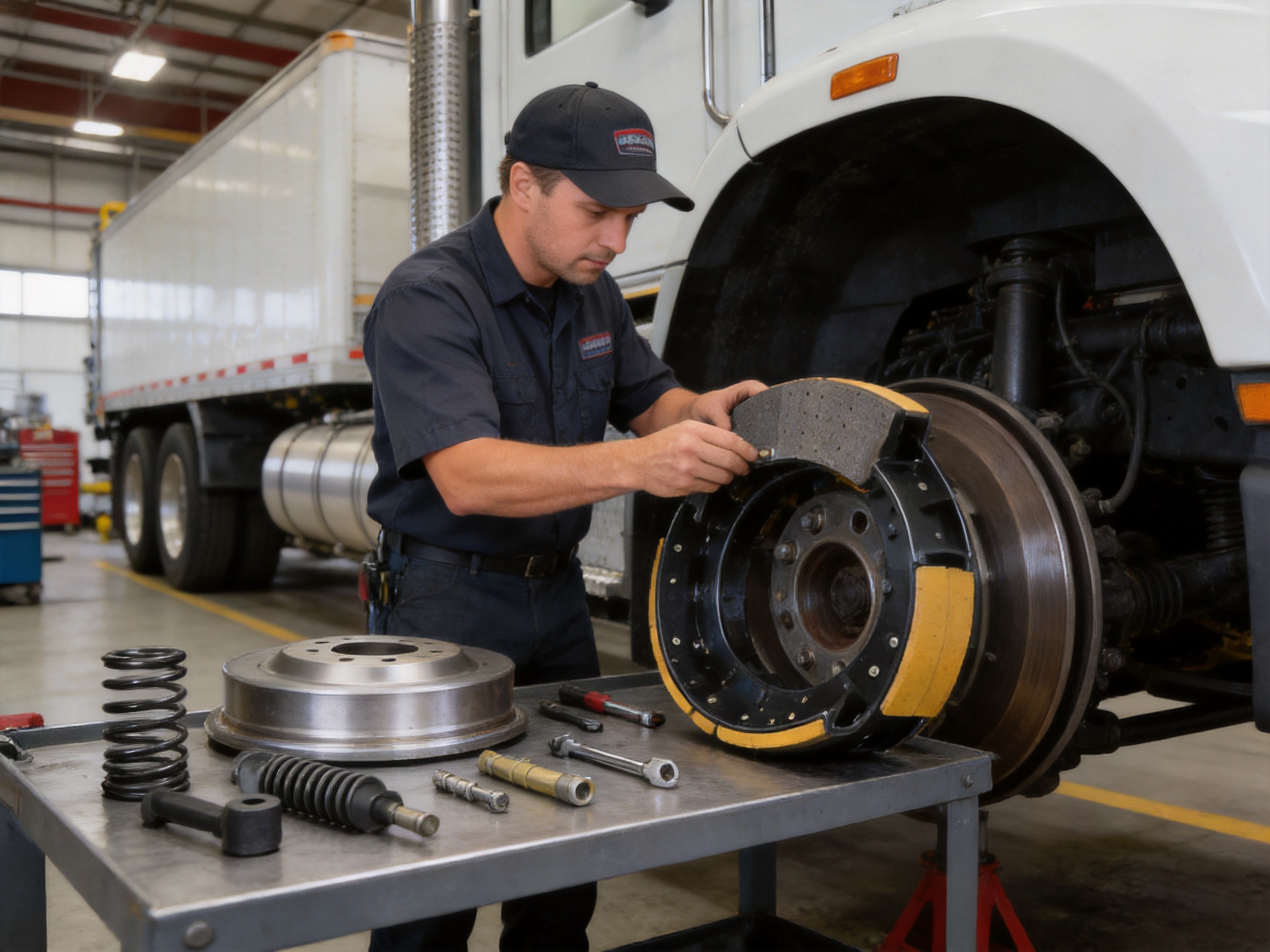
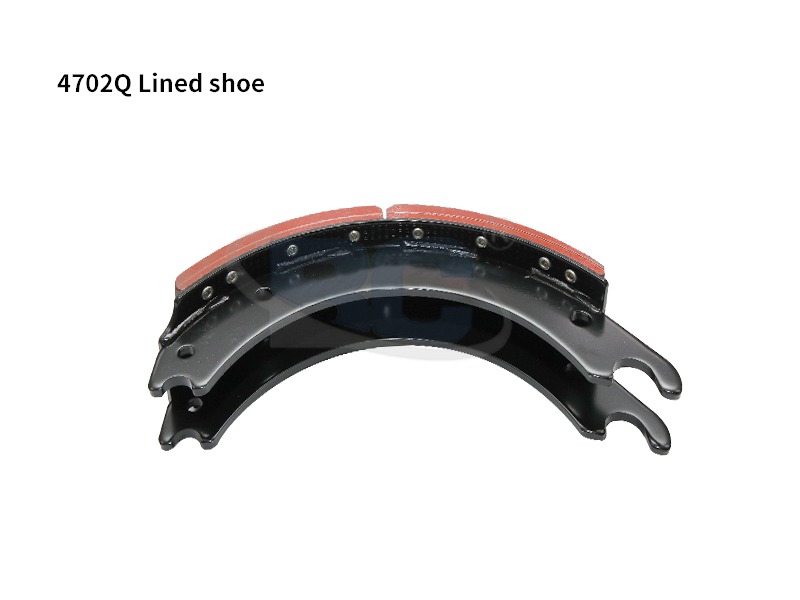
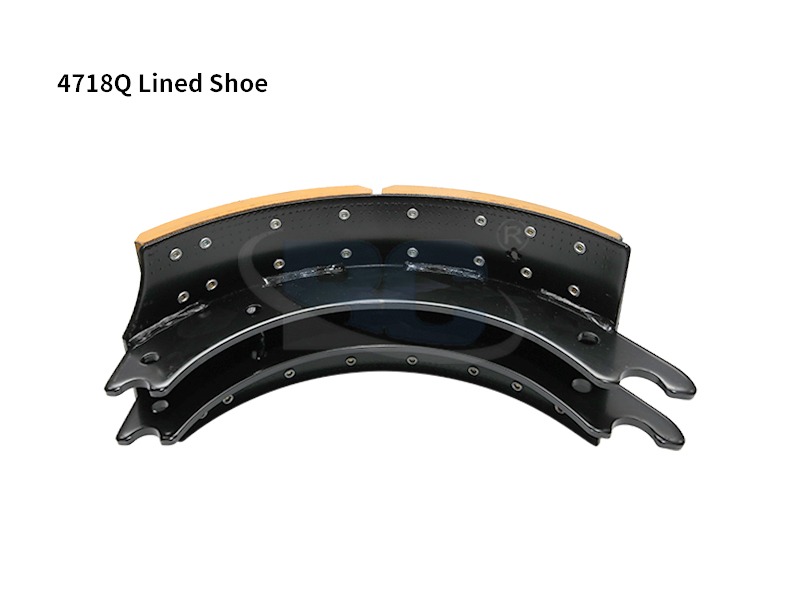
The 4718Q Lined Brake Shoe is a heavy-duty replacement component developed for commercial vehicle braking systems that require dependable friction performance, accurate fitment, and consistent serviceability. With a product size of 16.5 inches by 8 inches and 32 rivet holes, this lined brake shoe is designed around the dimensional and mounting requirements commonly associated with heavy truck and trailer brake assemblies.
Brake shoes operate in a demanding environment. They are exposed to repeated heating and cooling cycles, high mechanical loads, vibration, road contamination, moisture, and long periods of service. A brake shoe that appears simple in construction must therefore meet several requirements at the same time. Its metal shoe table must maintain structural integrity, its friction lining must remain securely attached, and the complete assembly must work evenly against the brake drum. The 4718Q Lined Brake Shoe addresses these needs as a complete lined assembly rather than as an unprepared metal shoe.
This product is manufactured by Zhejiang Bangchi Auto Parts Co., Ltd., a Chinese heavy-duty brake parts manufacturer serving the commercial vehicle replacement market. The company’s product range includes steel brake shoes, cast brake shoes, brake linings, lined brake shoes, brake shoe repair kits, and lined brake shoe kits. Its product development and identification system follows the global FMSI numbering system, helping customers connect replacement brake components with established application and interchange references.
For distributors, repair workshops, fleet maintenance departments, and original-equipment-oriented buyers, the 4718Q product offers a practical combination of complete assembly convenience, clear identification, 32-hole lining attachment, and heavy-duty dimensional coverage. It is suitable for customers who need a lined shoe that can be selected, stocked, and installed with less preparation than a bare brake shoe or loose lining.
4718Q Lined Brake Shoe
Product Overview and Main Specifications
The 4718Q Lined Brake Shoe is identified by the part number 4718Q. The product category is lined brake shoe, meaning that the brake lining is already attached to the brake shoe before delivery. This configuration can help reduce workshop preparation time and makes the component easier to handle during replacement work.
| Item | Specification |
|---|---|
| Product name | 4718Q Lined Brake Shoe |
| Product category | Lined Brake Shoe |
| Part number | 4718Q Lined Shoe |
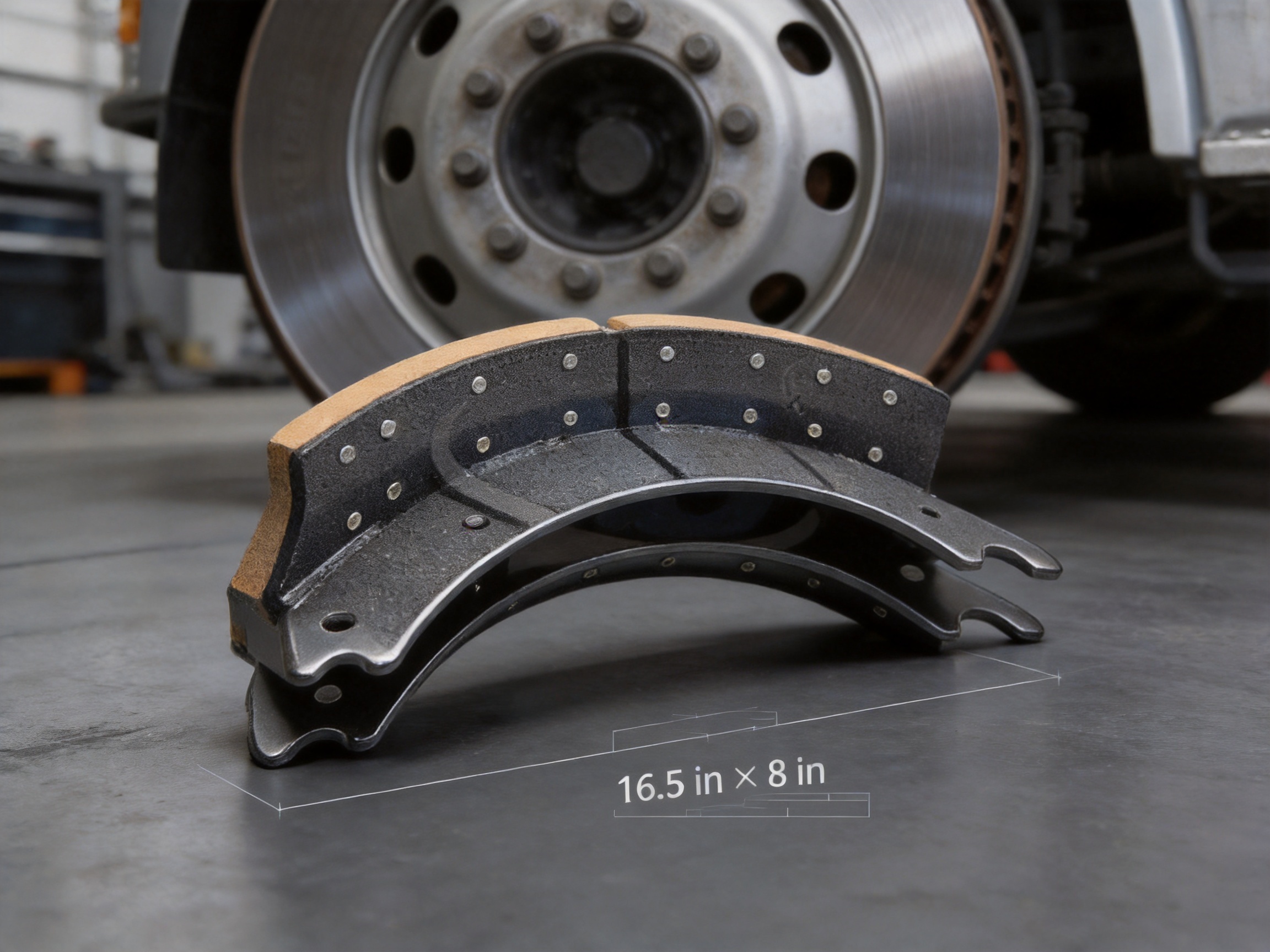
| Product size | 16.5 inches by 8 inches |
| Number of rivet holes | 32 |
| Application focus | Heavy-duty commercial vehicle brake service |
| Identification system | Global FMSI numbering system support |
| Available product family | Steel brake shoes, cast brake shoes, brake linings, lined brake shoes, repair kits, and lined brake shoe kits |
The 16.5-inch by 8-inch size is a key selection detail. Brake shoes must be matched to the correct brake drum, axle configuration, shoe geometry, lining profile, and mounting arrangement. Buyers should therefore use the stated size together with the part number, original equipment information, vehicle data, and service documentation before ordering.
The 32 rivet holes are another important identification feature. Rivet-hole count affects the lining attachment pattern and must correspond to the brake shoe and lining design. A brake lining with the wrong number of holes, an incorrect spacing pattern, or an unsuitable curvature may not provide proper attachment or contact. The 4718Q configuration gives customers a clear physical reference when comparing inventory, confirming an application, or evaluating replacement parts.
Why a Complete Lined Brake Shoe Is Valuable
A bare steel or cast brake shoe and a complete lined brake shoe serve different purchasing and maintenance needs. A bare shoe requires a separate lining, rivets, tooling, and an additional installation operation. The technician must select a compatible lining, verify the hole pattern, form or position the lining correctly, and install it with suitable riveting pressure. A complete lined shoe consolidates these steps into one supplied component.
The 4718Q Lined Brake Shoe can provide several practical advantages to maintenance operations:
First, it simplifies parts selection. The buyer orders one identified assembly rather than separately matching a shoe, lining, and attachment hardware. This can reduce the risk of pairing components that do not belong together.
Second, it can reduce workshop labor. A service technician can replace the worn lined shoe assembly without carrying out the separate relining operation. This may be particularly useful for fleet operators that maintain multiple vehicles and need predictable repair procedures.
Third, it improves inventory organization. A clearly numbered complete assembly is easier to list in a warehouse management system and easier to identify during dispatch. The part number, dimensions, and hole count provide three useful verification points.
Fourth, it supports consistent assembly quality. When the lining is installed under controlled manufacturing conditions, the manufacturer can manage the positioning, drilling or hole alignment, riveting sequence, and final inspection as part of a standardized process. A workshop may not always have the same equipment or production controls available when performing a field relining operation.
Finally, a complete lined shoe can help reduce vehicle downtime. The component arrives ready for installation, which is valuable for commercial vehicles that generate revenue through continuous operation. Faster replacement does not remove the need for correct inspection and adjustment, but it can make the overall maintenance process more efficient.
Construction of the 4718Q Assembly
Brake Shoe Foundation
The brake shoe is the structural foundation of the assembly. It transfers the force generated by the brake actuator through the shoe and into the friction lining. During braking, the shoe moves outward or otherwise applies pressure against the inner surface of the drum. The shoe must maintain its shape while carrying mechanical load and resisting repeated thermal cycles.
For a heavy-duty brake shoe, dimensional stability is important. The shoe must be manufactured with suitable curvature and mounting geometry so that it works correctly within the designated drum assembly. Excessive distortion, inaccurate dimensions, or poor fit may lead to uneven lining contact, abnormal wear, noise, or reduced braking consistency.
The 4718Q is supplied as a lined shoe rather than as a loose steel or cast component. This allows the metal foundation and friction material to be evaluated as one service assembly. The result is a product intended to provide a practical replacement option for maintenance organizations that prefer a ready-to-install configuration.
Friction Lining
The friction lining is the working surface that contacts the brake drum. Its function is to convert mechanical braking force into frictional resistance and heat. A suitable lining must provide stable friction characteristics over a broad range of temperatures and operating conditions while also controlling wear on both the lining and the drum.
Lining selection is not based on friction level alone. Commercial vehicle brake systems require a balance among friction stability, wear resistance, compressibility, noise behavior, heat tolerance, and compatibility with the drum. A lining that is too aggressive may increase drum wear, while a lining that loses friction stability under heat may reduce braking effectiveness. A well-designed heavy-duty lining must support predictable operation rather than simply produce a high initial friction value.
The 4718Q product is supplied with the lining attached to the shoe using a 32-hole rivet pattern. This attachment method is widely recognized in heavy-duty brake service because it provides a mechanical connection between the lining and the shoe. Correct hole alignment, rivet seating, and lining curvature are essential to the quality of the finished assembly.
Riveted Attachment
Riveting is a critical manufacturing stage. Each rivet must be properly positioned and formed so that the lining is held securely without cracks, loose areas, or excessive distortion. Rivet heads should be seated appropriately, while the lining surface should remain suitable for contact with the drum.
The 32-hole pattern distributes attachment points along the length of the lining. This helps the lining remain supported during repeated braking cycles. The actual performance of the attachment depends on factors such as rivet material, rivet dimensions, hole accuracy, riveting force, lining thickness, shoe curvature, and final inspection.
A complete lined brake shoe manufactured through a controlled riveting process can offer an advantage over inconsistently relined parts. The manufacturing environment allows the supplier to use repeatable work instructions and inspection checkpoints. This is especially relevant for commercial vehicle repair, where loose or poorly attached lining material can create serious safety and maintenance risks.
Manufacturing Process and Quality-Oriented Production
The production of a heavy-duty lined brake shoe involves more than attaching a friction lining to a metal component. A reliable manufacturing process coordinates incoming material control, component preparation, dimensional verification, lining installation, riveting, finishing, identification, and final inspection.
Material and Component Preparation
Production begins with the selection and preparation of the brake shoe foundation and friction lining. The shoe must correspond to the designated part number and geometry. The lining must be suitable for the intended application and must match the required length, width, thickness, curvature, and hole pattern.
Component preparation may include cleaning, surface conditioning, removal of burrs, and inspection for visible defects. Clean and properly prepared surfaces help ensure that the lining sits correctly against the shoe. A part that enters the riveting operation with burrs, contamination, or inaccurate holes can affect the quality of the finished assembly.
For a manufacturer serving multiple brake shoe categories, product identification is particularly important. Steel brake shoes, cast brake shoes, repair kits, and lined shoe assemblies can have similar appearances while differing in dimensions or application. Controlled part numbering and production records help prevent the wrong component from entering the next process.
Dimensional Control
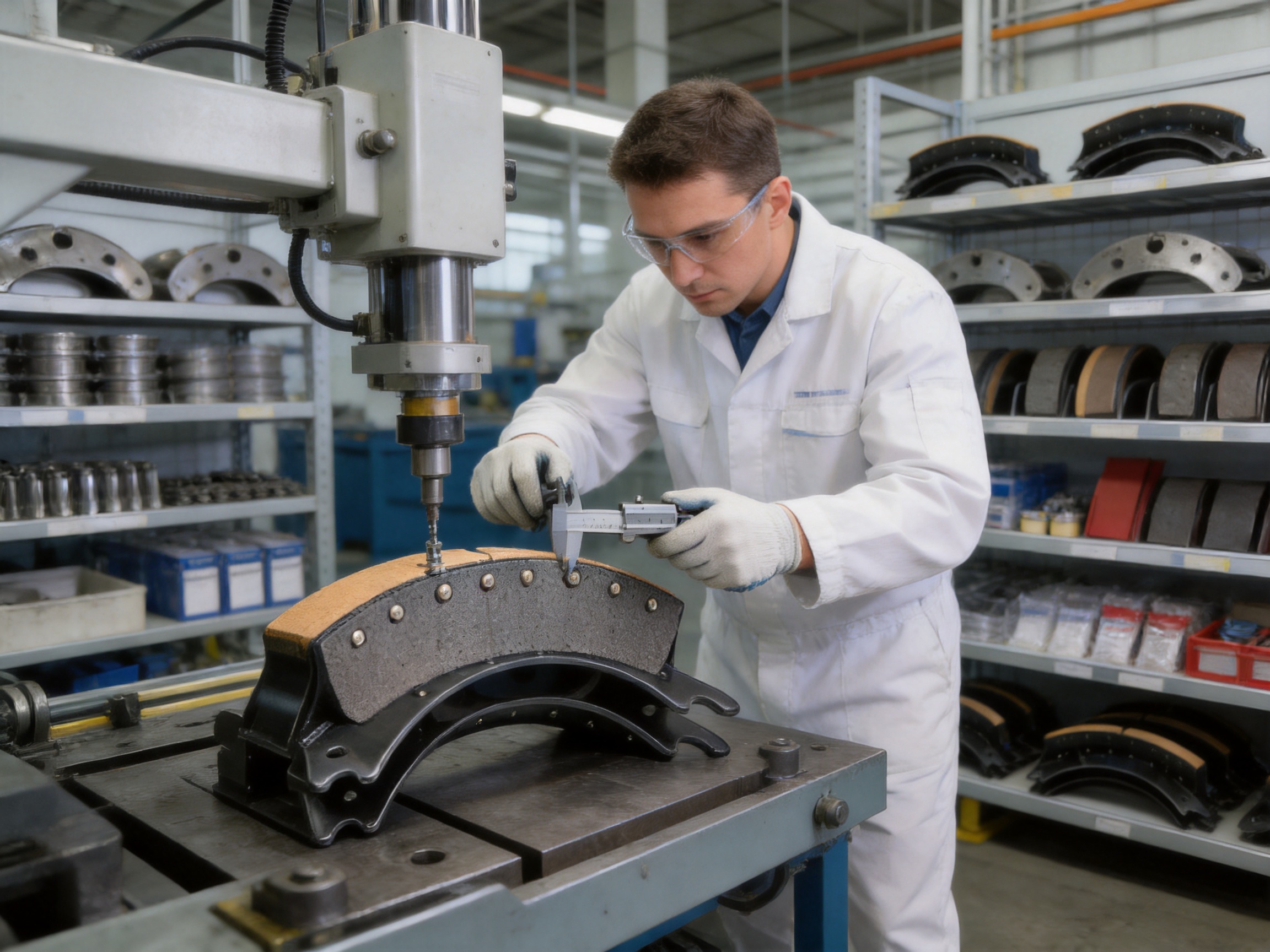
Dimensional control is central to brake shoe manufacturing. The finished 4718Q assembly must preserve the specified 16.5-inch by 8-inch product dimensions and the correct 32-hole attachment arrangement. Measurements can be used to verify overall size, lining position, hole spacing, shoe curvature, and other application-critical features.
Dimensional checks are valuable because a small error can affect installation or braking contact. If the lining is positioned too far from the correct edge, the shoe may not align properly inside the drum. If the curvature differs from the intended profile, the lining may contact the drum unevenly. If holes are misaligned, rivets may not seat correctly or the lining may be stressed during installation.
A disciplined manufacturing process uses inspection points throughout production rather than relying only on a final visual check. Early verification can identify a problem before additional labor and materials are invested. Final inspection then confirms that the completed assembly meets the relevant internal specifications for the part number.
Controlled Lining Installation
Before riveting, the lining is positioned on the brake shoe according to the established 4718Q configuration. The lining must follow the shoe’s curvature and remain correctly centered along its working surface. Positioning accuracy supports even contact with the drum and helps prevent premature edge wear.
The installation process should also avoid damage to the friction material. Cracks, chips, deep scratches, and excessive compression can compromise the lining. Proper handling is therefore part of manufacturing quality. The lining should be protected during movement between workstations and should be stored under appropriate conditions before assembly.
Riveting and Assembly Integrity
The riveting operation creates the mechanical connection between the lining and the shoe. For the 4718Q assembly, the 32 rivet holes must align accurately. Rivets are installed in a controlled sequence and formed so that the lining is held evenly along the shoe.
Assembly integrity can be evaluated through visual checks and dimensional verification. Inspectors may look for loose rivets, incomplete heads, cracks around holes, raised areas, misalignment, or gaps between the lining and shoe. The completed assembly should present a stable, uniform surface ready for installation into the brake system.
Manufacturing consistency is one of the strongest reasons to purchase a complete lined brake shoe from an experienced supplier. A professional production process can repeat the same assembly parameters across multiple units, helping distributors and fleets receive more uniform products than they might obtain from varied local relining sources.
Identification and Traceability
Clear identification supports the entire supply chain. The 4718Q part number should remain associated with the completed assembly through packaging, warehousing, delivery, and installation. Product labels and internal records can help customers verify that the component received corresponds to the ordered configuration.
The company’s use of the global FMSI numbering system is an additional strength for international buyers. Standardized identification makes it easier to compare catalog information, manage cross-reference data, and communicate with customers in different markets. Although part-number confirmation should always be completed against current application data, an established numbering approach improves the structure of product information.
Advantages Compared with Alternative Brake Shoe Options
Compared with Bare Steel Brake Shoes
A bare steel brake shoe gives the customer flexibility to select a lining separately, but it also transfers more work and responsibility to the repair shop. The buyer must confirm the lining material, dimensions, hole pattern, rivet selection, and installation method. This approach may be appropriate for specialist relining facilities, but it is not always the most efficient option for routine fleet maintenance.
The 4718Q lined configuration provides the shoe and friction lining as one identified product. Its principal advantage is convenience. The customer does not need to combine a separate lining with a bare foundation before installation. This can reduce selection errors and make the replacement process more predictable.
Compared with Loose Brake Linings
Loose linings can be economical when a workshop has a well-equipped relining department and trained personnel. However, loose linings require a compatible brake shoe and careful installation. If the shoe is worn, distorted, corroded, or damaged, installing a new lining alone may not restore the complete assembly to a satisfactory condition.
The 4718Q approach allows the brake shoe and lining to be replaced together. This is useful when the customer wants to renew the complete wearing assembly or when the condition of the old shoe makes relining unsuitable. A complete replacement can also simplify purchasing for workshops that do not want to stock many individual lining profiles.
Compared with Unverified Relined Assemblies
Some replacement brake shoes may be relined through inconsistent processes, with limited information about lining origin, hole alignment, rivet quality, or final inspection. The problem is not that relining is inherently unsuitable; professional relining can be effective. The concern is variation in workmanship and documentation.
A manufacturer-supplied lined shoe offers a more structured alternative. The part number, specified dimensions, 32-hole pattern, and production process create a clearer basis for procurement and quality control. Customers can establish receiving checks around the product specification and maintain more consistent replacement standards across vehicles.
Compared with Poorly Matched Low-Cost Components
Price alone does not determine the value of a brake component. A lower-priced part may create additional cost if it causes fitting problems, premature wear, repeated maintenance, or vehicle downtime. The 4718Q product is positioned as a heavy-duty replacement component whose value comes from correct configuration, ready-to-install convenience, and controlled assembly.
For distributors and fleets, these factors can support a lower total cost of ownership. The relevant calculation includes purchasing cost, labor, downtime, inventory complexity, inspection time, and the consequences of inconsistent braking components. A component that is easier to identify and install may be more economical over its service life even when the initial unit price is not the lowest available.
Manufacturing Strengths of Zhejiang Bangchi Auto Parts
Zhejiang Bangchi Auto Parts Co., Ltd. specializes in heavy-duty brake parts for commercial vehicle applications. Its product portfolio covers several related product types, including steel brake shoes, cast brake shoes, brake linings, lined brake shoes, brake shoe repair kits, and lined brake shoe kits. This breadth gives the company experience across the main components used in drum brake maintenance.
The company’s specialization is an important strength. A supplier focused on heavy-duty brake parts can organize its tooling, inspection methods, product knowledge, and catalog systems around the specific needs of commercial vehicle braking. This is different from a general metalworking supplier that may produce a brake shoe without maintaining a complete understanding of lining attachment and service requirements.
The company also provides products according to the global FMSI numbering system. This supports international product organization and helps customers communicate using recognizable replacement references. For export distributors, a consistent identification approach can assist catalog preparation, stock planning, quotation work, and customer service.
Its location in Haining, Zhejiang, places the company within a developed manufacturing region with access to industrial supply chains, processing resources, logistics services, and skilled production labor. The company address is No. 9 Building, No. 11 Qiyi Road, Chang’an Town, Haining, Zhejiang, China.
Another strength is product range coordination. A customer may require a lined brake shoe for one application, a cast brake shoe for another, and a repair kit for a third. Working with a supplier that offers several categories can reduce the number of separate sourcing relationships and make it easier to standardize brake component procurement.
For international buyers, direct communication is also important. Zhejiang Bangchi Auto Parts can be contacted by telephone at +86-133 7230 7977 or +86-0573-87960600. Its fax number is +86-0573-87960639, and its email address is sfp@zjbangchi.com. Customers should use these channels to confirm current availability, packaging, application information, production lead time, and technical documentation before placing an order.
Application and Selection Guidance
The 4718Q Lined Brake Shoe should be selected using more than one specification. Buyers should compare the part number, size, rivet-hole count, original brake system information, vehicle model, axle details, drum dimensions, and service documentation. The stated 16.5-inch by 8-inch size is an important starting point, but it should not replace complete application verification.
Before installation, the technician should inspect the brake drum. A drum with excessive wear, deep scoring, cracking, out-of-round deformation, or a diameter beyond its service limit may prevent a new shoe from operating correctly. Installing a new lined shoe against a damaged drum can lead to poor contact and uneven wear.
The remaining brake hardware should also be checked. Return springs, hold-down components, adjusters, anchor points, cam components, bushings, and related parts may affect brake operation. If these components are worn or damaged, replacing the lined shoe alone may not resolve the underlying problem.
The brake shoe should be installed by a qualified technician who follows the vehicle or axle manufacturer’s service procedure. Correct orientation is essential because leading and trailing shoes, where applicable, may have different positions or functions. The technician should confirm the position of each shoe and ensure that all hardware is correctly fitted.
After installation, the brake system should be adjusted according to the appropriate maintenance procedure. The vehicle should be tested in a controlled environment before returning to normal service. Any unusual noise, pulling, vibration, overheating, delayed application, or uneven braking should be investigated immediately.
Maintenance and Service Considerations
Brake performance depends on the complete system, not only on the friction lining. Regular inspection helps identify wear before it becomes a safety or downtime issue. Fleet operators should establish inspection intervals based on vehicle usage, load, road conditions, braking frequency, climate, and legal requirements.
During inspection, technicians may examine lining thickness, rivet condition, surface damage, contamination, cracking, glazing, and wear uniformity. The lining should not be allowed to wear to the point where rivet heads contact the drum. Such contact can damage the drum and significantly impair braking performance.
Uneven wear can indicate problems elsewhere in the system. Possible causes include worn bushings, incorrect adjustment, misaligned components, a damaged drum, seized hardware, contamination, or uneven shoe movement. The 4718Q assembly should be evaluated as part of the complete brake system rather than treated as an isolated component.
Contamination from grease, oil, or other substances can change friction behavior. If contamination is found, the source should be identified and corrected. Simply cleaning the surface may not restore the lining if the contaminant has penetrated the friction material.
Newly installed brake shoes may require a bedding-in or burnishing procedure specified by the vehicle or brake system manufacturer. Proper bedding helps the lining and drum establish a more uniform contact surface. Aggressive braking immediately after installation may create excessive heat and uneven contact, so technicians should follow the correct service guidance.
Benefits for Different Customer Groups
For Fleet Operators
Fleet operators benefit from standardization. Using a clearly identified 4718Q assembly can help maintenance teams order the same configuration repeatedly, create consistent inspection procedures, and simplify technician training. A ready-to-install product may also shorten workshop time and reduce the number of relining operations performed internally.
Fleet purchasing departments can use the part number and physical specifications to improve inventory control. Stock records can include the 4718Q identifier, 16.5-inch by 8-inch size, 32-hole pattern, and approved vehicle applications. This reduces the risk of issuing an incorrect component to a maintenance bay.
For Repair Workshops
Repair workshops can use a complete lined shoe to support faster service. Instead of setting up a separate relining operation, the workshop can focus on removal, inspection, installation, adjustment, and testing. This may be especially useful when equipment, space, or skilled relining labor is limited.
The product also supports a cleaner workflow. The workshop receives a completed assembly with a defined hole pattern and lining position, reducing the number of loose components that must be managed during the repair.
For Distributors
Distributors need products that are easy to describe and verify. The 4718Q part number, product category, size, and rivet-hole count provide useful catalog information. A supplier with multiple heavy-duty brake product categories can also help distributors build a broader commercial vehicle brake range.
Consistent product identification is valuable when serving different markets. Buyers can communicate using the part number while confirming application details with the supplier. This can reduce misunderstandings caused by informal descriptions such as “large truck shoe” or “16.5-inch brake lining.”
For Export Customers
Export customers often require dependable communication, packaging consistency, and technical confirmation before shipment. Zhejiang Bangchi Auto Parts provides direct contact channels for customers who need to discuss specifications, order quantities, private labeling possibilities, delivery arrangements, or product documentation.
International buyers should request current technical information and confirm the exact application before importing. They should also clarify packaging protection, marking requirements, inspection expectations, and shipping documents in advance. These steps help ensure that the product arrives in a condition suitable for warehouse storage and customer distribution.
Quality and Reliability in Heavy-Duty Brake Parts
Reliability in a brake shoe is created by the interaction of design, materials, manufacturing accuracy, and service conditions. No single feature can guarantee performance under every operating environment. The 4718Q product is therefore best understood as a complete replacement assembly designed around correct dimensions, a defined 32-hole rivet pattern, and controlled lining attachment.
Compared with generic products that provide little application information, the 4718Q has a clearer identity. The part number gives the buyer a specific reference, while the size and hole count provide physical confirmation. These details support better purchasing decisions and make it easier to investigate any installation issue.
Quality also includes consistency from one production batch to another. Commercial vehicle customers need replacement parts that behave predictably because inconsistent components can complicate maintenance records and vehicle performance. A specialized manufacturing supplier can use repeatable production procedures to support greater uniformity in shape, lining position, and attachment quality.
The company’s range of brake shoes, linings, and repair kits suggests an integrated understanding of the heavy-duty brake parts market. This can benefit customers that require more than one type of component. Instead of sourcing unrelated products from several suppliers, a buyer may be able to coordinate a broader product program through one specialized manufacturer.
Ordering and Pre-Purchase Checklist
Before ordering the 4718Q Lined Brake Shoe, customers should prepare the following information:
1. Confirm the required part number and whether the requested product is the complete lined shoe rather than a bare shoe or loose lining.
2. Confirm the product size of 16.5 inches by 8 inches.
3. Confirm that the required assembly uses a 32-rivet-hole lining pattern.
4. Compare the product with the vehicle, axle, brake, or original equipment information available to the customer.
5. Confirm the required quantity and whether the products are intended for fleet maintenance, distribution, or project supply.
6. Request current availability, production lead time, packaging details, and shipping information.
7. Clarify inspection requirements, labeling requirements, and any customer-specific documentation.
8. Confirm storage conditions and handling requirements after receipt.
9. Ask for any available application or cross-reference information before final approval.
10. Arrange a receiving inspection procedure so that the part number, dimensions, hole count, and visible assembly quality can be checked upon delivery.
This checklist helps prevent incorrect orders and supports a smoother transition from purchasing to installation. It is particularly important for international transactions, where returning an incorrectly specified heavy-duty brake component can cause additional freight cost and vehicle downtime.
Q&A
What is the 4718Q product?
The 4718Q is a lined brake shoe for heavy-duty commercial vehicle brake service. It is supplied as an assembly with the friction lining already attached to the brake shoe.
What are the dimensions of the 4718Q Lined Brake Shoe?
The stated product size is 16.5 inches by 8 inches. Customers should verify the complete brake application before ordering because size alone does not identify every aspect of a brake shoe configuration.
How many rivet holes does the 4718Q lining use?
The product has 32 rivet holes. This hole count should be matched against the existing brake system and application information before installation.
Why choose a lined brake shoe instead of a bare shoe?
A lined brake shoe is supplied as a more complete replacement assembly. It can reduce separate lining selection, relining labor, attachment work, and inventory complexity. It may be especially useful for workshops and fleets that want a ready-to-install component.
Can the 4718Q replace every 16.5-inch by 8-inch brake shoe?
No. The stated size is only one selection factor. Buyers must also confirm part number, shoe geometry, lining profile, rivet pattern, drum compatibility, axle configuration, and vehicle or brake manufacturer information.
What is the advantage of the 32-hole rivet pattern?
The 32-hole pattern provides a defined mechanical attachment arrangement between the lining and shoe. When correctly matched and properly riveted, the pattern supports secure lining retention across the shoe surface.
Who manufactures the 4718Q Lined Brake Shoe?
The product is manufactured by Zhejiang Bangchi Auto Parts Co., Ltd., a heavy-duty brake parts manufacturer located in Haining, Zhejiang, China.
What other products does the manufacturer provide?
The company provides steel brake shoes, cast brake shoes, brake linings, lined brake shoes, brake shoe repair kits, and lined brake shoe kits. This product range supports different repair and replacement requirements in the heavy-duty brake market.
Does the company support international product identification?
The company provides OEM brake parts following the global FMSI numbering system. This can help international customers organize product references and communicate about replacement applications.
What should be checked before fitting the 4718Q?
The technician should inspect the brake drum, shoe hardware, adjuster, springs, anchor points, bushings, and related components. The correct shoe position, lining condition, rivet security, and brake adjustment should also be confirmed.
What should be done after installation?
The brake should be adjusted and tested according to the relevant vehicle or brake system service procedure. The vehicle should be operated carefully until the new lining and drum establish suitable contact, and any abnormal noise, vibration, pulling, or overheating should be investigated.
How can customers contact the manufacturer?
Customers can contact Zhejiang Bangchi Auto Parts Co., Ltd. by telephone at +86-133 7230 7977 or +86-0573-87960600. The fax number is +86-0573-87960639, and the email address is sfp@zjbangchi.com.
Conclusion
The 4718Q Lined Brake Shoe is a practical heavy-duty replacement assembly for customers seeking a clearly identified shoe and lining combination. Its 16.5-inch by 8-inch size and 32-rivet-hole configuration provide important selection references, while the complete lined format helps reduce separate relining work and simplify workshop installation.
Its advantages over bare shoes, loose linings, and unverified relined assemblies come from configuration control, installation convenience, product identification, and the ability to procure a finished component from a specialized brake parts manufacturer. These advantages are particularly relevant to commercial vehicle fleets, repair workshops, distributors, and export buyers that need consistent replacement products.
Zhejiang Bangchi Auto Parts Co., Ltd. strengthens the product offering through its focus on heavy-duty brake components, broad product portfolio, support for the global FMSI numbering system, and manufacturing base in Haining, Zhejiang. By coordinating brake shoe foundations, friction linings, riveting, dimensional checks, identification, and final inspection, the company can provide a more organized alternative to individually sourced or inconsistently assembled parts.
As with any brake component, correct application verification and professional installation remain essential. When the 4718Q is matched to the correct brake system and maintained as part of a complete braking assembly, it can support efficient heavy-duty brake service and more consistent fleet maintenance practices.
References
1. Zhejiang Bangchi Auto Parts Co., Ltd. Product information for the 4718Q Lined Brake Shoe.
2. Zhejiang Bangchi Auto Parts Co., Ltd. Heavy-duty brake product range information, including steel brake shoes, cast brake shoes, brake linings, lined brake shoes, repair kits, and lined shoe kits.
3. Friction Materials Standards Institute. General principles for friction material identification and replacement reference systems.
4. Commercial vehicle brake service manuals covering drum inspection, brake shoe replacement, adjustment, and bedding procedures.
5. Heavy-duty vehicle maintenance guidelines covering brake drum condition, friction lining wear, rivet inspection, and brake hardware service.
6. General manufacturing quality-control practices for dimensional inspection, riveted assemblies, component identification, and production traceability.