 English
 简体中文
Heavy-duty braking systems must perform reliably under high loads, repeated heat cycles, variable road conditions, and demanding maintenance schedules. For commercial trucks, trailers, buses, construction equipment, and agricultural machinery, the brake shoe is a central structural component in the drum-brake assembly. It supports the friction lining, transfers mechanical force to the brake drum, and helps convert braking energy into controlled deceleration.
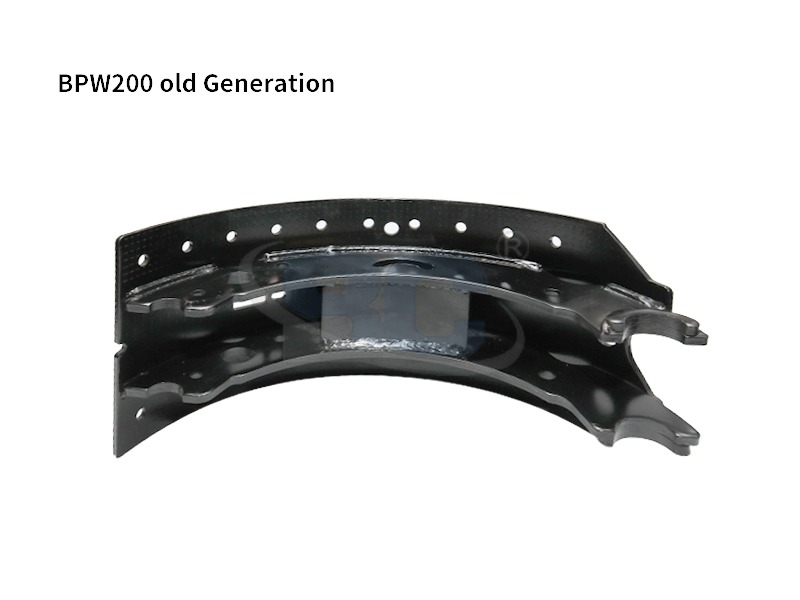
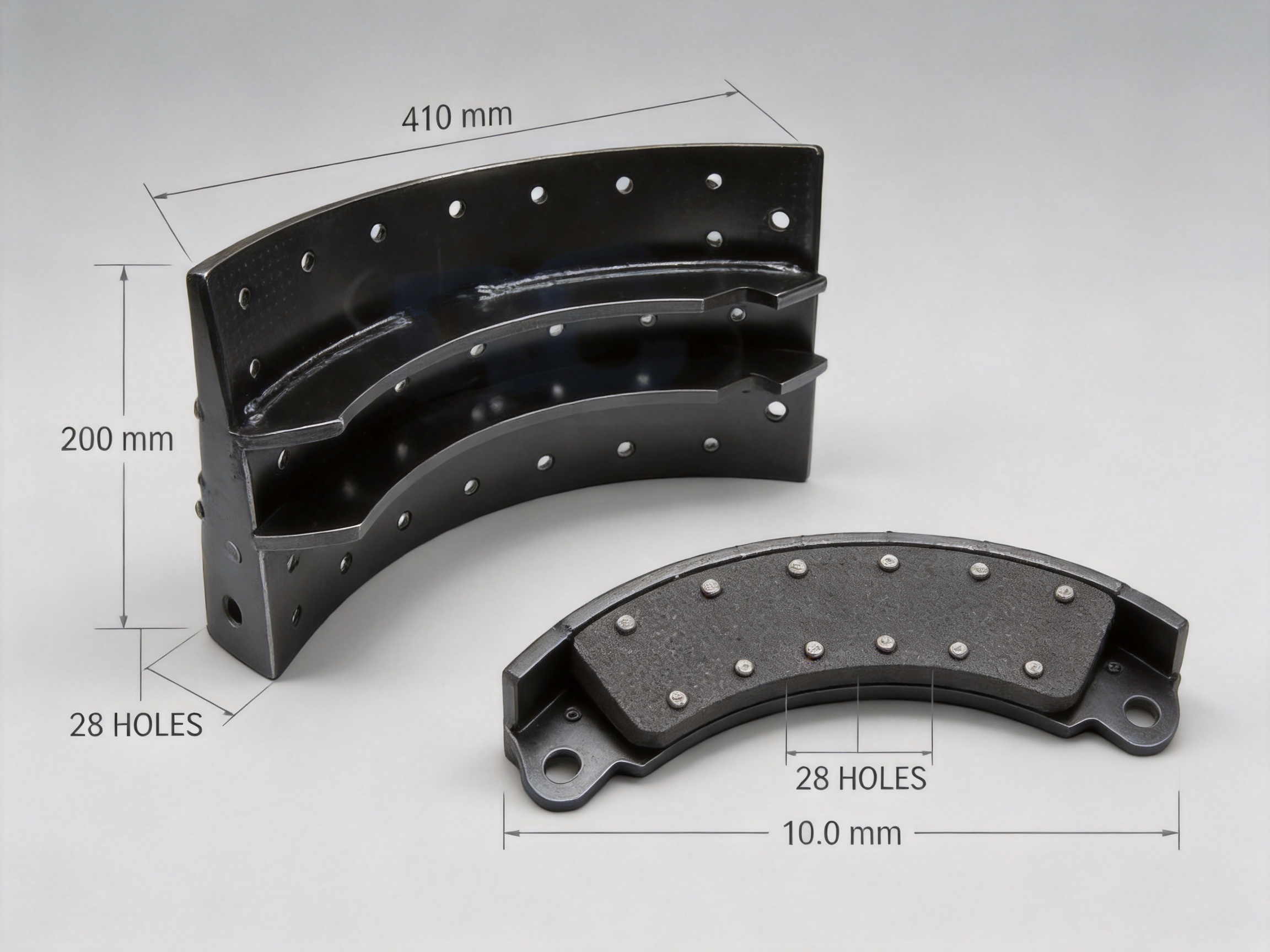
The old-generation 410 × 200 mm brake shoe is designed for operators who require a proven replacement solution for legacy vehicle platforms. With a 410 mm by 200 mm footprint, 28 rivet holes, and OE reference number 0270.828-7, this brake shoe is intended to provide a practical balance of structural strength, predictable braking behavior, straightforward servicing, and cost-effective fleet operation.
Unlike a newly developed brake shoe intended only for modern vehicle platforms, the old-generation design is based on an established configuration that has been used across demanding commercial applications. Its value is therefore not limited to the dimensions shown on a product sheet. The main advantage is compatibility with existing brake assemblies, familiar installation procedures, established lining arrangements, and replacement practices already understood by fleet maintenance teams.
This article explains the product’s construction, technical characteristics, operating advantages, manufacturing considerations, installation requirements, maintenance principles, and suitability for different heavy-duty applications. It also examines how a specialized manufacturer can support consistent product quality through controlled material selection, forming, welding, machining, dimensional inspection, surface treatment, and final quality assurance.
Product Identification and Core Specifications
The product is identified as an old-generation brake shoe with the part reference VL200 Old Generation and OE number 0270.828-7. The principal dimensions are 410 × 200 mm, and the shoe incorporates 28 rivet holes. These identifiers should always be checked against the vehicle manufacturer’s parts information, the existing brake assembly, and the dimensions of the removed component before ordering or installation.
| Item | Specification | Maintenance Significance |
|---|---|---|
| Product type | Heavy-duty steel brake shoe | Supports drum-brake friction lining applications |
| Generation | Old-generation design | Primarily suited to legacy vehicle and fleet replacement programs |
| Reference part | VL200 Old Generation | Useful for product identification and purchasing |
| OE reference | 0270.828-7 | Must be cross-checked with the vehicle application |
| Overall size | 410 × 200 mm | Important for brake drum and backing-plate compatibility |
| Rivet-hole quantity | 28 | Provides distributed attachment points for the lining |
| Rivet-hole diameter | 10.0 mm | Should match the approved rivet and lining specification |
| Material | Standard-grade steel | Provides the supporting structure for heavy-duty service |
| Listed friction coefficient | 0.38–0.43 | Indicates the expected friction range of the specified lining system |
| Listed maximum temperature | 450°C | Represents the stated thermal capability of the product configuration |
The dimensions and hole pattern are particularly important because brake shoes are not universal components. A shoe that appears visually similar may have a different arc, offset, cam profile, web thickness, hole diameter, or mounting geometry. Installing an incorrectly matched shoe can create uneven lining contact, excessive drum wear, poor braking balance, noise, or premature component failure.
For this reason, the OE number, part number, physical dimensions, number of rivet holes, and vehicle application should be considered together. A purchasing department should avoid relying only on a general description such as “410 mm brake shoe.” Detailed identification reduces the risk of receiving a visually similar but technically unsuitable replacement.
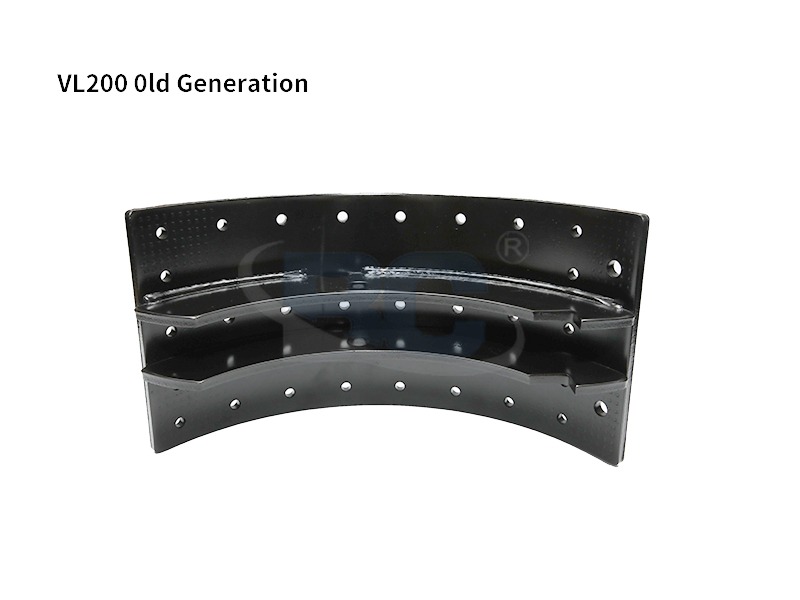
VL200 Old Generation Brake Shoe
Structural Design and Functional Role
A brake shoe has two primary functions. First, it acts as a rigid support for the friction lining. Second, it transfers the force generated by the brake actuator or cam mechanism into the lining and then into the rotating drum. These functions require adequate stiffness, accurate geometry, and stable dimensional characteristics.
The 410 × 200 mm shoe uses a steel foundation intended to maintain its shape under repeated loading. During braking, the shoe is subjected to expanding forces, vibration, thermal cycling, and localized pressure at the lining contact surface. If the foundation flexes excessively, the lining may not contact the drum evenly. Uneven contact can reduce braking efficiency and accelerate both lining and drum wear.
The 28-hole configuration distributes the attachment points along the lining. A well-distributed rivet pattern helps control lining movement and supports uniform load transfer. It also provides a familiar arrangement for maintenance personnel working on legacy commercial brake systems. The hole pattern must be aligned accurately with the lining, because an incorrectly positioned hole can weaken the lining or create installation stress.
Importance of the Steel Foundation
Steel selection influences the strength, stiffness, machinability, and durability of the brake shoe. A suitable steel grade must tolerate forming operations and subsequent service loads without excessive distortion. The material must also respond consistently to welding, machining, surface preparation, and handling during assembly.
High-grade or properly controlled standard-grade steel does not automatically mean that every shoe will perform identically. Product performance depends on the complete manufacturing system, including incoming material inspection, blank preparation, forming accuracy, weld quality, heat management, dimensional control, and final inspection. A reliable manufacturer therefore treats the material as one part of a wider quality chain.
Role of Geometry in Braking Performance
The shoe’s arc and overall profile should correspond to the brake drum with which it is intended to operate. When the geometry is correct, the lining can develop contact across the designed area as the shoe expands. When the geometry is inaccurate, contact may be concentrated at the leading or trailing edge, increasing local temperature and wear.
Correct geometry also supports stable adjustment. Excessive clearance between the lining and drum may increase actuator travel, while insufficient clearance may cause drag. The shoe must therefore be manufactured and installed within the tolerances specified for the related brake system.
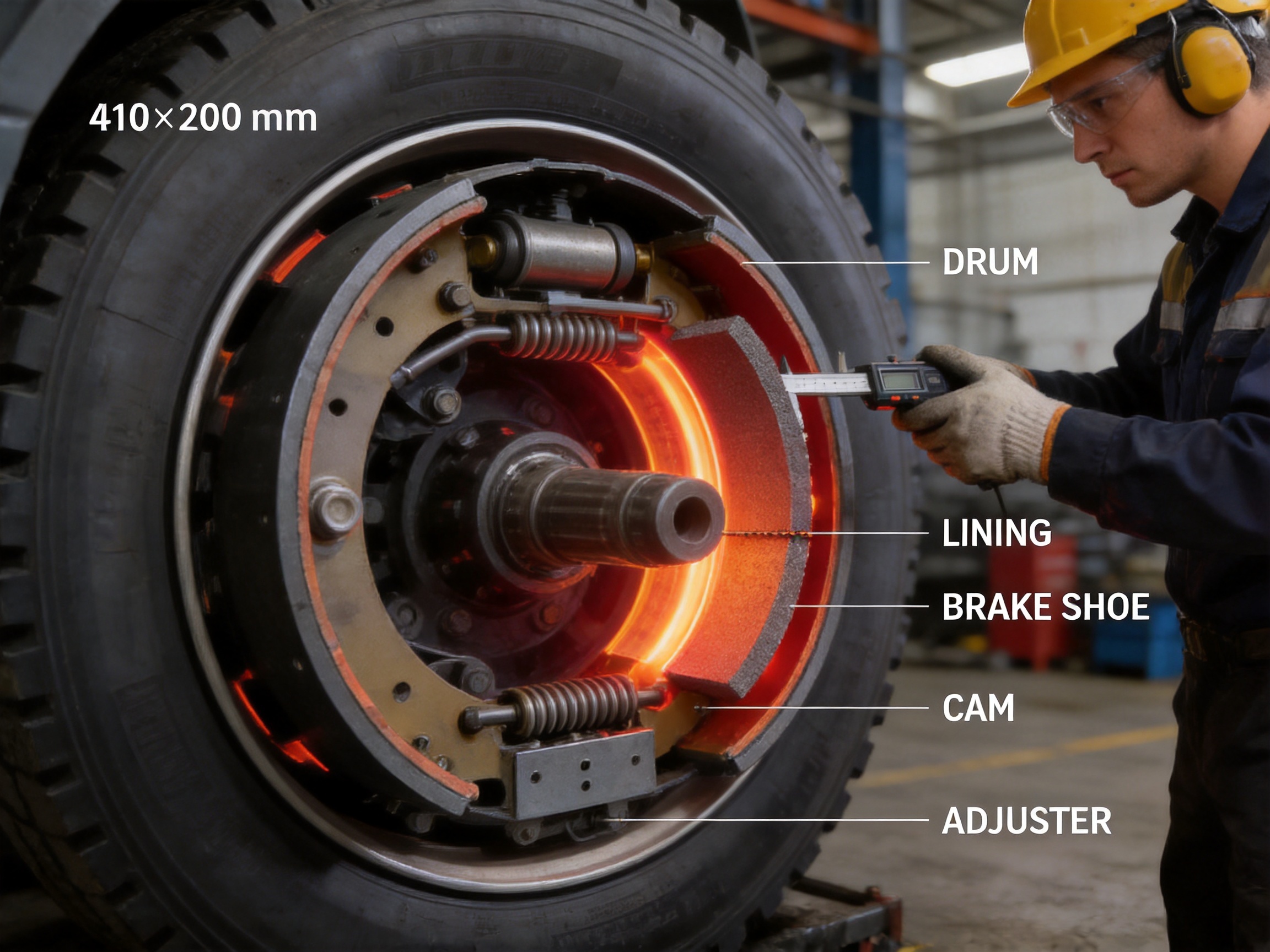
Because old-generation designs are often used in vehicles with many years of operating history, replacement work should include an inspection of the drum, camshaft, rollers, anchor points, return springs, bushings, and adjusters. A new shoe cannot compensate for a worn or damaged surrounding brake assembly.
Operating Advantages in Heavy-Duty Applications
The most important advantage of this brake shoe is its suitability for established heavy-duty applications. Fleet operators often maintain vehicles for long service periods, and many of those vehicles continue to use legacy brake assemblies. A replacement component that matches the original footprint and hole pattern can help reduce conversion work and avoid unnecessary changes to the wider braking system.
Proven 28-Hole Configuration
The 28-rivet arrangement is designed to support balanced attachment of the friction lining. Distributed fastening can help maintain consistent lining support across the shoe and reduce the risk of localized movement when the brake is applied repeatedly. It also provides a familiar reference for workshops that already service this type of brake shoe.
A balanced rivet layout does not eliminate the need for correct riveting technique. Rivets must be the correct size and material, and they must be set without cracking the lining or deforming the shoe. The installation surface should be clean and free of burrs, and the rivet sequence should follow the applicable service procedure.
Consistent Friction Behavior
The listed friction coefficient of 0.38–0.43 indicates a moderate friction range for the specified lining system. In practical terms, consistent friction behavior helps the driver and braking system produce predictable deceleration. It may also support more stable brake balance across repeated applications when the shoe is correctly matched with the vehicle, drum, actuator, and lining material.
Friction performance is affected by more than the shoe foundation. Lining formulation, drum condition, speed, load, moisture, temperature, bedding, adjustment, and application force all influence the final result. The stated coefficient should therefore be understood as product information for the specified configuration rather than a guarantee of identical performance under every operating condition.
Thermal Resistance for Repeated Service
The product information lists a maximum temperature of 450°C and describes fade resistance up to that level. Heavy-duty vehicles can generate substantial heat during downhill operation, frequent stop-and-go driving, emergency braking, or operation with high gross vehicle weight. A brake shoe and lining system must maintain structural stability and predictable friction behavior as temperatures rise.
Thermal performance also depends on correct drum condition and brake adjustment. A scored drum, sticking camshaft, seized adjuster, weak return spring, or dragging shoe can create unnecessary heat. Therefore, thermal capability should be viewed as part of a complete braking system rather than as an isolated property of the steel shoe.
Reduced Risk of Uneven Drum Wear
When the shoe geometry and lining contact are properly matched to the drum, braking pressure can be distributed more evenly. This may help reduce concentrated wear, hot spots, and aggressive scoring. A well-maintained shoe can therefore contribute to lower total maintenance cost over the service life of the brake assembly.
Drum wear must still be measured during service. If the drum has exceeded its approved diameter, developed deep scoring, or shows signs of heat checking, replacing only the brake shoe may not restore safe or consistent performance. Drum resurfacing or replacement should be considered according to the vehicle manufacturer’s limits.
Compatibility with Manual and Automatic Adjustment Systems
The old-generation shoe is described as compatible with both manual and automatic slack-adjuster systems when the correct installation procedures are followed. Compatibility means that the shoe can operate within the relevant mechanical arrangement; it does not remove the need to verify the exact axle, cam, adjuster, and return-spring configuration.
Automatic slack adjusters must be inspected for correct movement, mounting, and adjustment. Manual adjusters must be set according to the vehicle manufacturer’s service instructions. Poor adjustment can cause long actuator travel, reduced braking response, shoe drag, overheating, or uneven lining wear.
Comparison with Generic or Poorly Matched Alternatives
In the aftermarket, products may appear similar while differing in steel thickness, arc accuracy, hole location, weld quality, surface treatment, or dimensional consistency. The competitive advantage of a properly manufactured replacement shoe is not based solely on its nominal size. It is based on the ability to reproduce the required geometry and performance characteristics consistently from one production batch to another.
A generic shoe with an approximate 410 × 200 mm size may not be equivalent to the specified product. Small deviations in the rivet-hole pattern can affect lining alignment. Variations in the arc can reduce the initial contact area. Differences in web stiffness can alter force distribution. Even a small change in offset may create interference with adjacent components.
The old-generation design also offers a practical advantage over an unnecessary system conversion. Fleet operators replacing legacy brake shoes may prefer to retain the existing configuration when it remains suitable and parts are available. Maintaining a familiar design can simplify inventory planning, reduce technician retraining, and limit downtime.
| Evaluation Factor | Specified Old-Generation Shoe | Potentially Poorly Matched Alternative |
|---|---|---|
| Identification | Uses a defined part and OE reference | May rely only on approximate dimensions |
| Rivet-hole pattern | 28 holes with stated 10.0 mm diameter | May have different spacing or diameter |
| Vehicle suitability | Intended for established heavy-duty applications | May not match the axle or drum assembly |
| Geometry control | Requires controlled 410 × 200 mm profile | May show variation in arc or offset |
| Service familiarity | Supports existing workshop procedures | May require adaptation or additional verification |
| Maintenance planning | Useful for legacy fleet replacement programs | Can increase identification and fitting risk |
| Quality traceability | Can be linked to a defined production specification | May lack complete process documentation |
It is important not to assume that every alternative is inferior. A competing product can be suitable if it has verified dimensional compatibility, appropriate material quality, reliable manufacturing controls, and documented application approval. The correct purchasing decision should be based on evidence, not on price alone or visual similarity.
Manufacturing Process and Quality Strengths
The manufacturer’s ability to produce dependable brake shoes depends on process control from raw material receiving through final shipment. A heavy-duty brake shoe is a formed and machined structural component, and its quality cannot be assured by final appearance alone. Internal process discipline is essential for repeatability.
Controlled Raw Material Selection
Manufacturing begins with steel procurement from approved sources. Material documentation should identify the grade, thickness, heat or batch reference, and relevant mechanical or chemical characteristics. Incoming inspection may include visual checks, dimensional measurement, hardness testing, and verification of supplier documentation.
Consistent steel quality helps stabilize forming behavior and reduces unexpected variation during welding and machining. Material traceability also allows production teams to investigate issues more effectively if a quality concern is reported in the field.
Precision Blanking and Profile Preparation
The initial steel blank must be cut according to the approved drawing. Accurate blank dimensions support the later forming operation and help maintain a consistent shoe profile. Cutting quality is important because excessive burrs, heat-affected edges, or dimensional variation can interfere with forming and finishing.
Depending on the production arrangement, blanking may use dedicated stamping tools, mechanical cutting equipment, laser systems, or other controlled methods. The selected process should be capable of maintaining repeatable dimensions at the required production volume.
Forming and Arc Control
Forming establishes the curved profile and structural shape of the shoe. The tooling must be maintained to prevent progressive wear from changing the arc, width, offset, or web position. Production staff should verify first-off pieces and conduct periodic checks during the run.
Springback is a normal consideration when forming steel. If it is not controlled, the final shoe may deviate from the intended profile. Manufacturers can address this through tooling design, forming parameters, process trials, and dimensional inspection after forming.
Welding and Structural Assembly
Where the shoe design includes welded structural elements, welding quality contributes directly to the component’s strength. Proper joint preparation, suitable welding parameters, controlled heat input, and trained operators help reduce the risk of incomplete fusion, excessive spatter, undercut, distortion, or other defects.
Welded assemblies may be checked visually and dimensionally. Depending on customer requirements and applicable quality procedures, additional non-destructive inspection may be used for selected welds or production batches. The goal is to confirm that the joint supports the intended service load and that the finished shoe remains within its dimensional specification.
Machining and Hole Accuracy
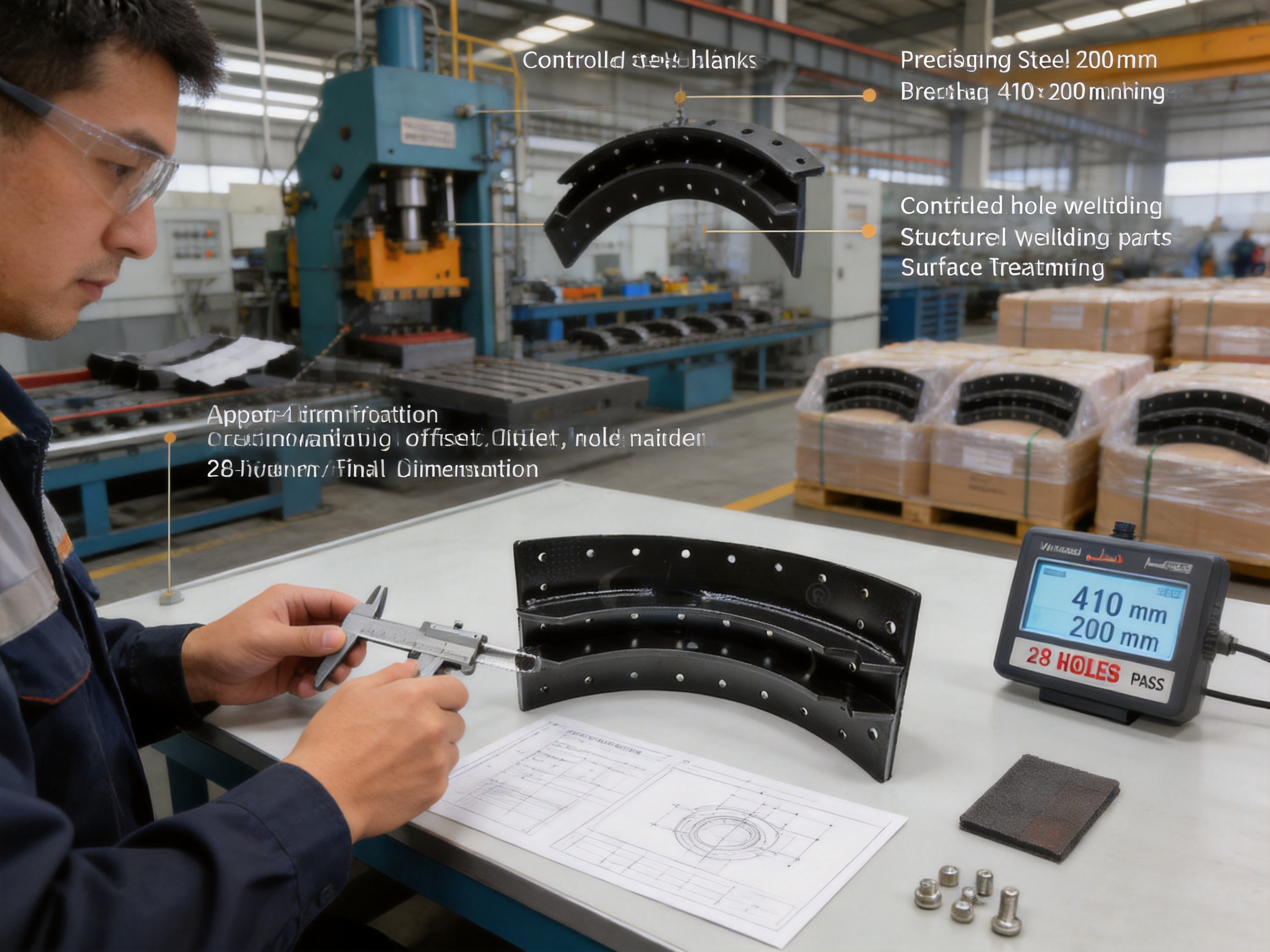
The 28 rivet holes must be positioned accurately and remain free from damaging burrs. Hole location affects lining installation, while hole diameter affects rivet fit and setting quality. Controlled drilling, punching, or machining processes can be used according to the design and production equipment.
Hole gauges, coordinate measurement, templates, and dedicated inspection fixtures can help verify the pattern. Particular attention should be given to the first and last holes in the sequence, as well as to the relationship between the hole pattern and the shoe centerline.
Surface Preparation and Corrosion Protection
After forming and machining, the steel surface may require cleaning, deburring, shot blasting, phosphating, painting, or another approved protective treatment. Surface preparation removes contaminants and supports better coating adhesion. Corrosion protection is important because brake shoes may be stored, shipped, or installed in environments with moisture, road salt, dust, and temperature variation.
Coating must be applied in a way that does not interfere with lining contact areas, rivet holes, mounting surfaces, or other critical interfaces. Masking and post-treatment inspection help ensure that protective finishing supports, rather than compromises, assembly accuracy.
Final Dimensional and Visual Inspection
Final inspection may include checks of overall dimensions, shoe arc, width, offset, hole count, hole diameter, surface condition, weld appearance, and identification marking. A batch should be reviewed against the approved drawing and product specification before release.
Inspection records support traceability and provide useful information for continuous improvement. When a manufacturer records process measurements rather than relying only on a pass-or-fail visual inspection, it becomes easier to identify trends before they create significant product variation.
Why Manufacturing Discipline Matters to Fleet Operators
For a fleet operator, component consistency affects more than braking performance. It affects installation time, vehicle availability, spare-parts planning, technician confidence, and warranty risk. A shoe that fits correctly on the first attempt reduces workshop delays and avoids the expense of returning or modifying unsuitable parts.
Consistent products also make maintenance results easier to evaluate. If the same specification is supplied repeatedly, fleet managers can compare lining wear, drum condition, inspection intervals, and operating performance more accurately. This supports data-based decisions about replacement timing and inventory levels.
A manufacturer with experience in heavy-duty brake components can also provide useful technical support during product selection. Application confirmation, drawing review, sample comparison, batch traceability, packaging identification, and export documentation all contribute to a smoother supply chain.
Zhejiang Bangchi Auto Parts Co., Ltd. is presented as a China-based heavy-duty brake-parts manufacturer and factory supplying OEM brake components according to the global FMSI numbering system. For buyers, this positioning suggests a focus on replacement-part identification, production capability, and support for international commercial-vehicle applications. As with any supplier, customers should confirm current certifications, inspection records, production capacity, and application approvals during the purchasing process.
Application Areas
Heavy-Duty Trucks
Long-haul and regional trucks place repeated demands on drum brakes. Vehicles may operate with high gross weight, frequent braking cycles, mountainous routes, or congested urban traffic. A replacement shoe for a legacy axle can help maintain the original service arrangement while supporting regular fleet maintenance.
Before installation, technicians should verify that the brake drum dimensions, axle model, cam arrangement, and lining specification correspond to the shoe. The vehicle should also be inspected for uneven braking, air-system faults, worn bushings, or incorrect adjustment.
Commercial Trailers
Trailers may remain in service for many years and can be exposed to dust, moisture, road salt, and long periods of storage. Their brake components should be inspected carefully for corrosion, contamination, and mechanical stiffness. A correctly identified old-generation shoe can be useful for maintaining trailer fleets with established drum-brake configurations.
Because trailers may be coupled to different tractors, braking balance and compatibility are especially important. The replacement shoe should be installed as part of a complete brake-system inspection rather than treated as an isolated component.
Buses and Coaches
Buses and coaches require predictable braking because they transport passengers and often operate on routes involving repeated stops. Urban buses may generate frequent heat cycles, while coaches may experience high-speed braking and long downhill descents. Correct shoe geometry, lining condition, drum condition, and adjustment are essential in both applications.
Construction Vehicles
Construction vehicles often work in dusty, uneven, or off-road environments. Their brake components may encounter contamination, vibration, heavy loads, and irregular operating cycles. The steel foundation and established design of this brake shoe make it suitable for consideration in applications where a compatible drum-brake assembly is already in service.
Agricultural Machinery
Agricultural machines can experience seasonal use, long storage periods, mud, moisture, and sudden changes in load. During seasonal maintenance, the brake shoe should be checked for corrosion, lining separation, contamination by oil or grease, and sticking mechanical components. Replacement should be based on condition and manufacturer limits rather than on calendar time alone.
Installation and Service Recommendations
Brake work should be performed by trained personnel using the correct tools and the vehicle manufacturer’s service information. The vehicle must be secured against movement, and the braking system must be depressurized or isolated as required by the service procedure.
Pre-Installation Inspection
Inspect the brake drum for scoring, cracks, heat checking, excessive diameter, or abnormal wear. Measure the drum where required and compare the result with the applicable limit. A drum that is outside its service specification can prevent the new lining from bedding correctly.
Inspect the camshaft, rollers, anchor points, bushings, springs, adjuster, and related hardware. Replace worn or damaged parts rather than reusing them simply because the brake shoe is being replaced. Clean the assembly carefully, but keep oil, grease, and solvent away from friction surfaces.
Riveting and Lining Attachment
The lining and shoe should be matched to the specified 28-hole pattern and 10.0 mm hole diameter. Use approved rivets and the correct riveting equipment. Rivets should be installed progressively and evenly to avoid stressing the lining.
The supplied service information recommends torquing rivets to 35–40 N·m using a cross pattern. Technicians must verify whether this instruction applies to the exact rivet type and installation tooling being used, because rivet-setting requirements can vary according to design and equipment. The lining should sit flush against the shoe without gaps, cracking, or distortion.
Installation on the Axle
After the shoe and lining are prepared, install the assembly according to the axle manufacturer’s procedure. Confirm that the shoe moves freely on its supports and that the cam, rollers, springs, and adjuster operate correctly. The shoe should not bind against the backing plate or adjacent components.
Check that the lining is centered correctly in relation to the drum. Confirm that all fasteners are tightened to the specified values. Do not substitute general tightening practices for the vehicle manufacturer’s torque requirements.
Bedding-In Procedure
The service information recommends 200–300 km of progressive braking to allow proper bedding. During this period, avoid unnecessary severe braking where operating conditions permit. Progressive bedding helps establish contact between the lining and drum and allows the technician or driver to identify abnormal noise, pull, vibration, or heat.
After bedding, inspect the system again if the application is severe or if symptoms appear. A new shoe and lining should not be considered fully validated until contact, adjustment, and braking behavior are satisfactory.
Inspection Intervals
The supplied information recommends inspecting lining thickness at 12,000 km intervals under normal conditions. Severe service, mountainous routes, heavy loads, frequent stops, contamination, or abnormal heat may require shorter intervals.
Replace the lining or shoe assembly when the friction material is worn below 8 mm, or earlier if cracking, glazing, separation, contamination, or uneven wear is observed. Follow the applicable vehicle and brake-system requirements when determining the final replacement limit.
Common Wear Patterns and Their Causes
Uneven lining wear can result from drum distortion, incorrect shoe geometry, worn rollers, seized adjusters, weak springs, improper bedding, or misalignment. Edge wear may indicate that contact is concentrated on one part of the lining. Tapered wear may suggest a mechanical alignment issue or uneven force distribution.
Glazing can develop when the lining becomes overheated or is subjected to repeated light braking without adequate bedding. Cracking may be related to thermal stress, excessive mechanical loading, incorrect riveting, or a defective lining. Oil or grease contamination generally requires immediate corrective action because it can significantly reduce friction.
Drum scoring should not be ignored. Deep grooves can prevent full lining contact and may accelerate wear. Blue discoloration, heat checking, or excessive polishing may indicate overheating or brake drag. These symptoms should lead to a complete system inspection rather than simply replacing the shoe.
Procurement and Inventory Planning
Fleet buyers should record the part number, OE reference, dimensions, hole pattern, lining specification, vehicle application, and supplier batch information. This creates a clear purchasing record and helps prevent incorrect substitutions.
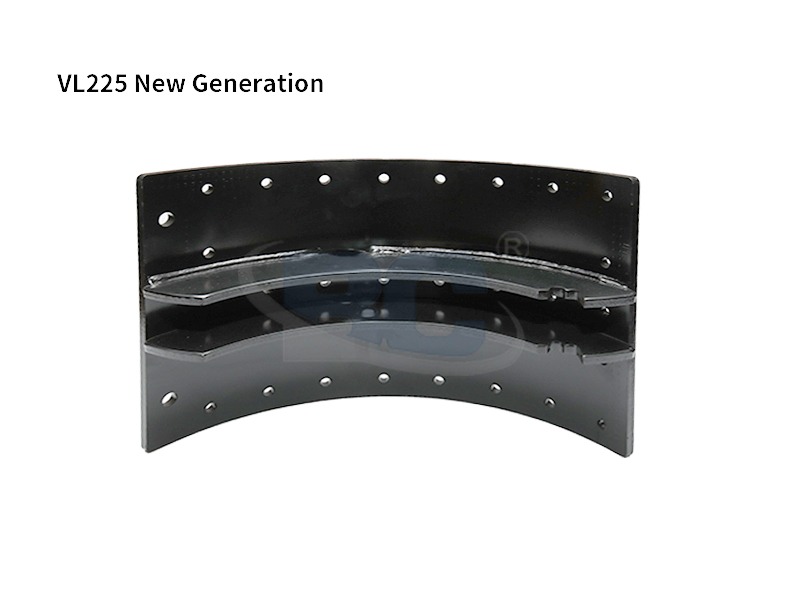
Because old-generation brake shoes are primarily intended for legacy fleet replacements, operators should review their future vehicle plans. If a fleet is gradually moving to a new-generation brake system, the purchasing team may need separate inventory categories for old-generation and new-generation components. Although the new-generation design is described as sharing the same footprint and bolt pattern, compatibility should still be confirmed for the exact vehicle and axle before upgrading.
Inventory should be stored in a dry, clean area away from corrosive chemicals, excessive humidity, and direct exposure to water. Brake shoes should remain in their protective packaging until installation. Parts should be rotated according to the date received, and packaging labels should remain legible throughout storage.
Quality and Supplier Evaluation Checklist
When evaluating this brake shoe or comparable products, buyers should request clear technical information. The supplier should be able to confirm the part reference, OE number, dimensions, rivet-hole count, hole diameter, material description, and intended application.
Buyers may also ask about incoming material inspection, production traceability, dimensional inspection, weld inspection, coating procedures, packaging protection, and complaint handling. For high-volume fleet programs, sample approval and periodic batch inspection can provide additional confidence.
A capable manufacturing partner should communicate clearly about technical deviations. If a drawing revision, material change, tooling update, or production-location change occurs, customers should receive appropriate notification when the change could affect fit, form, function, or quality.
Environmental and Economic Considerations
Replacing a worn brake shoe with a correctly matched component can help extend the useful life of an existing brake assembly. Maintaining legacy equipment may be economically attractive when the vehicle remains productive and the surrounding system is in good condition.
However, low purchase price should not be the only consideration. A poorly fitted shoe can increase installation labor, cause premature lining wear, damage the drum, and create vehicle downtime. Total cost of ownership includes the purchase price, labor, inspection time, replacement frequency, drum life, fuel effects from brake drag, and the cost of unplanned repairs.
Manufacturing efficiency can also contribute to cost control. Stable tooling, reduced scrap, optimized material use, controlled production batches, and effective inspection procedures help a manufacturer deliver consistent products at competitive prices without removing essential quality controls.
Safety Considerations
Brake shoes are safety-critical components. Product information, including dimensions, friction characteristics, and temperature capability, should never replace application verification or professional installation. Operators must follow the vehicle manufacturer’s service instructions and all applicable legal and technical requirements.
Do not mix incompatible lining materials on the same axle unless specifically approved. Avoid installing components that are cracked, bent, corroded beyond acceptable limits, contaminated, or otherwise damaged. After installation, perform the required functional tests in a controlled environment before returning the vehicle to normal operation.
Any unusual pull, vibration, noise, odor, wheel-end temperature, or change in pedal or actuator behavior should be investigated promptly. A brake problem can develop from related components even when the new shoe itself is correctly manufactured.
Frequently Asked Questions
What is the main application of this old-generation brake shoe?
It is primarily intended for replacement service on existing heavy-duty vehicles that use the compatible 410 × 200 mm brake-shoe configuration. Typical applications include heavy-duty trucks, commercial trailers, buses, coaches, construction vehicles, and agricultural machinery.
What is the OE reference number?
The listed OE reference number is 0270.828-7. Buyers should confirm this reference together with the physical dimensions, 28-hole pattern, vehicle model, axle type, and brake-system specification.
What are the product dimensions?
The stated product size is 410 × 200 mm. These dimensions should be treated as identification information and verified against the existing shoe and the relevant technical drawing before installation.
How many rivet holes does the shoe have?
The shoe has 28 rivet holes. The listed hole diameter is 10.0 mm. Both the number and diameter should match the selected lining and rivet system.
Can this product be used on new vehicles?
The old-generation design is primarily intended for existing fleet replacements and legacy vehicle applications. New vehicle platforms may use a new-generation design. Application compatibility must be confirmed before ordering.
Can operators upgrade from the old generation to the new generation?
The supplied product information states that the new-generation design shares the same footprint and bolt pattern and may be used as a direct upgrade option. Nevertheless, an upgrade should be confirmed for the exact vehicle, axle, lining, drum, adjuster, and service requirements.
What friction coefficient is listed for the product?
The listed friction coefficient is 0.38–0.43 for the specified lining configuration. Actual braking performance depends on lining material, drum condition, temperature, load, speed, adjustment, bedding, and other system factors.
What is the stated maximum temperature?
The listed maximum temperature is 450°C, with consistent fade resistance described up to that level. This value should not be interpreted as permission to operate a damaged, dragging, contaminated, or incorrectly adjusted brake at high temperature.
Is the shoe compatible with automatic slack adjusters?
Yes, the product information describes compatibility with automatic and manual slack adjusters when correct installation procedures are followed. The specific adjuster, axle, cam, and mounting arrangement still require verification.
What should be checked before installation?
Inspect the brake drum, camshaft, rollers, bushings, anchor points, springs, adjuster, backing plate, and related hardware. Check for scoring, cracking, excessive wear, corrosion, contamination, binding, and incorrect adjustment.
What bedding distance is recommended?
The supplied service notes recommend 200–300 km of progressive braking for proper bedding. The driver should monitor braking behavior and report noise, vibration, pulling, abnormal heat, or other unusual symptoms.
When should the lining be replaced?
The service information recommends replacement when lining thickness falls below 8 mm or when cracking, glazing, separation, contamination, or uneven wear is observed. Local regulations and vehicle manufacturer limits may require a different or more conservative threshold.
How often should lining thickness be inspected?
An inspection interval of 12,000 km is stated for normal conditions. Severe routes, high loads, frequent stops, steep grades, or abnormal heat may require more frequent inspection.
How does the manufacturer support product quality?
A dependable manufacturing program should control steel selection, blanking, forming, welding, machining, hole accuracy, surface treatment, dimensional inspection, final inspection, and product traceability. Buyers should request current documentation and confirm the controls applicable to their order.
Conclusion
The old-generation 410 × 200 mm heavy-duty brake shoe is a practical replacement solution for compatible legacy drum-brake systems. Its key identifiers include the 0270.828-7 OE reference, 28-rivet-hole configuration, 10.0 mm listed hole diameter, steel construction, 0.38–0.43 listed friction coefficient, and stated temperature capability up to 450°C.
Its principal advantages include a proven configuration, compatibility with established heavy-duty applications, familiar maintenance procedures, distributed lining attachment, and suitability for fleet replacement programs. These advantages are most valuable when the shoe is correctly matched to the drum, axle, lining, adjuster, and vehicle application.
The product’s performance also depends on the manufacturer’s process discipline. Controlled steel procurement, accurate forming, reliable welding, precise hole machining, effective surface protection, dimensional inspection, and traceable quality records help transform a basic steel component into a dependable commercial brake part.
For fleet operators, distributors, and repair facilities, the best purchasing decision combines verified application data with consistent manufacturing quality and professional installation. When these elements are managed together, the old-generation brake shoe can support dependable braking, manageable maintenance, and cost-effective operation across demanding commercial and off-highway environments.
References
1. Commercial Vehicle Drum Brake Service Principles, technical training reference for inspection, adjustment, lining replacement, and bedding procedures.
2. Federal Motor Vehicle Safety Standard No. 121, Air Brake Systems, regulatory reference for applicable heavy-vehicle braking requirements.
3. United Nations Economic Commission for Europe Regulation No. 13, Uniform Provisions Concerning the Approval of Vehicles with Regard to Braking.
4. ISO 6312, Road Vehicles and Braking Systems, reference material concerning brake-lining friction characteristics and testing practices.
5. Heavy-Duty Vehicle Brake Maintenance Manuals, general reference for brake drums, slack adjusters, cam mechanisms, friction linings, and service inspection.
6. Product technical information for the 410 × 200 mm old-generation brake shoe, including OE reference 0270.828-7, 28-rivet-hole configuration, service notes, and listed operating data.