 English
 简体中文
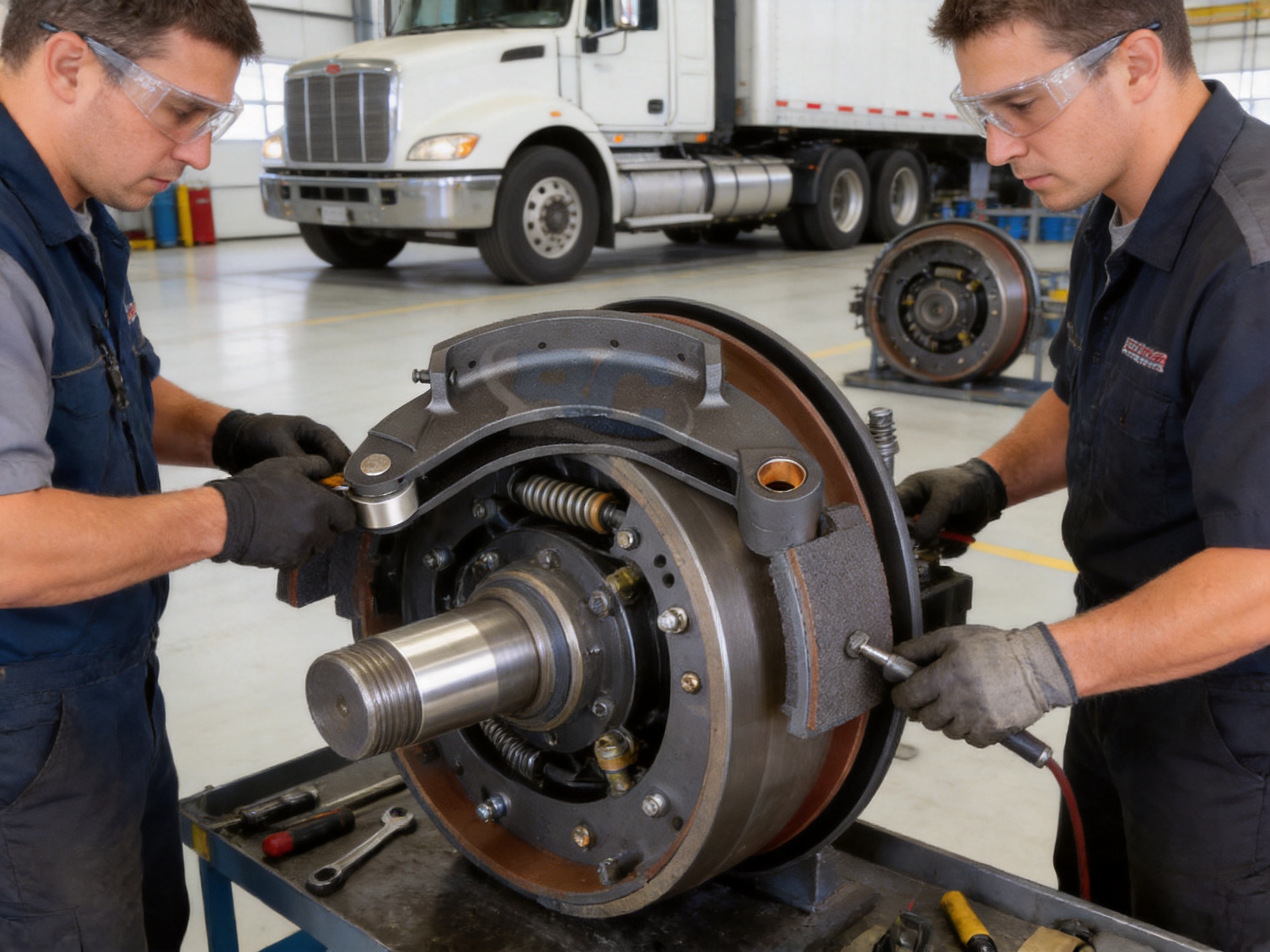
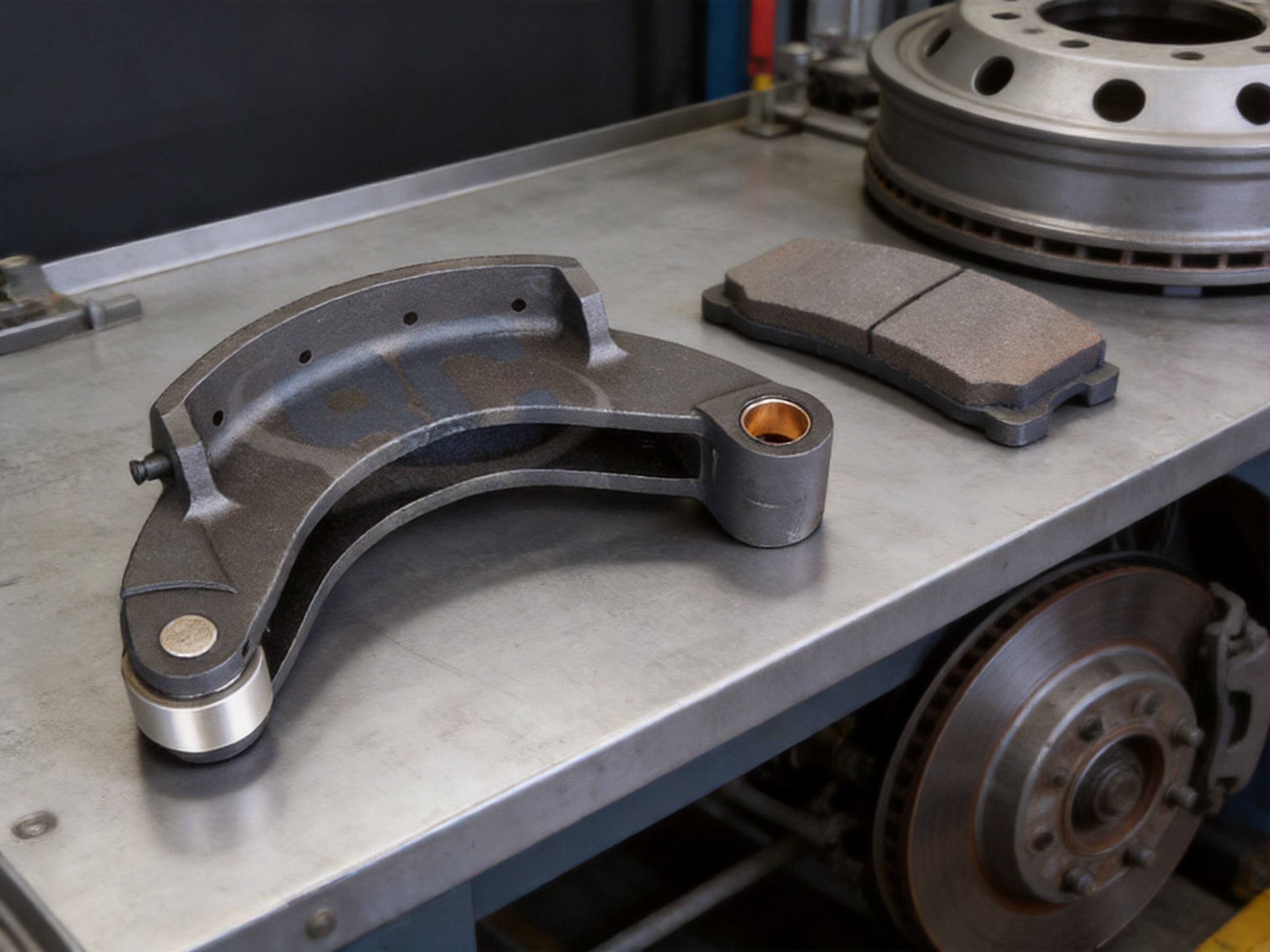
Heavy-duty braking systems demand components that can withstand high mechanical loads, repeated thermal cycles, vibration, contamination, and long operating hours. A casted brake shoe is one of the most important structural parts in a drum-brake assembly because it transfers the force generated by the actuator to the friction lining and then to the brake drum. The quality of the shoe influences braking consistency, lining service life, drum wear, maintenance frequency, and overall vehicle safety.
The 1104542 casted brake shoe, identified by part number SCA127, is designed for heavy commercial vehicle applications. It has a listed size of 413 x 127 millimeters, incorporates eight riveting holes, and is intended for use in systems identified for Scania vehicles. These specifications make it suitable for professional replacement programs where dimensional accuracy, structural strength, and dependable lining attachment are essential.
Produced by Zhejiang Bangchi Auto Parts Co., Ltd., this casted brake shoe is positioned within a broader heavy-duty brake-parts range that includes steel brake shoes, brake linings, lined brake shoes, brake shoe repair kits, and lined brake shoe kits. The product is manufactured for replacement and aftermarket applications while following the global FMSI numbering system. This approach supports easier product identification and helps distributors, repair centers, and fleet operators manage brake-component selection with greater confidence.
1. Product Overview
The 1104542 casted brake shoe is a heavy-duty foundation component for a drum-brake assembly. Its primary role is to support the friction lining and convert mechanical actuator movement into controlled friction against the inner surface of the brake drum. When the brake is applied, the shoe must remain stable while handling radial force, bending stress, vibration, and heat transferred through the lining.
Unlike a simple flat support plate, a brake shoe is a shaped structural element engineered to match the geometry of a specific brake system. The curvature must correspond with the brake drum, the ends must engage correctly with the brake hardware, and the riveting-hole pattern must allow the correct friction lining to be installed. Even a small dimensional error can create uneven contact, incomplete bedding, abnormal noise, accelerated lining wear, or reduced braking efficiency.
The 1104542 reference identifies the required replacement configuration, while SCA127 functions as the corresponding internal or product part number. The stated 413 x 127 millimeter dimensions provide an important first point of verification for buyers and technicians. However, professional installation should also confirm the full application data, including shoe profile, web geometry, hole spacing, anchor-end configuration, cam-end configuration, lining thickness, and brake-drum compatibility.
| Product Attribute | Specification | Importance in Service |
|---|---|---|
| Product type | Casted brake shoe | Provides a rigid support structure for the friction lining |
| Product part number | SCA127 | Supports internal identification and ordering |
| OEM reference | 1104542 | Helps match the replacement component to the vehicle system |
| Nominal size | 413 x 127 mm | Provides a dimensional basis for application verification |
| Riveting-hole count | 8 | Determines compatibility with the specified friction lining |
| Application | Scania heavy vehicles | Indicates the intended commercial vehicle platform |
| Product category | Casted brake shoe | Distinguishes the component from steel shoes and complete lined assemblies |
2. Why Casted Brake Shoes Matter in Heavy-Duty Braking
Commercial vehicles operate under conditions that are considerably more demanding than those experienced by passenger cars. A loaded truck or bus may carry many times the mass of a passenger vehicle, and that mass must be controlled repeatedly on highways, urban routes, gradients, construction sites, and industrial roads. During braking, the shoe is exposed to forces that are transmitted through the actuator, lining, and drum.
A casted construction can provide a strong and stable support structure when properly designed and manufactured. The casting process allows the shoe to be formed with integrated contours, reinforcing geometry, mounting features, and accurate end profiles. This is valuable for heavy-duty service because the shoe must preserve its shape throughout repeated braking cycles.
Structural stability helps maintain the intended relationship between the lining and the drum. If the shoe flexes excessively, the lining may not contact the drum evenly. Uneven contact reduces the effective friction area and can produce localized hot spots. Those hot spots may contribute to accelerated lining degradation, drum scoring, thermal cracking, or brake fade under severe conditions.
The casted brake shoe also acts as a foundation for correct lining installation. The eight riveting holes specified for the 1104542 application are not merely assembly details. They determine how the lining is secured and how the load is distributed along the shoe. A properly matched hole pattern helps the lining remain firmly attached and minimizes the risk of movement, lifting, or localized separation.
2.1 Load distribution and rigidity
During brake application, force is introduced at the actuator end of the shoe and transferred through the shoe body to the lining. The shoe must distribute this force over the contact surface rather than allowing excessive concentration at one point. A rigid, correctly profiled shoe supports more uniform pressure across the lining, which can improve wear balance and help the brake system deliver predictable performance.
Rigidity does not mean that the component can be manufactured without engineering control. Excessive variation in section thickness, distortion, or surface defects can affect the way the shoe behaves under load. For this reason, a reliable production program should include controlled casting, trimming, machining, dimensional inspection, and final quality verification.
2.2 Thermal exposure
Heavy vehicles frequently brake while carrying substantial loads or descending long gradients. The friction process converts kinetic energy into heat, and part of that heat passes from the lining into the shoe. Repeated heating and cooling create thermal expansion and contraction. The shoe must tolerate these cycles without developing unacceptable distortion, cracking, or loss of lining support.
Thermal performance depends on the complete brake system, including lining composition, drum condition, axle loading, brake adjustment, operating technique, and cooling. Nevertheless, the shoe remains an important part of the thermal chain. A stable shoe helps preserve the lining’s intended position and supports consistent contact as temperatures change.
2.3 Resistance to vibration and fatigue
Commercial vehicles operate over uneven roads and frequently experience vibration from suspension movement, wheel imbalance, road impact, and drivetrain operation. Brake shoes also experience dynamic movement during braking and release. Poorly controlled geometry or weak material quality may encourage fatigue damage, noise, or hardware wear.
A properly produced casted shoe is intended to remain dimensionally reliable during extended service. This is especially important for fleet operators, because unexpected brake-component failure can cause vehicle downtime, emergency repairs, cargo delays, and increased operating costs.
3. Key Technical Features of the 1104542 Casted Brake Shoe
The principal technical features of this product are its casted construction, 413 x 127 millimeter size, eight riveting holes, and heavy-vehicle application. Each feature contributes to product identification and functional performance.
3.1 Casted construction
The casted design provides a formed structural body rather than a simple fabricated strip. This construction is suitable for applications where the shoe must maintain a curved profile and support repeated high loads. A controlled casting process can produce the required body shape while accommodating the mounting and contact features required by the brake assembly.
For an aftermarket replacement, the casting must not only look similar to the original part. It must also match the operational geometry of the application. The anchor end, actuator end, web, side edges, curvature, and lining-support surface all affect installation and braking behavior. This is why product development should rely on drawing control, sample comparison, dimensional measurement, and application verification.
3.2 413 x 127 millimeter size
The stated 413 x 127 millimeter dimension identifies the nominal product envelope. The longer dimension generally relates to the shoe length along the brake arc, while the 127 millimeter value indicates the relevant shoe width. These dimensions help buyers make an initial selection, but they should not be treated as the only fitment criteria.
A suitable replacement requires compatibility with the complete brake assembly. Technicians should compare the shoe with the removed component and confirm the brake-drum diameter, shoe width, lining dimensions, riveting position, and hardware interfaces. This is particularly important where multiple brake configurations are available for the same vehicle family.
3.3 Eight riveting holes
The eight riveting holes are a significant identification and installation feature. They determine the number and approximate distribution of the rivets used to secure a lining to the shoe. Correct hole alignment ensures that the lining can be installed without forcing, drilling, elongating, or repositioning the holes.
Correct riveting is essential for safety. Rivets must be seated properly, with the lining held firmly against the shoe and without excessive gaps. The selected rivet material, rivet diameter, riveting pressure, and forming method should be appropriate for the lining and shoe assembly. A professional brake service provider should follow the relevant workshop procedure and inspect every installed rivet.
3.4 Application-specific design
The product is listed for Scania application, which means that application matching is central to its use. The vehicle brand reference provides an initial guide, but technicians should verify the axle, brake system, model year, drum specification, and original part reference before installation.
Application-specific manufacturing reduces the risk of using a visually similar but functionally incorrect component. In commercial vehicle braking, correct application is more important than superficial resemblance. The correct product should fit the intended hardware without modification and should position the lining correctly relative to the drum.
4. Manufacturing Process and Quality Control
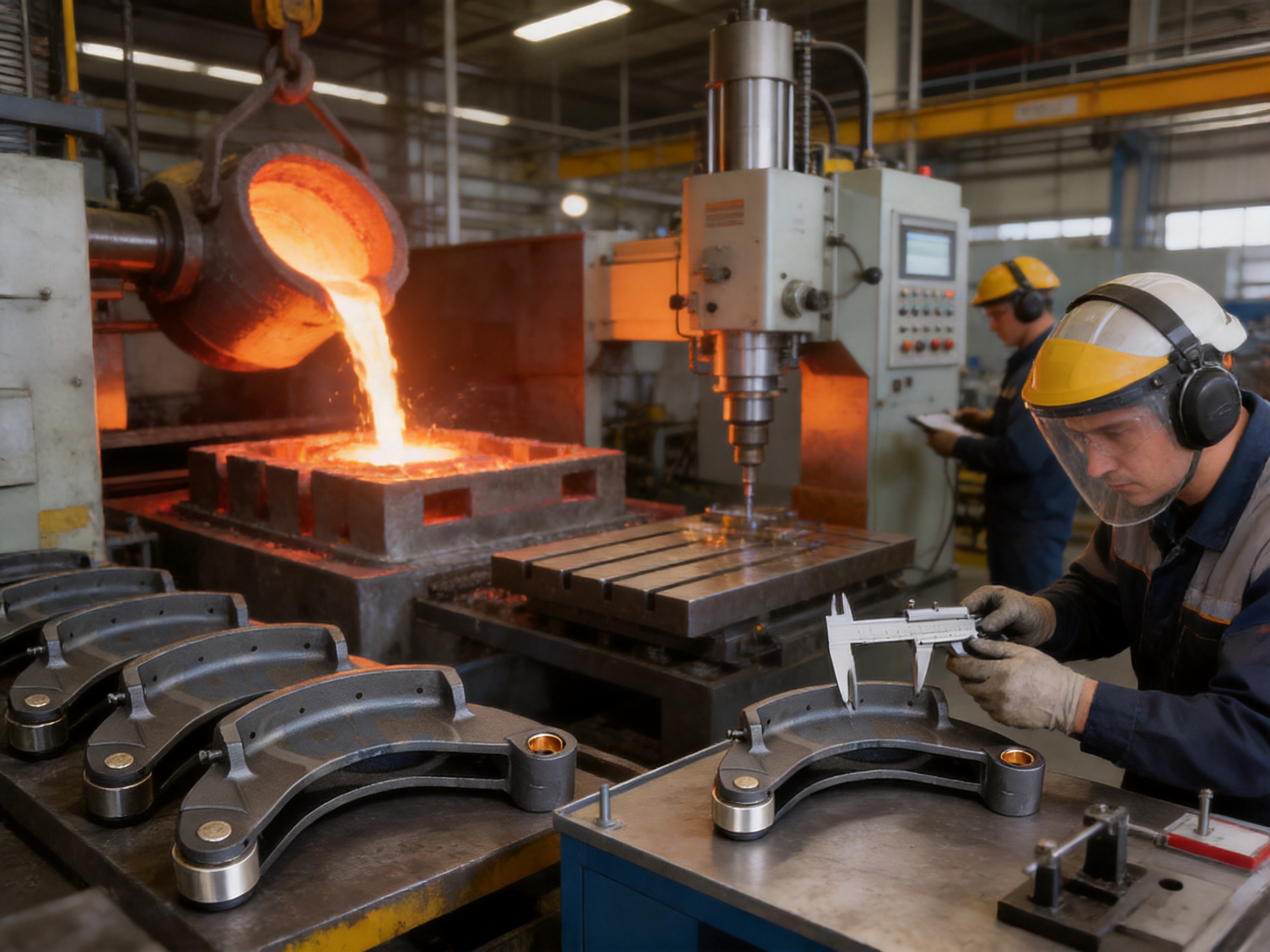
The performance of a casted brake shoe depends heavily on the consistency of its manufacturing process. Zhejiang Bangchi Auto Parts Co., Ltd. specializes in heavy-duty brake components and provides products under categories covering both individual replacement parts and repair solutions. A complete manufacturing system should control every stage, from product design and material preparation to casting, finishing, inspection, packing, and shipment.
4.1 Product drawing and application analysis
Manufacturing begins with an accurate understanding of the target brake system. Engineering personnel analyze the original reference, available samples, dimensional data, and application requirements. Important data may include overall length, width, arc radius, web profile, hole position, hole diameter, end geometry, and contact-surface condition.
For the 1104542 casted brake shoe, the product identity combines the OEM reference, the SCA127 part number, the 413 x 127 millimeter size, and the eight-hole configuration. Maintaining these identifiers in engineering and production records helps prevent confusion between similar heavy-duty shoes.
4.2 Pattern and mold preparation
In a casting operation, pattern and mold accuracy directly influence the quality of the finished shoe. The mold must reproduce the required contours while allowing appropriate material flow and solidification. Poor mold preparation can result in dimensional variation, incomplete filling, surface defects, or internal discontinuities.
A controlled production environment should monitor mold condition, release procedures, alignment, and reuse limits. Consistent mold preparation helps ensure that the shoe retains the correct profile from batch to batch. It also reduces the amount of corrective machining required after casting.
4.3 Material preparation and melting control
The material used for the shoe must provide an appropriate balance of strength, toughness, wear resistance, and dimensional stability. Material selection should be supported by a controlled specification rather than informal substitution. Charge materials, alloy additions, melting temperature, holding time, and pouring conditions all influence the final properties of a cast component.
Reliable production requires attention to melt cleanliness and composition. Excessive inclusions, gas porosity, shrinkage, or unfavorable microstructure can reduce structural reliability. Process records and inspection procedures help identify variation before parts reach the customer.
4.4 Casting and solidification
During casting, molten material fills the prepared mold and solidifies into the shoe body. Filling speed, temperature, gating design, riser performance, and cooling conditions must be coordinated to reduce defects. The goal is to produce a sound part with consistent geometry and adequate structural integrity.
Solidification control is particularly important in areas where the shoe changes section thickness or contains mounting features. Uneven cooling can contribute to shrinkage, distortion, or residual stress. Production personnel should therefore monitor the casting process and use suitable inspection methods to verify the result.
4.5 Trimming, cleaning, and surface finishing
After casting, excess material such as gates, runners, and flash must be removed. The shoe is then cleaned so that its surfaces can be inspected and machined where necessary. Finishing operations should not weaken critical edges or alter the designed contact geometry.
Surface preparation also affects downstream operations. A clean, stable shoe is easier to measure, mark, drill, and assemble. It provides a better foundation for corrosion protection and helps reveal cracks, cavities, or other irregularities during inspection.
4.6 Machining and riveting-hole processing
The riveting holes must be processed with sufficient accuracy to match the intended lining. Hole count alone is not enough; the locations, diameters, spacing, and edge conditions must also be controlled. Inaccurate holes may prevent correct lining installation or create an uneven distribution of retaining force.
Machining or drilling equipment should be maintained and checked regularly. Fixtures can help hold the shoe in the correct position and improve repeatability between parts. After hole processing, inspection should confirm that the holes are free from excessive burrs, blockage, distortion, or misalignment.
4.7 Dimensional and visual inspection
Dimensional inspection verifies the features most important to fitment. These may include overall size, arc profile, width, end geometry, hole locations, and critical thicknesses. Visual inspection checks for cracks, unacceptable porosity, sharp edges, incomplete finishing, corrosion, and other visible defects.
Inspection results should be recorded in a manner that supports traceability. Traceability is valuable for production improvement, customer service, and batch investigation. It also demonstrates that the manufacturer treats brake components as safety-related products rather than as ordinary castings.
4.8 Final packaging and identification
Brake shoes must be protected against impact, moisture, contamination, and mixing during storage and transport. Packaging should preserve the shoe’s finished surfaces and ensure that the part number, OEM reference, quantity, and batch information remain readable.
Clear identification supports distributors and repair workshops. It reduces picking errors and makes it easier to match the part to the appropriate lining, repair kit, or vehicle application. For international distribution, consistent labeling is particularly helpful because products may pass through several logistics and warehouse stages before installation.
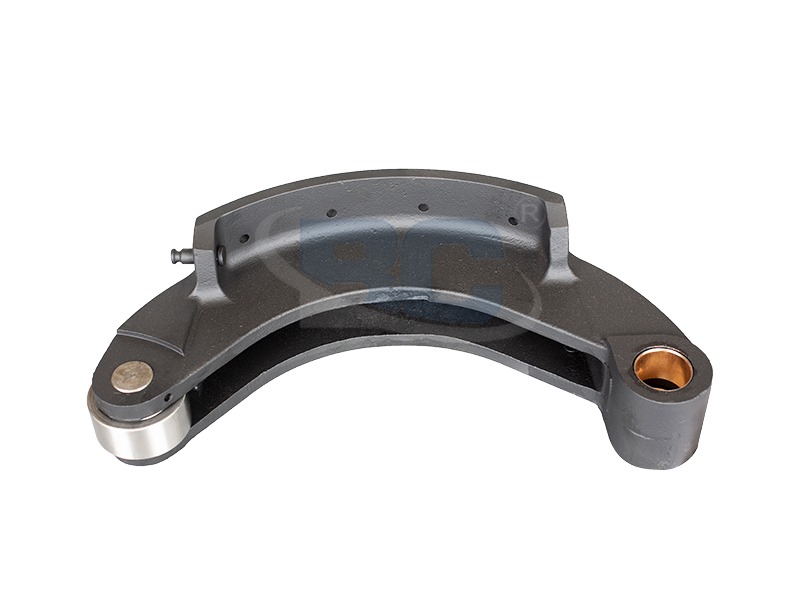
1104542 Casted Brake Shoe
5. Manufacturing Strengths of Zhejiang Bangchi Auto Parts Co., Ltd.
Zhejiang Bangchi Auto Parts Co., Ltd. is based in Haining, Zhejiang, China, and focuses on heavy-duty brake parts. Its product range includes steel brake shoes, casted brake shoes, brake linings, lined brake shoes, brake shoe repair kits, and lined brake shoe kits. This product breadth is a significant strength because it allows the company to understand brake shoes not only as individual castings but also as parts of complete friction and repair systems.
A manufacturer with experience across several brake-product categories can coordinate the interfaces between the shoe, lining, rivet, and repair hardware. That knowledge is useful when developing replacement components because brake performance depends on compatibility among all these elements.
5.1 Focus on commercial vehicle brake components
Heavy-duty brake parts require different priorities from light-vehicle components. Commercial vehicle products must be designed for high loads, long service intervals, frequent operation, and demanding environmental conditions. A focused manufacturer can build its engineering, tooling, inspection, and customer-support procedures around these requirements.
The company’s specialization in heavy-duty brake parts supports a practical understanding of fleet maintenance. Customers often need more than a single replacement shoe. They may require matching linings, repair kits, multiple axle applications, packaging customization, and stable repeat supply. A focused product portfolio is well suited to these needs.
5.2 Integration of individual and complete repair solutions
The product range includes individual casted shoes as well as lined brake shoes and repair kits. This gives customers flexibility. A workshop may purchase a bare shoe when it has its own lining and riveting process, while another customer may prefer a complete lined assembly to reduce installation time.
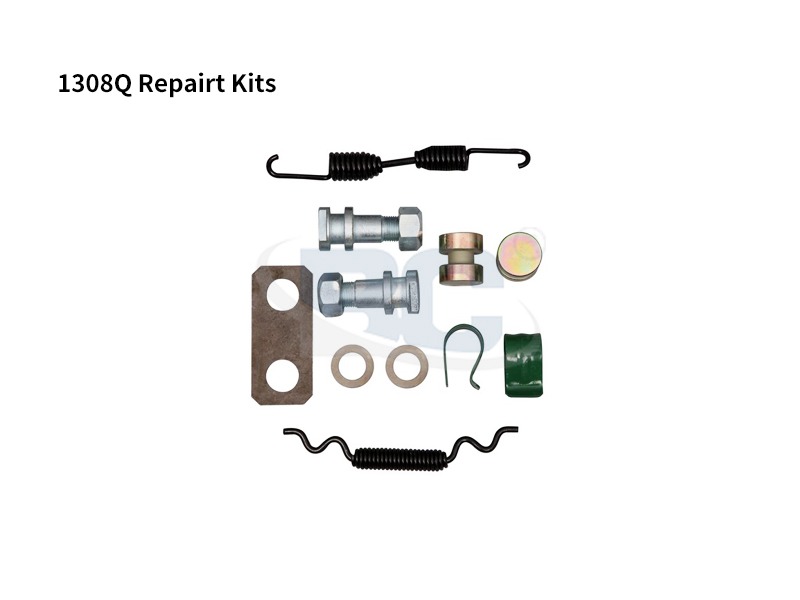
Repair kits can also help address worn springs, rollers, pins, retainers, or related hardware, depending on the kit configuration. Supplying coordinated products can reduce the risk of combining incompatible components from unrelated sources. It also simplifies purchasing and inventory planning for distributors and fleet maintenance departments.
5.3 Use of the global FMSI numbering system
The company states that its OEM brake parts follow the global FMSI numbering system. Standardized numbering supports product identification and helps customers compare replacement requirements across catalogs and markets. For international buyers, a recognizable numbering method can reduce ambiguity caused by different local naming conventions.
Numbering systems are most effective when combined with complete technical information. The SCA127 product identity, OEM reference 1104542, 413 x 127 millimeter size, eight riveting holes, and application data together provide a more reliable purchasing basis than any single reference alone.
5.4 Support for international aftermarket distribution
The company’s location in Zhejiang, an important manufacturing region, provides access to industrial supply networks, transportation infrastructure, machining resources, casting capabilities, and export logistics. These advantages can support regular production and international order fulfillment.
For overseas customers, supply reliability includes more than manufacturing capacity. It also includes communication, documentation, product labeling, packing consistency, and the ability to respond to technical questions. A professional aftermarket supplier should help customers confirm application information before an order is finalized.
6. Advantages Compared with Lower-Quality Alternatives
Not all replacement brake shoes provide the same level of reliability. Low-quality alternatives may appear attractive because of a lower initial purchase price, but they can create additional costs through poor fit, frequent replacement, brake noise, uneven lining wear, and workshop rework.
6.1 More dependable fitment
A shoe manufactured around controlled dimensions is more likely to install correctly without modification. Correct fitment reduces installation time and prevents technicians from forcing parts into position or altering holes and mounting features. The 1104542 product’s defined part number, dimensions, hole count, and application reference provide a clear basis for verification.
6.2 Better lining support
The brake shoe is the foundation of the lining. If its curvature or support surface is inconsistent, the lining may contact the drum unevenly. A properly manufactured casted shoe helps maintain the intended contact pattern, which can promote more uniform wear and stable braking response.
6.3 Improved production consistency
Controlled casting and inspection processes help reduce variation between batches. Consistency is especially important for fleet operators that maintain multiple vehicles using the same brake configuration. Predictable parts simplify service procedures and reduce the need for repeated fitment checks.
6.4 Reduced risk of premature failure
Material defects, cracks, distortion, and poorly finished holes can shorten service life. A production system that emphasizes material control, casting quality, finishing, and inspection can reduce these risks. Although no component can eliminate every operational failure, stronger process control improves the likelihood of dependable performance.
6.5 Better total operating value
The true cost of a brake shoe includes purchase price, installation labor, vehicle downtime, lining life, drum wear, inspection time, and the consequences of unplanned repairs. A higher-quality component may provide better total value even when its unit price is not the lowest available.
For fleet operators, consistency across many vehicles can produce substantial savings. Fewer fitment problems mean less workshop interruption. Better compatibility with linings and hardware can reduce premature rework. Clear identification can also improve inventory turnover and prevent incorrect parts from being ordered.
7. Installation and Service Considerations
Installation should be carried out by qualified brake technicians using the correct workshop tools and procedures. Before fitting the 1104542 casted brake shoe, the technician should compare the new part with the removed component and verify the application details.
The brake drum should be inspected for wear, scoring, cracks, heat damage, and out-of-round conditions. A new shoe cannot compensate for a drum that is beyond its service limits. The lining should also be checked for correct dimensions, material suitability, and hole alignment.
7.1 Preparing the shoe and lining
The shoe and lining surfaces should be clean and free from oil, grease, loose scale, and contamination. The lining must sit flush against the shoe without rocking or leaving significant gaps. The holes should align naturally; they should not be forced into position by excessive clamp pressure or improvised drilling.
Riveting must be performed with suitable equipment. Each rivet should be formed evenly and checked for secure retention. Over-compression may damage the lining, while under-compression may allow movement. The specific riveting procedure should follow the lining manufacturer’s technical instructions and the applicable workshop standard.
7.2 Checking brake hardware
Brake springs, rollers, pins, bushings, retainers, adjusters, and cam components should be inspected whenever the shoes are replaced. Worn hardware can prevent the shoe from moving correctly even when the shoe itself is new. Where necessary, a suitable brake shoe repair kit can help restore the associated hardware to proper working condition.
7.3 Adjusting the brake system
After installation, the brake system must be adjusted according to the vehicle manufacturer’s procedure. Excessive clearance may delay brake response, while insufficient clearance may cause drag and overheating. Automatic adjusters should be checked for correct function rather than assumed to be serviceable.
7.4 Bedding-in and post-installation inspection
New linings require a controlled bedding-in process so that the contact surface develops evenly against the drum. Severe braking immediately after installation should be avoided unless required for a controlled safety test. After initial operation, the technician should inspect for abnormal noise, pulling, overheating, uneven wear, or signs of lining movement.
8. Application Verification Guide
Before ordering or installing the 1104542 casted brake shoe, buyers should verify the following information:
First, confirm that the OEM reference is 1104542 and that the corresponding product number is SCA127. Second, compare the nominal size of 413 x 127 millimeters with the existing brake shoe and the vehicle service documentation. Third, confirm the eight-hole riveting pattern. Fourth, verify the vehicle and axle application rather than relying solely on a general brand reference.
| Verification Item | Recommended Check | Reason |
|---|---|---|
| Reference number | Compare 1104542 and SCA127 with purchasing records | Prevents selection of a visually similar part |
| Dimensions | Check the 413 x 127 mm nominal size | Confirms the basic shoe envelope |
| Riveting pattern | Confirm eight holes and matching lining | Ensures proper lining installation |
| Brake drum | Verify diameter, width, and service condition | Confirms complete brake-system compatibility |
| Hardware | Inspect pins, rollers, springs, and adjuster parts | Prevents old hardware from limiting performance |
| Vehicle application | Check model, axle, brake configuration, and service data | Reduces the risk of incorrect application |
| Packaging information | Confirm label, quantity, and batch identification | Supports traceability and inventory accuracy |
If any application detail is uncertain, customers should provide the vehicle information, original part number, photographs, measurements, and brake-system details to the supplier before purchasing. This is more efficient than ordering an uncertain part and discovering a mismatch during workshop installation.
9. Maintenance Benefits for Fleets and Distributors
Fleet operators benefit from brake components that are easy to identify, consistent in quality, and compatible with established maintenance procedures. The 1104542 casted brake shoe can be incorporated into planned brake-service programs when its application has been verified and the complete brake assembly is maintained correctly.
Planned maintenance allows fleets to replace shoes and linings before severe wear creates secondary damage. It also gives technicians time to inspect drums, cams, adjusters, bearings, and related components. This approach is generally more economical than waiting for a brake problem to cause roadside downtime.
Distributors benefit from a clear product structure. The SCA127 part number, OEM reference, dimensions, hole count, and application data can be included in catalogs, quotations, warehouse systems, and customer-support documents. Clear records reduce duplicate stocking and help sales teams respond accurately to technical inquiries.
9.1 Inventory management
Heavy-duty brake components are often stored for different vehicle applications, axle positions, and brake configurations. Misidentified inventory can occupy warehouse space while failing to meet an urgent customer requirement. Consistent numbering and labeling help warehouse personnel locate the correct product efficiently.
Distributors should store casted brake shoes in a dry, clean area and protect them from unnecessary impact. Products should remain in their original packaging until required for inspection or installation. Stock rotation can help maintain orderly inventory and reduce the chance of packaging deterioration.
9.2 Service documentation
Each installation should be documented where fleet procedures require it. Useful records include vehicle identification, axle position, part number, installation date, mileage, lining type, drum condition, and technician observations. These records help identify wear patterns and improve future purchasing decisions.
When a fleet uses standardized components across multiple vehicles, maintenance data can reveal whether a particular application is experiencing abnormal wear. Such information may indicate issues with brake adjustment, loading, driver operation, drum condition, or environmental exposure rather than a defect in the shoe itself.
10. Safety and Responsible Use
Brake shoes are safety-critical components. They should never be modified casually, installed without application verification, or used with damaged drums and unsuitable linings. Any evidence of cracks, severe distortion, missing material, or questionable fit should be treated seriously.
The product should be used within the operating limits of the vehicle and brake system. Overloading, excessive speed, improper brake adjustment, and continuous braking on long descents can generate heat and forces beyond normal service conditions. Correct component selection is essential, but safe vehicle operation and proper maintenance remain equally important.
Technicians should use appropriate personal protective equipment during brake service. Brake dust, corrosion products, sharp edges, and heavy components can create workplace hazards. Cleaning procedures should avoid practices that unnecessarily disperse dust into the air. Workshop personnel should follow applicable occupational-safety requirements.
After service, the vehicle should receive a controlled brake test in a safe area. The technician should confirm that the brake operates smoothly, releases correctly, and does not produce abnormal heat or noise. A professional inspection is particularly important when both shoes, linings, drums, or hardware have been replaced at the same time.
11. Why Choose a Specialized Heavy-Duty Brake Supplier?
A specialized supplier can provide more than a catalog number. It can support application identification, product selection, technical communication, packaging requirements, and repeat-order consistency. This is valuable in international aftermarket supply, where a customer may need to coordinate products across different vehicle populations and regional service practices.
Zhejiang Bangchi Auto Parts Co., Ltd. offers a focused range of heavy-duty brake products rather than treating brake shoes as an incidental product line. Its range includes the basic shoe structure, friction linings, complete lined shoes, and repair kits. This product coverage can make it easier for customers to develop a coordinated purchasing program.
The company’s stated focus on OEM brake parts following the global FMSI numbering system also supports structured identification. For buyers, this can simplify product comparisons, quotation preparation, and replacement planning. For manufacturers and distributors, standardized references improve communication across borders and reduce the possibility of ordering errors.
The 1104542 casted brake shoe reflects the practical requirements of the heavy-duty aftermarket: a defined application, a known size, an established riveting pattern, a structurally capable casted body, and a manufacturing process designed to support repeatable quality.
12. Frequently Asked Questions
Q1: What is the 1104542 casted brake shoe?
The 1104542 casted brake shoe is a heavy-duty brake-shoe component identified by product number SCA127. It is designed to support a brake lining in a drum-brake assembly and is listed with a nominal size of 413 x 127 millimeters and eight riveting holes.
Q2: What vehicles is this brake shoe designed for?
The listed application is Scania heavy vehicles. Exact fitment should still be confirmed by checking the vehicle model, axle, brake configuration, original part reference, drum dimensions, and service documentation.
Q3: Why is the casted construction important?
Casted construction provides a shaped structural body capable of supporting the lining and transferring braking force. A properly produced casted shoe can offer the rigidity and dimensional stability required for repeated heavy-duty braking cycles.
Q4: What does the 413 x 127 millimeter specification mean?
It describes the nominal size of the brake shoe. These dimensions help identify the product, but they should be considered together with the complete profile, hole positions, brake-drum specifications, and hardware interfaces.
Q5: Why are the eight riveting holes important?
The eight holes define the lining-retention pattern for the specified application. The replacement lining must have a matching hole layout so that it can be secured correctly without modification.
Q6: Can the shoe be installed with any brake lining of the same width?
No. The lining must match the shoe’s length, curvature, thickness, hole pattern, friction requirements, and brake-system application. Width alone is not sufficient to establish compatibility.
Q7: Does a new brake shoe require a new brake drum?
Not necessarily. The existing drum may be reused if it remains within applicable service limits and is free from unacceptable scoring, cracking, distortion, or heat damage. A qualified technician should inspect and measure the drum before installation.
Q8: Should the old springs and rollers be reused?
They should be inspected carefully. Worn, corroded, stretched, cracked, or distorted hardware may affect shoe movement and brake adjustment. Replacing worn hardware with a suitable repair kit can improve the reliability of the complete assembly.
Q9: What are the advantages of purchasing from a specialized brake-parts manufacturer?
A specialized manufacturer generally has focused experience in brake-shoe geometry, friction-lining interfaces, riveting, casting, inspection, and aftermarket application management. A broader brake-parts range can also support coordinated purchasing of shoes, linings, and repair kits.
Q10: How should distributors identify this product in inventory?
Distributors should record the SCA127 product number, OEM reference 1104542, 413 x 127 millimeter size, eight-hole configuration, application information, packaging quantity, and batch details. Using several identifiers reduces the risk of selecting an incorrect replacement.
Q11: How can buyers confirm an uncertain application?
Buyers should provide the original part number, vehicle model, axle information, photographs, measurements, brake-drum details, and any available service documentation. The supplier can then compare the information with the product specification before order confirmation.
Q12: What should be checked after installation?
The technician should check lining seating, rivet security, hardware condition, brake adjustment, drum clearance, wheel rotation, and signs of rubbing or drag. A controlled road or workshop test should confirm smooth application and release without abnormal noise or overheating.
13. Conclusion
The 1104542 casted brake shoe is a purpose-defined heavy-duty replacement component with the product number SCA127, a nominal size of 413 x 127 millimeters, and an eight-hole riveting pattern. Its intended application is within Scania heavy-vehicle drum-brake systems, subject to complete vehicle and brake-assembly verification.
Its main value lies in the combination of structural casted design, application-specific dimensions, lining-support capability, and standardized product identification. When manufactured under controlled conditions, a casted shoe can provide the rigidity, dimensional stability, and load-distribution characteristics required for demanding commercial vehicle service.
Zhejiang Bangchi Auto Parts Co., Ltd. strengthens this product offering through a focused heavy-duty brake-parts portfolio that includes shoes, linings, lined assemblies, and repair kits. Its use of the global FMSI numbering system supports clearer identification for international customers, distributors, workshops, and fleet maintenance departments.
For the best result, the product should be selected through careful application verification and installed by qualified technicians. The brake drum, lining, rivets, springs, rollers, adjuster, and other related components must be evaluated as part of the complete system. With correct matching, controlled installation, and regular maintenance, the 1104542 casted brake shoe can support dependable brake service and efficient heavy-duty fleet operation.
References
1. Commercial Vehicle Drum Brake Service Principles, technical training reference for heavy-duty brake inspection and maintenance.
2. Friction Material and Brake Lining Installation Practices, workshop reference for lining selection, riveting, bedding-in, and inspection.
3. Cast Component Manufacturing and Quality Control, reference material covering mold preparation, melting, solidification, finishing, and dimensional inspection.
4. Heavy-Duty Vehicle Brake System Maintenance Guidelines, reference for drum inspection, brake adjustment, hardware replacement, and post-service testing.
5. Global FMSI Brake Component Numbering Practices, reference for replacement-part identification and aftermarket catalog management.
6. Commercial Vehicle Fleet Maintenance Management, reference for planned service, inventory control, traceability, and total operating cost evaluation.