 English
 简体中文
简体中文
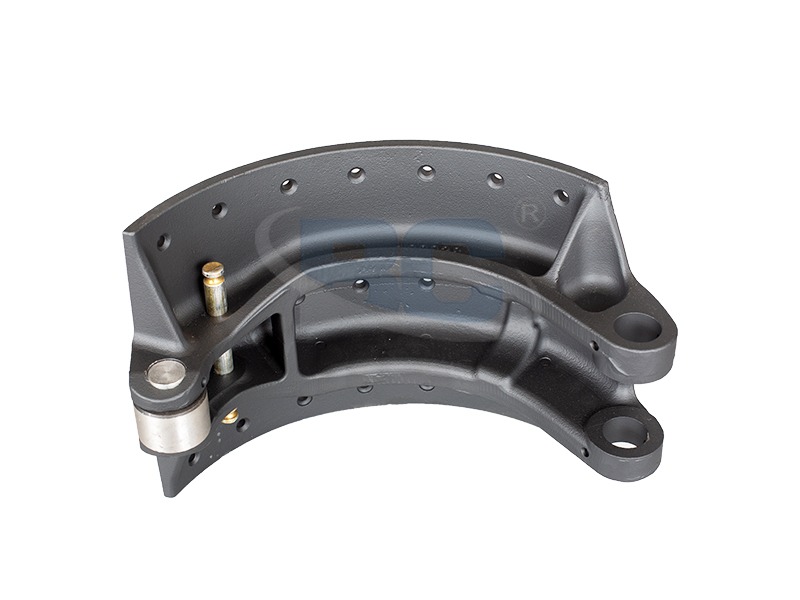
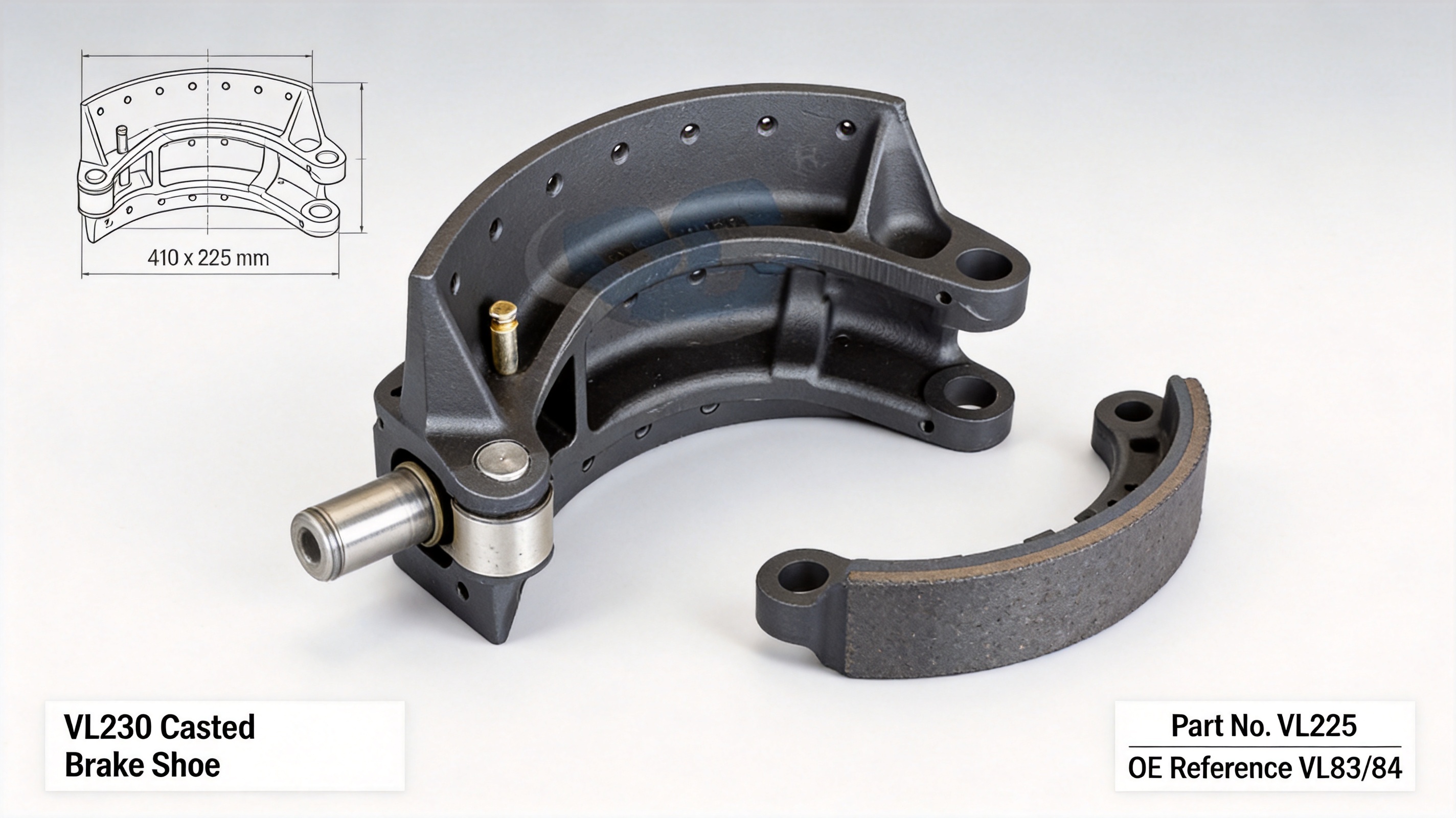
Reliable braking performance begins with the correct foundation: a brake shoe that fits accurately, supports the lining securely, withstands repeated thermal loading, and remains stable under the demanding conditions of commercial vehicle operation. The VL230 Casted Brake Shoe is designed for heavy-duty braking applications associated with Volvo vehicles and is identified with the supplied original equipment reference VL83/84. Its listed dimensions are 410 x 225 millimeters, and it is manufactured with 21 riveting holes for the attachment of a compatible brake lining.
As a casted brake shoe, the VL230 is intended for applications where structural strength, dimensional consistency, and resistance to mechanical stress are essential. Unlike a brake shoe that is selected only by general size, a properly engineered casted shoe must combine the correct geometry with sufficient rigidity, controlled material quality, precise hole positioning, and a dependable surface for lining installation. These characteristics influence braking response, wear behavior, service life, and maintenance efficiency.
This article examines the product specifications, operating advantages, manufacturing considerations, installation requirements, quality expectations, and commercial value of the VL230 Casted Brake Shoe. It also explains how a specialist heavy-duty brake parts manufacturer can support distributors, repair workshops, fleet operators, and original equipment replacement programs through process control, application knowledge, and flexible supply capabilities.
Product Overview
The VL230 Casted Brake Shoe is categorized as a casted brake shoe for heavy-duty vehicle brake systems. The product information supplied for this item includes the following key details:
| Item | Specification |
|---|---|
| Product name | VL230 Casted Brake Shoe |
| Product category | Casted Brake Shoe |
| Listed part number | VL225 |
| Listed original equipment reference | VL83/84 |
| Size | 410 x 225 millimeters |
| Riveting holes | 21 |
| Application | Volvo commercial vehicle braking systems |
| Manufacturer | Zhejiang Bangchi Auto Parts Co., Ltd. |
Before placing an order or installing the product, purchasers should confirm the part number, original equipment reference, dimensional requirements, brake assembly configuration, lining specification, and vehicle application. The supplied product information lists VL230 as the product title and VL225 as the part number. This type of identification difference should be checked against the supplier's current catalog, technical drawing, and sample approval process to avoid an incorrect application.
Why the Brake Shoe Matters in a Heavy-Duty Brake Assembly
A brake shoe is more than a support for friction material. It is a load-bearing component that transfers the force generated by the braking actuator to the brake lining and then to the rotating drum. During braking, the shoe experiences compression, bending, contact pressure, vibration, and repeated thermal cycles. In a commercial vehicle, these forces are intensified by vehicle mass, high mileage, steep gradients, frequent stops, trailer loads, and changing road conditions.
The shoe must retain its shape while the lining is pressed against the drum. If the shoe deforms excessively, the lining may not contact the drum evenly. Uneven contact can lead to localized wear, reduced braking efficiency, noise, overheating, and premature maintenance. A rigid and accurately manufactured shoe helps the lining work across its intended contact area, supporting consistent friction performance throughout the service interval.
The brake shoe also provides the mounting structure for springs, pins, rollers, adjuster mechanisms, and other related components, depending on the specific brake design. Hole location and overall geometry are therefore important. Even a small dimensional discrepancy can create installation difficulty or affect the movement of the brake mechanism. For this reason, replacement brake shoes should be selected by verified application data rather than appearance alone.
Casted Construction and Structural Stability
The principal product characteristic of the VL230 is its casted construction. Casting allows the component to be formed as a robust structural part with the required overall profile and load-bearing sections. For heavy-duty brake applications, this construction approach can provide a favorable balance of rigidity, production repeatability, and compatibility with established commercial vehicle brake designs.
A well-controlled casting process begins with suitable material selection and carefully prepared patterns or molds. The material must fill the mold effectively, reproduce the required geometry, and achieve a stable structure after cooling and subsequent processing. The casting must then be inspected for dimensional accuracy, surface condition, and any defects that could affect service performance.
Compared with poorly controlled or unsuitable replacement parts, a properly produced casted brake shoe can offer greater confidence in structural integrity. The benefit is not simply the presence of a cast surface. The real advantage comes from the combination of controlled metallurgy, appropriate casting practice, heat management, machining, and inspection. Each stage contributes to the shoe's ability to withstand repeated braking loads.
In competitive purchasing, buyers may encounter brake shoes with similar external dimensions but different material quality, casting control, machining precision, or inspection standards. The VL230 should therefore be evaluated as a complete engineered component rather than as a basic metal replacement. A supplier that controls the full manufacturing process is better positioned to maintain consistent results between production batches.
Dimensional Compatibility
The listed size of the VL230 is 410 x 225 millimeters. This dimensional information provides an initial reference for application selection, but it should be considered together with the complete brake assembly geometry. Important verification points include the shoe profile, pivot location, roller or cam contact area, lining radius, web thickness, hole arrangement, and the relationship between the shoe and the brake drum.
The 21 riveting holes are another significant identification feature. Riveting holes must be positioned accurately so that the selected lining can be mounted securely and evenly. The number of holes alone is not sufficient for confirmation; hole spacing, diameter, countersink or preparation, end distances, and the exact curvature of the shoe should also correspond to the required lining and brake assembly.
Accurate dimensions support several practical benefits. They can reduce fitting time, minimize the need for workshop modification, and help ensure that the lining sits correctly on the shoe. They also simplify inventory planning for distributors because a clearly identified product can be matched with the correct lining, rivets, and repair components.
For fleet maintenance departments, dimensional consistency is especially valuable. When replacement parts from different production batches maintain the same approved geometry, technicians can follow established installation procedures with less uncertainty. Consistency also helps workshops standardize inspection records and reduce unexpected variation during brake overhauls.
VL230 Casted Brake Shoe
Advantages for Heavy-Duty Applications
Load-Carrying Strength
Heavy trucks and commercial vehicles place high loads on braking components. The brake shoe must support the pressure required to generate friction while resisting distortion. The casted construction of the VL230 is intended for this type of demanding service environment, where structural support is essential to dependable braking.
In a correctly matched application, a rigid shoe helps maintain the intended position of the lining against the brake drum. This can contribute to more uniform pressure distribution and help reduce the risk of localized contact. Uniform contact is important because the lining should wear progressively rather than develop isolated high-wear zones.
Compatibility with Lining Installation
The 21-hole configuration provides a defined mounting arrangement for a compatible brake lining. A suitable hole pattern supports secure riveting and helps the lining follow the shoe profile. Correct riveting is essential because the lining must remain firmly attached under vibration, thermal expansion, and repeated braking cycles.
When the shoe and lining are designed to work together, the installation process can be more predictable. The workshop can use the correct rivets, drilling or preparation equipment, riveting force, and inspection criteria. This reduces the chance of loose rivets, damaged lining material, uneven seating, or an improperly aligned friction surface.
Application-Focused Design
The stated Volvo application gives distributors and maintenance professionals an important starting point when selecting the product. Application-focused identification is more reliable than choosing a shoe solely by approximate dimensions. Heavy-duty braking systems often include several visually similar parts with different mounting points or operating characteristics.
A product associated with a specific vehicle manufacturer and reference number can simplify cross-referencing. However, responsible selection still requires confirmation of axle type, brake model, vehicle production version, drum dimensions, lining material, and regional specification. This is particularly important when vehicles have been modified, rebuilt, or imported from another market.
Support for Preventive Maintenance
A dependable replacement shoe contributes to a planned maintenance strategy. Fleet operators can replace worn or damaged shoes during scheduled brake service instead of waiting for a serious braking problem. When the part is consistently available and accurately identified, maintenance teams can prepare complete service kits in advance and shorten vehicle downtime.
Preventive maintenance also allows related parts to be inspected at the same time. The technician can examine the drum, camshaft, rollers, return springs, adjuster, bushings, lining, and mounting hardware. Replacing a brake shoe as part of a complete inspection helps ensure that the whole brake assembly operates as intended.
Manufacturing Process Considerations
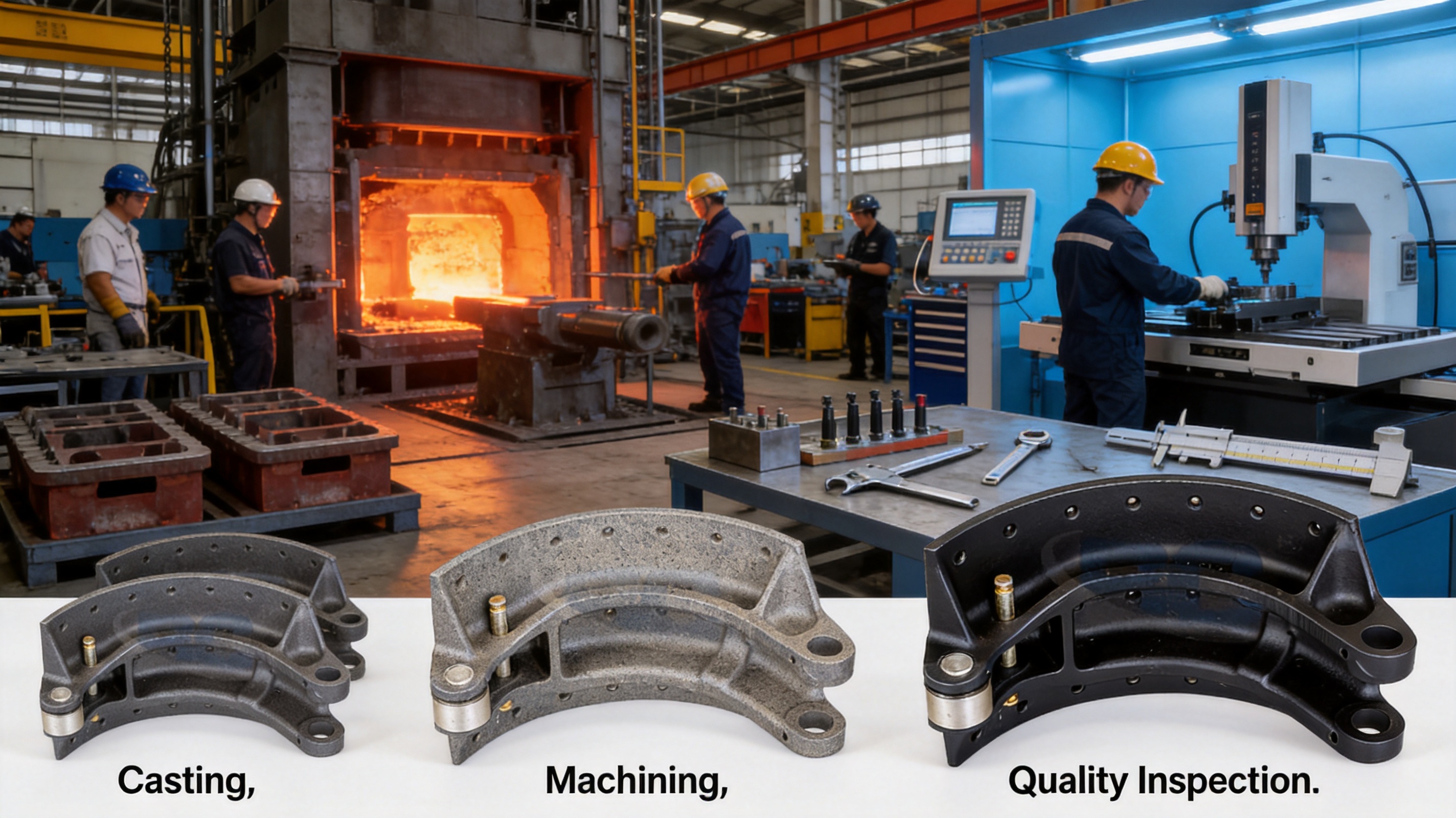
The quality of a casted brake shoe depends on the control exercised at every production stage. A professional heavy-duty brake parts manufacturer should treat the process as a sequence of linked controls rather than relying only on final visual inspection. The following stages describe the manufacturing approach expected for a product such as the VL230.
Technical Review and Pattern Preparation
Production begins with technical data. Drawings, samples, reference parts, dimensions, hole locations, and application requirements are reviewed before a production pattern or tooling arrangement is prepared. This stage is important because errors introduced into the pattern can be repeated across an entire batch.
Engineering personnel should confirm the shoe profile, web design, mounting features, machining allowances, and lining interface. Where a product is supplied under more than one catalog identification, the technical team should also reconcile the product name, part number, and original equipment reference. Clear internal documentation helps prevent confusion between similar models.
Material Preparation
Material preparation affects the stability and consistency of the finished casting. The selected material should be suitable for the mechanical demands of a heavy-duty brake shoe and compatible with the intended production process. Charge materials, additives, and recycled content should be controlled according to defined manufacturing standards.
Good material control includes proper storage, identification, batching, and traceability. Moisture, contamination, or uncontrolled variation in the charge can affect the quality of the final casting. A specialist manufacturer should maintain procedures for checking materials before they enter production and should retain records that connect finished products to their manufacturing batch.
Casting and Solidification
During casting, molten material is introduced into a prepared mold and allowed to solidify. Temperature, filling behavior, mold condition, cooling rate, and handling procedures all influence the result. The objective is to produce a sound casting with the required shape and a stable internal structure.
Controlled solidification is important because uneven cooling can contribute to dimensional variation or internal stress. The casting process should be designed to reduce risks such as incomplete filling, excessive porosity, shrinkage-related defects, inclusions, or surface irregularities. Process parameters should be monitored and adjusted through documented production procedures.
Cleaning and Surface Treatment
After solidification, the casting is removed from the mold and cleaned. Excess material, gates, risers, and other casting remnants are removed so that the component reaches its intended form. The cleaning process must be thorough but controlled, avoiding damage to functional surfaces and maintaining the required geometry.
Surface treatment may include shot blasting or another suitable method to remove residual scale and improve surface cleanliness. A clean surface makes later machining and inspection more effective. It also helps reveal visible defects that might otherwise be hidden by casting residue.
Machining and Hole Processing
Machining brings the casting closer to its final dimensional condition. Functional surfaces, mounting features, and riveting holes may require drilling, reaming, milling, grinding, or other operations depending on the design. The 21 riveting holes should be processed with appropriate tooling and checked for position, diameter, edge condition, and consistency.
Accurate hole processing is essential for lining installation. A hole that is out of position can make the lining difficult to fit or place excessive stress on the rivet. Burrs and sharp edges can also interfere with seating. Controlled deburring and cleaning should therefore be included in the production process.
Dimensional Inspection
Inspection verifies that the finished shoe corresponds to the approved technical requirements. Typical checks may include overall length and width, profile dimensions, hole count, hole diameter, hole spacing, mounting points, surface condition, and critical reference distances.
Inspection equipment should be appropriate for the tolerance level and product geometry. Depending on the production program, this may include calipers, gauges, coordinate measuring equipment, profile fixtures, templates, and dedicated inspection tools. Inspection results should be documented so that nonconforming parts are identified before packing.
Final Quality Control
Final quality control combines dimensional review with visual and functional checks. Inspectors should look for cracks, unacceptable porosity, distortion, incomplete machining, sharp edges, contamination, corrosion, and identification errors. The product should be clean, properly protected, and packaged in a way that prevents handling damage.
A robust quality system does not treat inspection as a substitute for process control. Instead, inspection confirms that the controlled process is producing acceptable results. When nonconformities appear, the manufacturer should investigate their cause, isolate affected products, and implement corrective action.
Advanced Manufacturing Strengths
Zhejiang Bangchi Auto Parts Co., Ltd. is presented as a manufacturer of heavy-duty brake parts, including steel brake shoes, casted brake shoes, brake linings, lined brake shoes, brake shoe repair kits, and lined brake shoe kits. This product range indicates a manufacturing focus on commercial vehicle drum brake components rather than a general automotive parts catalog.
A focused product range can provide several practical advantages. Production teams can develop deeper knowledge of brake shoe geometry, lining attachment, riveting requirements, material behavior, and application cross-referencing. This specialization can support better communication with distributors and workshops because technical discussions are centered on the actual requirements of heavy-duty brake service.
The company's stated use of the global FMSI numbering system is also relevant to international aftermarket supply. A recognized numbering approach helps buyers organize catalogs, compare applications, and manage cross-reference information. It does not replace application verification, but it can make product identification more systematic across different markets.
Manufacturing strength is also reflected in the ability to supply multiple related product forms. A buyer may require an unlined casted shoe, a complete lined shoe, a repair kit, or a matched lining and hardware combination. A supplier with capability across these categories can help reduce the number of separate sources needed for a brake service program.
For distributors, this can improve purchasing efficiency and simplify stock planning. For repair workshops, it can make it easier to obtain compatible parts for different stages of a brake overhaul. For fleet operators, it can support standardized sourcing across multiple maintenance locations.
Production Consistency
One of the most important differences between established manufacturers and low-control competitors is batch consistency. A brake shoe that meets requirements in one shipment but varies significantly in another creates problems for inventory control and workshop confidence. Consistent tooling, material records, machining fixtures, and inspection procedures help reduce this risk.
Consistency also supports predictable lining installation. If shoe curvature or hole positions vary, the same lining and rivet process may produce different results from batch to batch. Maintaining stable dimensions helps technicians use repeatable procedures and reduces time spent correcting fitment problems.
Application Knowledge
Heavy-duty brake components require more than general metalworking knowledge. The manufacturer must understand how the shoe interacts with the drum, lining, actuator, springs, and adjustment system. Application knowledge helps identify which dimensions are critical and which visual similarities may be misleading.
A technically capable supplier should be able to review customer drawings, samples, photographs, and vehicle information. It should also be able to communicate which details must be verified before production or shipment. This is particularly valuable for international customers that may use regional vehicle specifications or alternative catalog references.
Flexible Supply Capability
Aftermarket customers often require a mixture of standard products and application-specific items. A manufacturer with suitable tooling, production planning, and technical support can respond more effectively to these needs. Flexible capability may include support for different shoe profiles, hole arrangements, lining options, packaging requirements, and private-label programs, subject to technical approval.
Flexibility should not mean uncontrolled variation. Each requested version should be supported by an approved drawing, sample, or specification. The best manufacturing approach combines responsiveness with documentation, ensuring that customized products remain traceable and repeatable.
Comparison with Lower-Quality Alternatives
When comparing the VL230 with competing brake shoes, buyers should look beyond price and superficial appearance. A low-cost component may have a similar outline but differ in casting quality, material control, hole accuracy, surface finish, or inspection discipline. These differences can create additional labor, increased warranty exposure, and reduced confidence in service performance.
| Evaluation area | Quality-focused casted brake shoe | Potential risk with an uncontrolled alternative |
|---|---|---|
| Material control | Documented material selection and batch management | Uncertain composition or inconsistent mechanical properties |
| Casting condition | Controlled filling, cooling, cleaning, and defect review | Porosity, inclusions, distortion, or hidden casting defects |
| Dimensional accuracy | Defined inspection points and application-specific checking | Fitment difficulty or incorrect brake geometry |
| Riveting holes | Verified count, diameter, spacing, and edge condition | Misaligned lining, damaged rivets, or workshop modification |
| Traceability | Product identification and batch records | Difficulty investigating complaints or inconsistent supply |
| Product range | Related shoes, linings, and repair kits available | Need to coordinate multiple suppliers |
| Technical support | Application review and specification confirmation | Greater risk of selecting a visually similar but incorrect part |
The VL230's principal competitive value should be assessed through this complete combination of structural design, application information, hole configuration, manufacturing control, and supplier support. A component that saves a small amount at purchase but requires additional fitting or creates an early service issue may cost more over its operating life.
For fleet operators, total cost of ownership includes vehicle downtime, technician labor, replacement frequency, roadside incidents, inventory complexity, and warranty administration. A dependable brake shoe can support lower indirect costs when it fits correctly and performs consistently with the rest of the brake system.
Lining and Riveting Considerations
The VL230 is supplied as a casted brake shoe, so the buyer must confirm whether the intended service requires an unlined shoe or a complete lined assembly. The correct lining should match the brake drum, vehicle duty cycle, operating temperature, axle position, and applicable regulatory or fleet requirements.
Riveting is a critical operation. The lining must be clean, correctly positioned, and fully supported by the shoe before riveting begins. Rivets should correspond to the hole size and lining thickness. The riveting equipment must apply sufficient and controlled force to form a secure joint without cracking the lining or deforming the shoe.
Technicians should confirm that each rivet is properly set and that the lining is seated without gaps. The finished lining surface should follow the shoe curvature. Any abnormal movement, loose rivet, damaged lining edge, or uneven seating should be corrected before the brake assembly is returned to service.
After installation, the brake drum and related components should be inspected. A drum with excessive wear, scoring, cracking, or an unsuitable internal diameter can compromise the performance of a new shoe and lining. Replacing the shoe alone cannot correct problems caused by worn drums, seized adjusters, damaged rollers, or contaminated friction surfaces.
Installation and Service Guidance
Confirm the Application
Before installation, compare the replacement shoe with the removed component and the approved technical information. Confirm the part number, original equipment reference, dimensions, hole arrangement, brake position, and vehicle application. Because the supplied data identifies both VL230 and VL225, this cross-check is especially important for purchasing and workshop documentation.
Inspect Associated Components
Inspect the drum, camshaft, rollers, bushings, springs, adjuster, anchor points, retaining hardware, and seals. Components that are worn, seized, cracked, contaminated, or outside service limits should be repaired or replaced. The shoe must operate within a complete and properly maintained brake mechanism.
Prepare the Shoe and Lining
Ensure that all mating surfaces are clean and free from oil, grease, loose scale, and foreign material. Verify the lining orientation and hole alignment before riveting. Do not force the lining into position in a manner that could bend the shoe or damage the friction material.
Complete the Riveting Operation
Use approved riveting equipment and follow the lining supplier's technical procedure. Work in an appropriate sequence so that the lining seats progressively and remains aligned. Inspect the rivet heads after installation and confirm that the lining is firmly attached across the full shoe length.
Check Drum Contact and Adjustment
After the brake assembly is reinstalled, verify movement, clearance, adjustment, and actuator operation according to the vehicle manufacturer's service procedure. The shoe should move freely without binding. The brake drum should rotate as specified, and the final adjustment should provide the required relationship between braking response and running clearance.
Conduct a Controlled Road Test
A controlled test should be performed after service, following the applicable vehicle maintenance procedure. Braking should be checked gradually, with attention to pulling, vibration, noise, abnormal heat, and inconsistent response. The brake system should not be placed immediately into severe duty before the new lining has been properly bedded according to the lining manufacturer's instructions.
Quality Assurance for Distributors and Fleet Buyers
Distributors purchasing the VL230 for resale should establish a clear incoming inspection process. The inspection can include packaging condition, product marking, visible casting quality, shoe dimensions, hole count, and comparison against an approved sample or drawing. Records should identify the supplier, shipment, batch, and inspection result.
Fleet buyers should also define their acceptance criteria. These may include approved applications, packaging units, corrosion protection, labeling language, documentation, and replacement policy. A written specification helps ensure that purchasing decisions remain consistent even when personnel or suppliers change.
For larger programs, sample approval before mass production can be useful. The customer may review a sample shoe, verify the fit on the intended brake assembly, confirm the lining interface, and approve packaging or marking. Once approved, future shipments should be compared with the retained reference sample and production documentation.
Technical communication is especially important when different markets use different reference systems. The supplier's stated use of the global FMSI numbering system can support catalog organization, but all cross-reference data should be verified. A reference number should be treated as an identification aid, not as the only basis for a safety-critical purchasing decision.
Packaging, Storage, and Handling
Brake shoes should be packaged to prevent impact, corrosion, contamination, and deformation during transportation. Heavy castings can damage one another if they are allowed to move freely inside a carton. Suitable separators, protective materials, and stable stacking arrangements help maintain product condition.
Storage areas should be dry, clean, and protected from aggressive chemicals. Brake shoes should not be stored where they can be exposed to water, oil, grease, or corrosive vapors. Even when the shoe is not a friction material itself, contamination can affect later lining installation and may require additional cleaning before service.
Inventory teams should rotate stock and retain product identification throughout storage. Boxes or pallets should remain labeled so that the product reference, batch information, and customer order can be traced. Good storage practice supports faster picking and reduces the possibility of mixing similar brake shoe models.
Commercial Value for International Customers
International buyers often require more than a technically acceptable part. They need stable communication, clear product identification, dependable packing, and practical support with cross-referencing. A manufacturer that focuses on heavy-duty brake components can help customers build a more coherent sourcing program.
The product categories offered by Zhejiang Bangchi Auto Parts Co., Ltd. cover several stages of brake repair. These include steel brake shoes, casted brake shoes, brake linings, lined brake shoes, brake shoe repair kits, and lined brake shoe kits. This range can help customers select the level of assembly that suits their market and workshop capabilities.
A distributor with in-house lining or riveting capability may prefer unlined shoes and separate linings. A fleet maintenance department may prefer ready-to-install lined shoes to reduce workshop labor. A repair shop may require a kit containing the shoe, lining, and related service items. A supplier with multiple product formats can serve these different purchasing models without forcing every customer into one configuration.
Another advantage is the potential for catalog development. By using consistent product naming, application references, dimensions, and hole counts, a distributor can create clearer listings for its sales team and customers. Accurate technical content reduces misquoting and helps end users select the correct product before placing an order.
Customers can contact the manufacturer through the supplied company channels for product confirmation, technical questions, and commercial discussions. The listed contact information includes the company's address in Haining, Zhejiang, China, telephone numbers, fax number, and email address. Before ordering, buyers should request the latest product drawing, application list, packaging details, and quality documentation relevant to their market.
Recommended Purchasing Checklist
When purchasing the VL230 Casted Brake Shoe, buyers should confirm the following information:
| Check | Recommended confirmation |
|---|---|
| Product identity | Confirm VL230 product designation and reconcile the listed VL225 part number. |
| Reference number | Verify the VL83/84 original equipment reference against the intended vehicle and brake assembly. |
| Dimensions | Confirm the 410 x 225 millimeter size and all critical profile dimensions. |
| Hole pattern | Verify 21 holes, including diameter, spacing, position, and lining compatibility. |
| Application | Confirm the Volvo vehicle, axle, brake model, and market specification. |
| Product condition | Specify whether the order is for an unlined casted shoe or a complete lined assembly. |
| Quality documents | Request drawings, inspection standards, material information, and available batch records. |
| Packaging | Confirm quantity per carton, protective materials, markings, and export packing requirements. |
| Sample approval | Use a sample or retained reference where the application is new or technically sensitive. |
This checklist helps reduce ordering errors and creates a documented basis for supplier communication. It is particularly useful when a company maintains several similar brake shoe models or serves multiple vehicle markets.
Environmental and Operational Responsibility
Brake component manufacturing should be managed with attention to resource efficiency, workplace safety, and responsible waste handling. Casting and machining operations generate metal residues, dust, used process materials, and packaging waste. Appropriate collection, recycling, filtration, and disposal procedures help reduce environmental impact and improve production safety.
Operational responsibility also includes controlling emissions, maintaining equipment, and training employees in safe handling practices. Well-maintained machinery is more likely to produce stable parts and less likely to create avoidable production interruptions. Safety-focused production management therefore supports both worker protection and product consistency.
For fleet operators, durable and correctly fitted brake components can contribute to better maintenance efficiency. A part that remains stable through its expected service period may reduce unnecessary replacements and associated material use. The most important environmental benefit, however, remains safe and reliable vehicle operation supported by proper maintenance and responsible component selection.
Frequently Asked Questions
What is the VL230 Casted Brake Shoe?
The VL230 is a casted brake shoe intended for heavy-duty commercial vehicle brake applications associated with Volvo vehicles. The supplied specifications identify it with a 410 x 225 millimeter size and 21 riveting holes.
What part number is listed for the product?
The supplied product information lists VL225 as the part number and VL83/84 as the original equipment reference. The product title is VL230. Buyers should confirm these identifiers with the supplier before ordering because the difference between a product designation and a part number may reflect a catalog or application reference.
Is the product supplied with brake lining?
The listed item is a casted brake shoe, which normally identifies the shoe structure rather than a complete lined assembly. Customers should confirm whether they require an unlined shoe, a separate lining, a lined brake shoe, or a complete repair kit.
Why are the 21 riveting holes important?
The holes provide the mounting arrangement for a compatible brake lining. Their number, spacing, diameter, and position must match the lining and riveting procedure. Correct hole alignment supports secure installation and helps the lining follow the shoe profile.
Can the shoe be installed on any Volvo truck?
No. The product should be used only after confirming the exact vehicle, axle, brake assembly, drum, application reference, dimensions, and lining requirements. Volvo vehicles may use different brake configurations depending on model, production year, market, and axle specification.
What are the main benefits of casted construction?
Casted construction can provide a robust structural form suitable for repeated heavy-duty loading when the material and manufacturing process are properly controlled. The benefits depend on casting quality, dimensional accuracy, machining, and final inspection.
How should the product be compared with a cheaper competitor?
Compare more than purchase price. Review material control, casting condition, dimensions, hole accuracy, traceability, packaging, application support, and expected workshop labor. A lower initial price may not represent lower total cost if the part creates fitment or service problems.
What should be inspected before installation?
Inspect the shoe for damage, distortion, cracks, unacceptable surface defects, contamination, and incorrect machining. Confirm the dimensions, hole pattern, and product identification. The brake drum and associated brake hardware should also be checked before the shoe is installed.
How should the lining be attached?
The lining should be attached with the correct rivets and approved riveting equipment. The lining must be aligned, fully seated, and free from contamination. Each rivet should be inspected after installation, and the completed assembly should be checked for secure attachment and correct curvature.
Why is supplier traceability valuable?
Traceability connects the finished part with its material batch, production process, inspection record, and shipment. It helps distributors and fleet operators investigate quality concerns, manage stock, and maintain consistent purchasing standards.
Can the manufacturer supply related brake products?
The supplied company information lists steel brake shoes, casted brake shoes, brake linings, lined brake shoes, brake shoe repair kits, and lined brake shoe kits among its product categories. Customers should request current availability and application details for the specific products they require.
What information should be sent when requesting a quotation?
Include the product designation, part number, original equipment reference, vehicle and axle details, dimensions, hole count, required quantity, lining or kit preference, packaging requirements, destination market, and any drawing or sample information available. Clear details help the supplier confirm the correct product.
Conclusion
The VL230 Casted Brake Shoe is positioned as a heavy-duty replacement component for Volvo commercial vehicle brake applications. Its key supplied specifications are the 410 x 225 millimeter size, 21 riveting holes, the VL83/84 original equipment reference, and the listed VL225 part number. These details provide a useful basis for product identification, but final application approval should always include a complete dimensional and vehicle-specific verification.
The product's value lies in the role of the brake shoe as a structural foundation for the braking assembly. A correctly manufactured casted shoe can support lining alignment, load transfer, dimensional stability, and dependable service in demanding commercial vehicle conditions. Its advantages over uncontrolled alternatives are best evaluated through casting quality, machining accuracy, hole consistency, traceability, and technical support rather than price alone.
Zhejiang Bangchi Auto Parts Co., Ltd. offers a focused heavy-duty brake parts range that includes shoes, linings, lined assemblies, and repair kits. This specialization can support international distributors, workshops, and fleet operators seeking a more organized source for commercial vehicle drum brake components. The stated use of the global FMSI numbering system can further assist catalog management and cross-market identification when combined with careful application verification.
For the best result, purchasers should confirm the VL230 and VL225 identifiers, verify the VL83/84 reference, inspect the 410 x 225 millimeter dimensions and 21-hole pattern, select a compatible lining, and follow approved installation and adjustment procedures. When these steps are combined with disciplined manufacturing and quality control, the casted brake shoe can become a dependable part of a broader heavy-duty brake maintenance program.
References
1. Product specification supplied for the VL230 Casted Brake Shoe, including part number, original equipment reference, dimensions, riveting holes, and application.
2. Manufacturer product category information for steel brake shoes, casted brake shoes, brake linings, lined brake shoes, brake shoe repair kits, and lined brake shoe kits.
3. Manufacturer information concerning heavy-duty brake parts production and the use of the global FMSI numbering system.
4. General commercial vehicle brake maintenance principles concerning brake shoe inspection, lining riveting, drum condition, adjustment, and post-installation testing.
5. General foundry and machining quality-control principles for cast metal automotive components.
6. General fleet maintenance practices for preventive inspection, component traceability, inventory control, and heavy-duty brake service.