 English
 简体中文
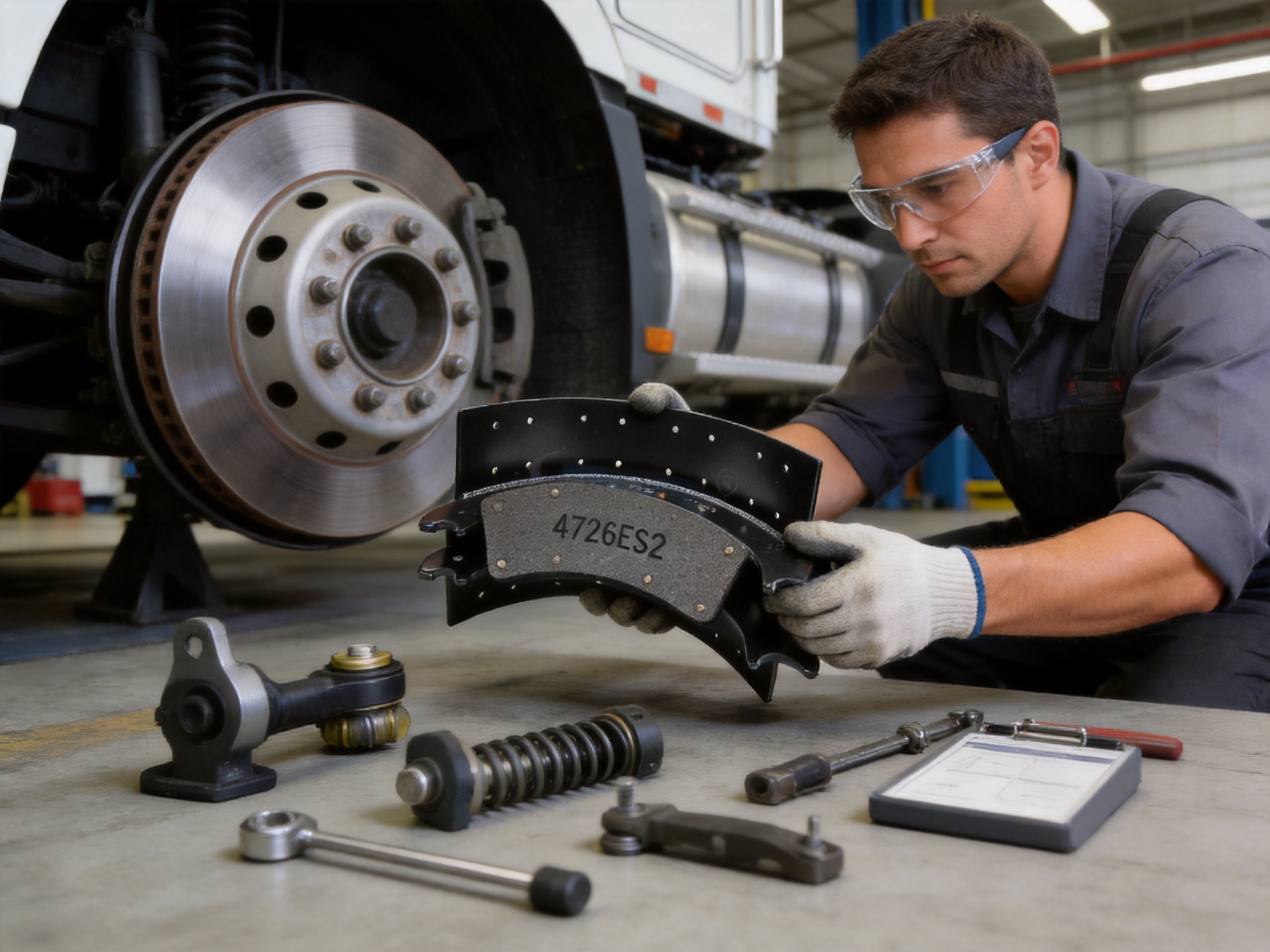
Heavy-duty braking systems depend on accurately manufactured components that can withstand repeated thermal loading, mechanical stress, vibration, contamination, and demanding service conditions. Within a drum brake assembly, the brake shoe is a structural and functional component. It supports the friction lining, transfers braking force to the drum, and must maintain dimensional stability throughout the service life of the brake system. A brake shoe that is improperly formed, poorly aligned, or inadequately inspected can affect lining contact, braking efficiency, noise levels, wear patterns, and overall maintenance cost.
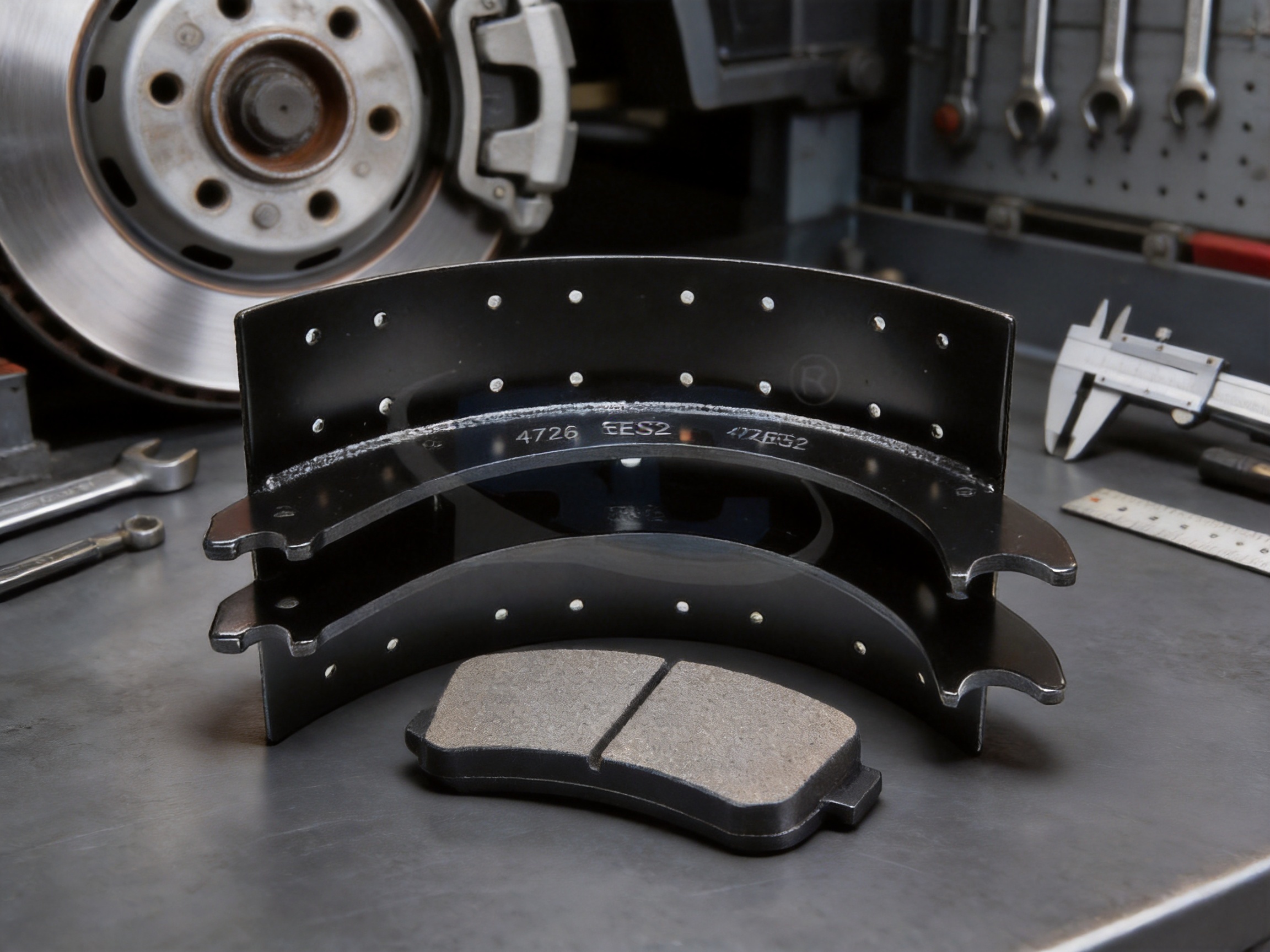
The 4726ES2 brake shoe is a steel brake shoe designed for heavy-duty applications. The supplied product information identifies the part number as 4726ES2, the category as Steel Brake Shoe, the product size as 16.5 inches by 8.625 inches, the number of rivet holes as 32, and the OE reference as EATON 819708. These specifications provide a practical starting point for fleet operators, distributors, repair specialists, and original-equipment replacement buyers who need a reliable replacement component for compatible drum brake assemblies.
This article examines the design significance, manufacturing considerations, inspection requirements, installation factors, and purchasing advantages associated with the 4726ES2 brake shoe. It also explains how a specialized heavy-duty brake parts manufacturer can create value through controlled forming, accurate hole placement, process inspection, material management, and production consistency. Since vehicle configurations may vary, all applications should be confirmed against the vehicle manufacturer’s service information and the actual brake assembly before installation.
Product Overview
The 4726ES2 is classified as a steel brake shoe. Unlike a complete lined brake shoe, a steel brake shoe is generally supplied as the structural shoe component, without the friction lining permanently installed. This configuration is useful for repair operations, remanufacturing programs, and customers who use a separately selected lining material or who need to install a lining according to a particular fleet or service requirement.
The product data identifies a size of 16.5 inches by 8.625 inches. The source specification presents the dimensions as “16.5"*8.625"mm,” which combines inch and millimeter notation. For this reason, the dimensions should be treated as a reference requiring confirmation before ordering. Buyers should check whether the intended application uses a 16.5-inch drum brake format and whether the second dimension corresponds to the applicable shoe width or another catalog measurement. A drawing, sample comparison, or vehicle-specific catalog should be used whenever dimensional ambiguity exists.
The brake shoe has 32 rivet holes. This is an important identifying characteristic because the hole pattern determines whether the shoe can accept a specific lining and whether the lining can be securely attached using the appropriate rivets. Hole count alone does not establish complete interchangeability. Hole diameter, pitch, spacing, edge distance, countersink or counterbore details, and the overall curvature of the shoe must also match the intended lining and brake assembly.
The listed OE reference is EATON 819708. An OE reference can assist in cross-referencing and procurement, but it should not replace application verification. Part numbers may be used differently by manufacturers, distributors, vehicle platforms, or regional catalogs. The best practice is to compare the OE reference, brake dimensions, hole layout, shoe profile, and the original component removed from the vehicle.
| Product characteristic | Supplied information | Why it matters |
|---|---|---|
| Part number | 4726ES2 | Primary product identification for quotation, ordering, and inventory control |
| Product category | Steel Brake Shoe | Indicates the structural shoe component rather than a complete lined assembly |
| Reference size | 16.5 inches by 8.625 inches | Helps establish the general dimensional class; final measurements must be verified |
| Rivet-hole quantity | 32 | Supports lining compatibility and helps distinguish the part from similar shoes |
| OE reference | EATON 819708 | Provides an additional cross-reference for sourcing and application research |
| Product type | Unlined steel brake shoe | Suitable for lining installation, repair programs, and selected replacement strategies |
Why the Steel Brake Shoe Matters
In a drum brake, the shoe acts as the foundation for the friction lining. When the brake actuator or cam mechanism moves the shoe outward, the lining contacts the inner surface of the drum. The resulting friction converts kinetic energy into heat and slows the vehicle. The shoe must distribute the actuator force across the lining while remaining sufficiently rigid to preserve the intended contact geometry.
A heavy-duty brake shoe is exposed to several types of loading. Radial loading occurs as the shoe is pressed against the drum. Bending stress develops along the shoe web and table. Localized stress appears around anchor points, cam contact areas, and rivet holes. Thermal cycles can cause expansion and contraction, while road vibration can contribute to fatigue. Corrosion, dirt, moisture, and improper adjustment may further increase operating stress.
For these reasons, a quality steel shoe is more than a curved piece of stamped or formed metal. Its profile must be consistent, its mounting points must be correctly positioned, and its surface must be suitable for lining installation and service. A small variation in curvature can create high spots, uneven lining contact, or accelerated wear. A misplaced rivet hole can interfere with lining fit or reduce the material available around the hole. In a commercial vehicle environment, these issues can increase downtime and create repeat repair work.
The 4726ES2 configuration is particularly relevant to maintenance programs that require a standardized structural component with a defined hole count and a recognized OE cross-reference. It can be used as a basis for building a compatible lined shoe, provided that the lining, rivets, and assembly procedures are selected correctly. This makes the product useful not only to vehicle repair shops but also to distributors, brake rebuilders, and fleet maintenance departments.
Key Advantages of the 4726ES2 Brake Shoe
Defined heavy-duty configuration
The part is presented as a heavy-duty steel brake shoe with a defined size class and 32-hole configuration. Clear identification reduces the risk of ordering an unrelated shoe that appears similar but does not match the application. In commercial vehicle maintenance, catalog clarity is valuable because many brake shoes have visually similar profiles while differing in width, curvature, anchor arrangement, or lining-hole layout.
Useful OE cross-reference
The EATON 819708 reference gives purchasers an additional method for researching compatibility. A cross-reference can simplify communication between a fleet, repair facility, distributor, and manufacturer. It can also support inventory organization, provided that the reference is checked against physical and application data rather than used as the only purchasing criterion.
32-hole lining support
The 32-rivet-hole arrangement is a significant functional feature. A correctly matched lining can be attached at multiple points across the shoe, helping distribute retention loads and maintain stable lining support. A multi-hole arrangement may also be appropriate for long friction surfaces used in larger drum brake assemblies. The exact performance depends on the lining material, rivet specification, riveting quality, and final assembly accuracy.
Steel structural base
A steel shoe provides the structural strength required to transfer braking force from the actuator to the friction lining. Properly selected steel and controlled forming help the component resist deformation during repeated braking. The structural material must be compatible with the intended service environment and manufacturing process. Strength, ductility, weldability where applicable, and resistance to fatigue are all important considerations.
Suitable for customized lining programs
Because the product category is a steel brake shoe rather than a complete lined brake shoe, it can support different replacement strategies. A repair specialist may select a lining based on vehicle duty cycle, axle position, operating temperature, noise requirements, or fleet standardization. This flexibility can be advantageous when a customer does not want a single preassembled friction specification for every operating environment.
Efficient procurement and inventory management
A clearly defined part number, OE reference, size description, and rivet-hole count can make inventory planning easier. Distributors can list the item under its principal identifier and cross-reference. Fleet maintenance departments can separate steel shoes from lined shoes and repair kits. Purchasing teams can also request consistent packaging, inspection documentation, and batch records from the supplier.
Manufacturing Quality Begins with Material Control
The performance of a steel brake shoe begins with the incoming raw material. Sheet or plate used for brake shoe production should be purchased according to controlled specifications covering thickness, mechanical properties, surface condition, and chemical composition where required. Material certificates and lot identification help maintain traceability from the incoming coil or sheet to the finished product.
Material thickness is especially important. If the material is too thin, the shoe may lack stiffness or may be more vulnerable to distortion during forming and service. If it is too thick, the shoe may not fit the intended hardware or may be unnecessarily heavy. Consistent thickness also supports repeatable forming and stable rivet-hole geometry.
Surface condition should be checked for excessive scale, deep scratches, laminations, edge cracks, or other defects that could affect forming or fatigue resistance. Material preparation may include leveling, slitting, blanking, or cutting. Each operation should be controlled to avoid excessive burrs and edge damage.
A capable manufacturer can strengthen production reliability by using lot-based identification. Each batch of raw material can receive a traceability code linked to production date, machine, operator, inspection results, and packaging information. This approach does not eliminate the need for final inspection, but it makes investigation and corrective action more efficient if a quality issue is reported.
Advanced Forming and Tooling Processes
Brake shoes require controlled geometry. The manufacturing process may involve blanking, stamping, roll forming, pressing, bending, machining, welding, or a combination of these operations, depending on the shoe design and production equipment. The important objective is to create a repeatable curved structure with accurately positioned functional features.
Progressive or dedicated tooling can help improve repeatability. When a blank is produced with controlled dimensions, subsequent forming operations are more likely to produce a stable shoe profile. Proper tool design also reduces unnecessary material movement and helps control the relationship between the shoe web, table, ends, and hole pattern.
Forming forces must be selected carefully. Excessive force can create cracks, sharp transitions, or unwanted thinning. Insufficient force can leave the shoe under-formed or produce springback beyond the acceptable range. Tool wear can gradually change the profile, so maintenance intervals and first-piece checks are essential components of a mature process.
Springback compensation is another important manufacturing consideration. Steel tends to recover partially after forming, which means that the tool shape may not be identical to the final desired geometry. Experienced process engineers compensate for this behavior through tooling design, forming sequence, and controlled measurement. A manufacturer with suitable forming expertise can reduce variation between production batches.
Where welding or attachment operations are used, the heat input must be controlled to prevent distortion and undesirable changes in the material. Fixtures can hold parts in the correct position during joining. After welding, visual inspection and dimensional checks can verify that the shoe remains within the intended profile. If the design does not require welding, the same principle still applies: every process should protect the final geometry.
Modern production can combine physical tooling with digital process planning. CAD models, controlled drawings, inspection templates, and coordinate measurements allow engineering teams to compare the manufactured shoe with the approved design. Digital records can also support revisions, tooling maintenance, and communication with customers.
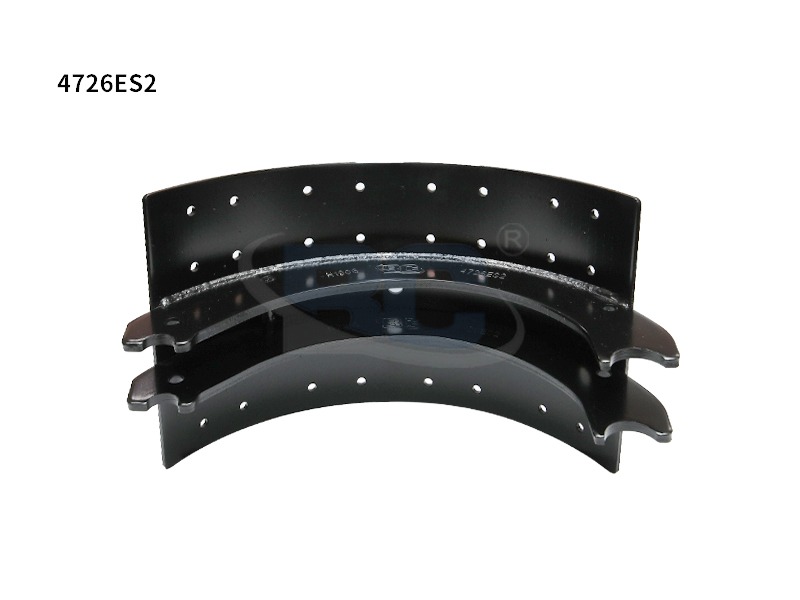
4726ES2 Brake Shoe
Hole-Pattern Accuracy and Rivet Compatibility
The 32 rivet holes are among the most important features of this product. Their quantity, location, size, and finish determine whether the intended lining can be installed correctly. Hole placement should be controlled relative to a stable datum system rather than measured independently from an inconsistent edge. This helps maintain the correct pitch and ensures that the lining aligns with the shoe.
Hole diameter must be compatible with the selected rivet. A hole that is too small can damage the rivet or make assembly difficult. A hole that is too large may reduce the quality of the formed rivet head and allow movement between the lining and shoe. Hole shape also matters. Excessive taper, deformation, burrs, or out-of-round conditions can interfere with seating.
Edge distance deserves careful attention. Adequate material must remain around every hole to preserve structural strength and prevent cracking during riveting or service. The first and last holes are often particularly sensitive because they are closer to the lining ends and may experience local stress concentrations.
Counterbore or countersink requirements should be checked against the lining and rivet design. The finished rivet head must be properly seated so that it does not interfere with drum clearance. At the same time, the lining must not be excessively weakened by an improperly sized recess.
Manufacturers can control the hole pattern through precision punching, drilling, or dedicated tooling. The selected method depends on production volume, material thickness, required tolerance, and the design of the shoe. Regardless of method, periodic gauge checks and first-piece approval are valuable. Automated vision inspection or coordinate measurement may also be used for higher-volume production.
Surface Protection and Corrosion Resistance
Steel brake shoes are exposed to moisture, road salt, dust, and temperature variation. Corrosion can reduce appearance and, if severe, affect structural integrity or interfere with lining installation. Surface protection should therefore be considered in relation to the expected storage and service environment.
A manufacturer may use cleaning, phosphating, painting, powder coating, plating, or another approved treatment depending on the application. The selected treatment must not create excessive thickness at contact areas, mounting points, or lining seats. Coating uniformity is important, but so is controlled coverage. Surfaces intended for welding, riveting, or direct mechanical contact may require special preparation.
Good packaging is part of corrosion control. Components should be protected from rain, condensation, and abrasive contact during transportation. Packaging should prevent shoes from striking each other in a way that could bend ends or damage finished surfaces. Labels should identify the part number, quantity, production batch, and any handling instructions needed by the customer.
Before installation, repair technicians should inspect the shoes for rust scale, impact damage, bent sections, coating buildup, or contamination. A component that has been stored improperly should not be installed merely because its part number appears correct.
Inspection and Testing Strategy
Quality assurance for a brake shoe should include incoming inspection, in-process inspection, and final inspection. A robust system does not rely on one measurement at the end of production. Instead, it identifies important characteristics at the stages where variation can be prevented or corrected.
Incoming inspection
Incoming inspection may include verification of material thickness, surface condition, dimensions, and supplier documentation. Samples should be checked according to a defined inspection plan. If a material lot does not meet requirements, it should be identified and controlled before it enters production.
In-process inspection
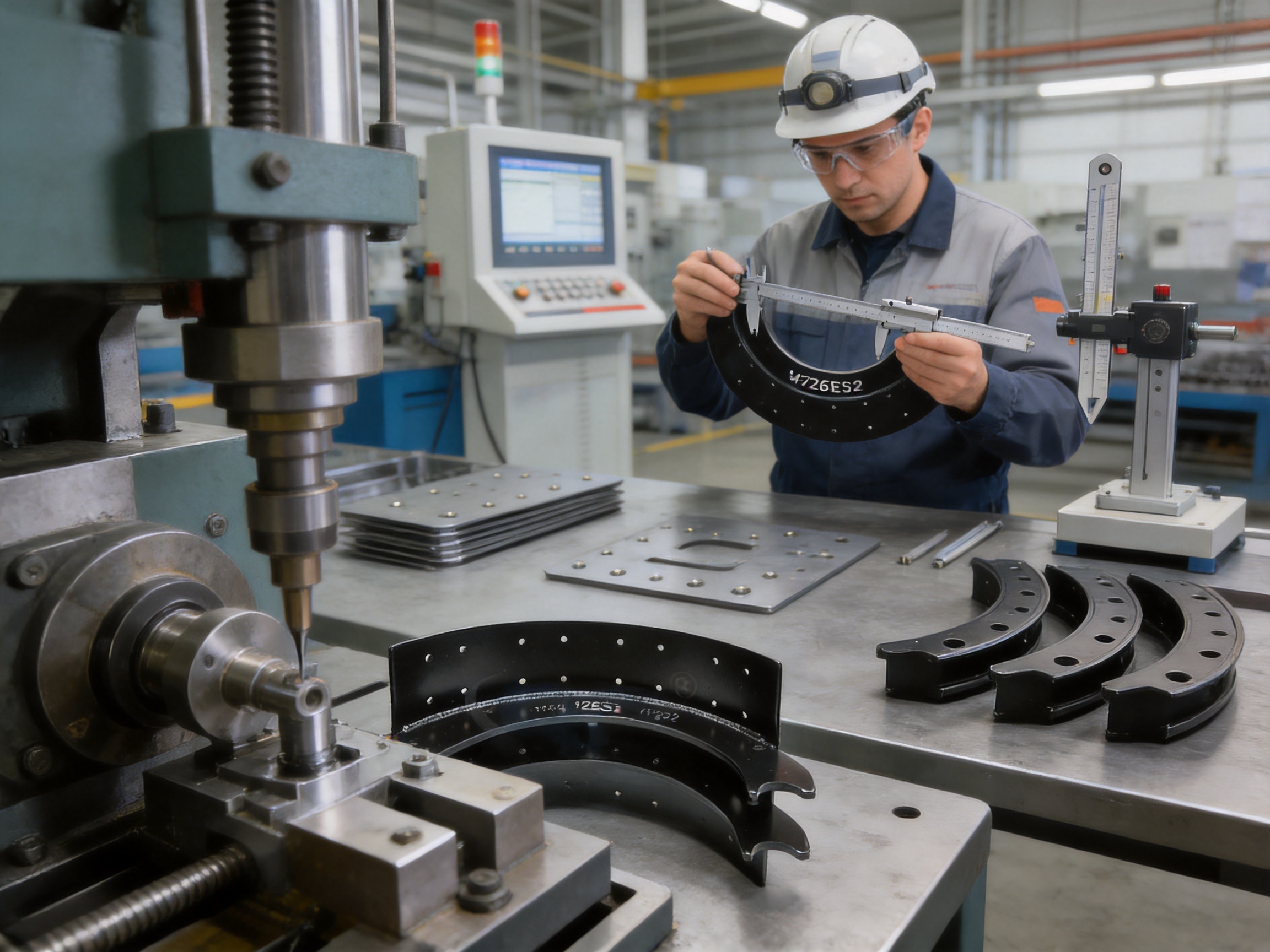
In-process inspection can verify blank dimensions, hole locations, forming angle, profile curvature, and the condition of edges. First-piece inspection is especially important after a tool change, maintenance activity, material change, or setup adjustment. Operators should have clear gauges and work instructions so that inspection is practical and repeatable.
Final dimensional inspection
Final inspection should confirm the key dimensions and the overall geometry of the completed shoe. Useful checks may include width, length, curvature, end position, hole count, hole diameter, hole spacing, and the relationship between mounting features. Inspection should be performed against an approved drawing or controlled sample, not an informal visual reference.
Visual and workmanship inspection
Visual inspection can identify cracks, sharp burrs, incomplete forming, distortion, weld irregularities, coating defects, contamination, and handling damage. Visual quality is not a substitute for dimensional inspection, but it is an efficient way to detect conditions that may affect assembly or service.
Functional and process validation
Depending on customer requirements and product classification, validation may include fit checks, lining assembly trials, rivet installation tests, fatigue evaluation, or other laboratory and production tests. The precise test program should be based on the applicable technical standard, customer specification, and intended vehicle application.
| Inspection area | Typical control point | Potential consequence of variation |
|---|---|---|
| Material | Thickness, grade, surface condition | Reduced strength, forming defects, premature fatigue |
| Blanking | Overall blank dimensions and edge quality | Incorrect final profile or excessive burrs |
| Rivet holes | Count, diameter, pitch, position, edge distance | Incorrect lining fit or poor rivet retention |
| Forming | Curvature, width, angle, springback | Uneven drum contact or difficult installation |
| Joining | Position, weld condition, distortion control | Structural weakness or misalignment |
| Surface treatment | Coverage, adhesion, contact-area control | Corrosion or interference during assembly |
| Packaging | Protection, labels, batch identification | Transit damage or traceability problems |
Manufacturing Strengths of a Specialized Supplier
A specialist in heavy-duty brake parts can provide advantages that are difficult to achieve through general metal fabrication alone. Brake components require knowledge of drum brake geometry, friction lining assembly, rivet patterns, commercial vehicle service conditions, and replacement-part identification. This application knowledge helps connect manufacturing decisions with real maintenance needs.
One important strength is product-family expertise. A manufacturer producing steel brake shoes, cast brake shoes, brake linings, lined brake shoes, repair kits, and lined brake shoe kits can understand how individual components interact. This broader product knowledge can improve communication when a customer needs a complete repair solution rather than one structural shoe.
Another strength is production flexibility. Different customers may require loose steel shoes, lined assemblies, private-label packaging, repair kits, or mixed quantities. A supplier with adaptable tooling, controlled assembly areas, and organized inventory can support distributors and fleet programs more effectively than a supplier focused only on a single generic component.
Process consistency is also a major competitive advantage. A component may be less costly at the time of purchase but more expensive over its lifecycle if it causes fitment issues, rework, or premature replacement. Consistent forming, hole placement, surface condition, and packaging reduce the likelihood of avoidable installation problems.
Technical communication is equally important. A capable manufacturer should be able to provide product drawings, dimensional information, application references, packaging details, and inspection support when requested. Customers benefit when the supplier can explain what is confirmed, what requires verification, and what information is needed to approve an application.
The supplied company profile identifies Zhejiang Bangchi Auto Parts Co., Ltd. as the manufacturer and lists an address in Haining, Zhejiang, China. It also identifies contact channels for sales and technical communication. These details can support procurement inquiries, sample requests, application verification, and discussions about OEM cross-references. Buyers should request the latest product documentation and confirm all commercial and technical details before placing an order.
Advantages Compared with Inconsistent or Generic Alternatives
The strongest advantage of a properly identified 4726ES2 brake shoe is application confidence. Generic alternatives may be marketed using broad descriptions such as “16.5-inch brake shoe,” yet still differ in hole arrangement, profile, or mounting geometry. The stated 32-hole configuration and EATON 819708 reference provide more specific information for comparison.
A second advantage is the ability to separate structural selection from lining selection. Some complete assemblies are convenient, but they may not offer the friction material preferred by a particular fleet or regional service program. An unlined steel shoe can be integrated into a controlled lining process, allowing the customer to select the lining and rivets according to approved requirements.
A third advantage is manufacturing transparency. When a supplier can discuss material control, forming, hole-pattern inspection, surface protection, and traceability, the customer has more information for evaluating long-term reliability. The lowest visible unit price does not always represent the lowest total cost. Rejected parts, installation delays, emergency freight, and repeat labor can quickly exceed the original price difference.
A fourth advantage is support for professional inventory management. An identifiable product with a part number, category, reference number, and defined feature set can be more efficiently cataloged than an unmarked or poorly documented substitute. Better cataloging reduces picking errors and makes replenishment more predictable.
Installation and Assembly Considerations
Before installation, technicians should compare the replacement shoe with the original component and the approved service information. Confirm the part number, overall dimensions, hole count, curvature, anchor features, cam contact points, and lining compatibility. Do not assume that a similar-looking shoe is interchangeable.
If the shoe is supplied without lining, the lining must be selected for the correct brake assembly and service conditions. The lining should match the shoe’s hole pattern and contact surface. Rivets must be the correct type, length, diameter, and material for the lining and shoe combination. Riveting equipment should produce uniform, secure heads without crushing or cracking the friction material.
The shoe and lining contact surfaces should be clean and free from oil, grease, loose coating, and abrasive contamination. The lining should sit naturally against the shoe without excessive forcing. If the lining does not align with all 32 holes, the assembly should be stopped and investigated. Enlarging, relocating, or improvising holes can weaken the assembly and compromise safety.
After assembly, the rivet heads should be checked for proper seating and consistency. The lining should not be loose, tilted, cracked, or damaged. The finished shoe should be compared with the drum and related hardware for clearance and proper fit. The brake assembly should be serviced according to the vehicle manufacturer’s instructions, including inspection of drums, cams, rollers, anchors, bushings, springs, adjusters, and related components.
Brake work should be performed by qualified personnel using appropriate tools and safety procedures. Heavy-duty brake assemblies can contain stored mechanical energy and heavy components. Proper lifting, support, personal protective equipment, and contamination control are essential.
Maintenance and Service-Life Factors
The life of a brake shoe depends on more than the shoe itself. Drum condition, lining selection, adjustment, axle loading, driving terrain, operating speed, brake balance, temperature, and maintenance quality all influence performance. A correctly manufactured shoe can support reliable service, but it cannot compensate for a cracked drum, worn bushings, incorrect adjustment, or a lining that is unsuitable for the duty cycle.
Regular inspection should look for uneven lining wear, loose rivets, cracks, distortion, corrosion, heat damage, and abnormal contact patterns. If wear is concentrated at one end or along one edge, the cause may involve brake geometry, drum condition, cam operation, or shoe alignment rather than simply the friction material.
Fleet maintenance teams should record installation dates, vehicle mileage or operating hours, axle position, lining type, drum condition, and removal observations. These records can help identify recurring issues and support better purchasing decisions. If a batch of shoes shows an unusual fit or wear pattern, the supplier should be contacted with the part number, batch information, photographs, measurements, and application details.
Storage should be dry, clean, and organized. Shoes should not be stacked in a way that bends their ends or distorts the formed profile. Products should remain in their original protective packaging until needed, and older stock should be rotated appropriately. Clear labels reduce the risk of mixing similar components.
Purchasing Checklist for Distributors and Fleets
When sourcing the 4726ES2 brake shoe, purchasing teams should provide as much application information as possible. The part number and OE reference are useful, but additional details can prevent errors and speed technical confirmation.
Confirm the part number: 4726ES2.
Confirm that the required component is a steel brake shoe rather than a lined brake shoe or complete kit.
Verify the 16.5-inch by 8.625-inch reference dimensions using an approved drawing or physical sample.
Confirm the 32-rivet-hole pattern, including hole diameter and pitch.
Check the EATON 819708 cross-reference against the intended application.
Specify whether lining, rivets, or assembly services are required separately.
Request inspection documentation or a sample approval process when introducing a new source.
Discuss packaging, labeling, batch traceability, and minimum order quantities.
Confirm surface treatment and storage requirements.
Review delivery schedules and replacement support before finalizing the supply agreement.
For larger fleet programs, buyers may also request a quality agreement defining key dimensions, inspection frequency, nonconformance handling, change notification, and document retention. These measures help maintain consistency over time, especially when the product is supplied across multiple purchasing cycles.
Applications Across the Heavy-Duty Aftermarket
The 4726ES2 brake shoe can be relevant to several segments of the heavy-duty aftermarket. Independent repair shops may use it when rebuilding a compatible drum brake assembly. Fleet workshops may purchase it for scheduled brake service or as part of a preventive maintenance inventory. Distributors may list it as a replacement structural shoe under the primary part number and OE cross-reference.
Brake remanufacturers can also use steel shoes as the foundation for a controlled relining process. In this setting, the shoe should be inspected before lining installation. A previously used shoe must not be reused automatically. It should be checked for cracks, distortion, excessive wear at contact points, corrosion, damaged holes, and other conditions that could affect safety.
Export and regional distribution programs may benefit from clear identification and standardized documentation. Because brake component terminology can vary between markets, product records should include the category, part number, reference number, dimensions, hole count, and photographs or drawings where available. This reduces translation-related ambiguity and assists local distributors in matching the correct component.
Why Process Capability Supports Competitive Value
In the replacement-parts market, competitive value is created by the combination of fit, consistency, availability, technical support, and total cost. A manufacturer that controls its production process can offer more than a nominally equivalent shape. It can provide repeatable dimensions, predictable assembly behavior, and a clearer response when customers have questions.
Advanced manufacturing does not necessarily mean that every process must be fully automated. It means that the manufacturer understands the critical characteristics and controls them with appropriate equipment, fixtures, gauges, documentation, and trained personnel. For a brake shoe, this may involve dedicated forming dies, accurate hole-making tools, profile gauges, batch traceability, controlled surface treatment, and final inspection procedures.
Automation can improve repeatability in high-volume operations, while skilled operators remain valuable for setup verification, visual inspection, tool adjustment, and problem solving. The best production systems combine equipment capability with process knowledge. A machine can repeat a poor setup very consistently, so first-piece approval and ongoing verification remain essential.
Continuous improvement is another source of strength. Production data can reveal recurring burrs, springback, coating buildup, handling damage, or packaging failures. Corrective actions may include tool refurbishment, revised work instructions, improved fixtures, updated inspection frequency, or changes to packaging materials. Over time, these improvements reduce variation and improve customer satisfaction.
The manufacturer’s ability to support multiple brake-part categories can further improve product development. Experience with cast brake shoes, brake linings, lined brake shoes, repair kits, and lined brake shoe kits provides a broader understanding of how the 4726ES2 steel shoe functions in a complete braking solution. This can help with product matching, kit development, and aftermarket application support.
Frequently Asked Questions
What is the 4726ES2 brake shoe?
The 4726ES2 is a steel brake shoe identified in the supplied information as a heavy-duty replacement component. It is listed under the Steel Brake Shoe category and is not described as a complete lined brake shoe.
What are the stated dimensions?
The supplied product data states 16.5 inches by 8.625 inches. Because the source combines inch and millimeter notation, buyers should verify the units and measurement definitions using a drawing, sample, or application catalog before ordering.
How many rivet holes does it have?
The product is specified with 32 rivet holes. Hole count should be confirmed together with hole diameter, spacing, countersink details, and lining compatibility.
What is the OE reference?
The listed OE reference is EATON 819708. It should be used as a cross-reference and verified against the actual vehicle and brake assembly.
Does the product include a friction lining?
The supplied category identifies it as a steel brake shoe, so it should be treated as an unlined structural shoe unless the quotation or packaging specifically states otherwise. Customers requiring a complete lined assembly should request a lined brake shoe or lined brake shoe kit.
Can any 16.5-inch lining be installed on this shoe?
No. The lining must match the shoe’s complete geometry, including the 32-hole arrangement, hole size, spacing, curvature, width, and end profile. The correct rivets and installation method are also required.
What should be checked before installation?
Technicians should check the part number, dimensions, hole pattern, curvature, mounting features, surface condition, lining fit, rivet compatibility, and the condition of the related drum brake hardware. The vehicle manufacturer’s service information should be followed.
What makes a manufacturer competitive in this product category?
Important strengths include controlled raw-material sourcing, accurate forming, stable tooling, precise hole placement, surface protection, traceability, inspection, flexible product support, and responsive technical communication. These factors can reduce fitment problems and total maintenance cost.
Is the product suitable for fleet maintenance?
It may be suitable for fleet maintenance when the application is confirmed and the component meets the fleet’s approved technical requirements. Fleet buyers should establish inspection, documentation, packaging, and batch-control expectations with the supplier.
Where can buyers request more information?
Product and commercial inquiries can be directed to Zhejiang Bangchi Auto Parts Co., Ltd. using the contact information supplied for the product. Buyers should request current drawings, application confirmation, quotations, lead times, packaging details, and any available inspection documentation.
Conclusion
The 4726ES2 brake shoe is a clearly identified steel brake shoe for heavy-duty drum brake service, with a stated reference size of 16.5 inches by 8.625 inches, a 32-rivet-hole configuration, and an EATON 819708 OE cross-reference. Its value lies in its role as a stable structural foundation for a compatible friction lining and in the additional procurement clarity provided by its part number and defined specifications.
Its advantages over poorly documented or inconsistent alternatives include a specific identification system, a recognized cross-reference, a defined hole pattern, and suitability for controlled lining programs. However, reliable performance depends on complete application verification, correct lining and rivet selection, accurate assembly, and proper brake-system maintenance.
Manufacturing quality is equally important. Controlled material sourcing, precision blanking, stable forming, accurate hole placement, surface protection, traceability, and layered inspection can help produce a brake shoe that performs consistently in demanding service. A specialized supplier with experience across steel shoes, cast shoes, linings, lined assemblies, and repair kits can offer broader technical support and more efficient aftermarket solutions.
For distributors, repair facilities, and fleet operators, the best purchasing decision is based on total value rather than price alone. Fitment reliability, manufacturing consistency, documentation, supply continuity, and responsive support all contribute to lower operating risk. By combining the correct application checks with a controlled manufacturing process, the 4726ES2 brake shoe can serve as a practical component for professional heavy-duty brake repair programs.
References
1. Product specification supplied for the 4726ES2 steel brake shoe, including part number, size reference, rivet-hole count, and OE cross-reference.
2. Heavy-duty drum brake service and inspection principles for commercial vehicle maintenance.
3. General engineering practices for steel stamping, forming, hole-pattern control, and dimensional inspection.
4. General guidance for friction lining riveting, brake shoe assembly, and replacement-part verification.
5. Manufacturer and supplier information supplied for Zhejiang Bangchi Auto Parts Co., Ltd., including product categories and contact details.
6. Common quality-control practices for automotive aftermarket components, including material traceability, first-piece inspection, in-process checks, and final inspection.